







The ongoing political strife in Hong Kong is not directly slowing shipping activity at the world’s busiest cargo airport, but could gradually reshape supply chains in unexpected ways.
A two-day occupation of passenger terminals at Hong Kong International Airport (HKIA) in August didn’t physically impact cargo facilities or freighter-dominant carriers, and the airport quickly resumed normal operations.
Experts mostly attribute this year’s sharp decline in HKIA’s cargo volume to the U.S.-China trade war and tepid economic growth in key regional markets – the same forces that have led to a similar airfreight slowdown throughout the Asia-Pacific region.
Still, the civil unrest is forcing shippers and logistics providers to consider alternative airports as a backstop against potential delays. Although there have been no significant stoppages for freight, most companies don’t want to take that risk. Even more worrisome is the possibility that airlines could cut more passenger service as travel to Hong Kong declines, thereby reducing available freight capacity and pushing up cargo rates, logistics managers say.
“When airlines start to remove routes and scheduled flights, that belly space starts to disappear rather quickly. It can create a domino effect in which all the available space in the market is not enough and things will become very tight, especially going into the [upcoming] Chinese New Year,” Brian Bourke, vice president of marketing at SEKO Logistics, said in a phone interview.
“That’s what really concerns us. It would be like a month-long West Coast port strike that would just knock everyone off their scheduled flight plans and air cargo operations. And, then, there might be more of a focus on Shanghai, or Singapore, as a hub,” he added, referring to the lengthy work slowdown by U.S. longshoremen in 2014-15 that gummed up marine terminals for a large portion of the winter.
Economic, Reputational Damage
Massive anti-government protests, sometimes violent, have rocked the Chinese-controlled city for six months – closing down roads, universities, transportation and large areas of downtown. The protests, originally sparked by anger over a law allowing extradition to mainland China, have broadened into a movement for broader democratic reforms and opposition to perceived police brutality.
The protests are discouraging tourism and local consumption, putting Hong Kong on track for its first recession in a decade.
Tourism has plunged to levels not seen since the widespread severe acute respiratory syndrome (SARS) illness in 2003. Potential visitors worry for their safety or about missing flights home if demonstrations block their route to the airport. Dozens of countries have travel warnings for Hong Kong. Visitor arrivals in October dropped 43.7% compared to the same month in 2018 and were down 46% from mainland China because tourists spent their “golden week” National Day holiday at other destinations, according to the Hong Kong Tourism Board. Hotel occupancy rates are also much lower than usual.
During November, five million passengers moved through HKIA, a 16.2% decrease from the same month in 2018.
Through the first 11 months of the year, the airport experienced a 3.4% decline in passengers, according to airport authority figures.
The political unrest, along with the lengthy U.S.-China trade war, were responsible for a 24.3% tumble in Hong Kong’s October retail sales, the largest year-over-year decline for a single month on record, according to the most recent figures from the Census and Statistics Department. Consumer spending dropped to HK$30.1 billion (US$3.86 billion) and is down 9% for the first 10 months. More than 400 restaurants closed in September and October and many local retailers are expected to shut down and lay off workers if the situation continues to worsen, the South China Morning Post reported.
With fewer visitors, some airlines have scaled back passenger flights to Hong Kong. Last summer, United Airlines (NASDAQ: UAL), for example, suspended flights between Chicago and Hong Kong. Hometown carrier Cathay Pacific (HKG: CPCAY) has scaled back frequency to some destinations with multiple daily flights. In an October investor presentation, the airline said it reduced passenger flight capacity 2% to 4% between August and October, and 6% to 7% for November and December. Financially troubled Hong Kong Airlines has also trimmed capacity and flights in response to the weak travel demand.
The huge amount of wide-body belly capacity on passenger jets is one reason why shippers and their logistics providers like to move goods through HKIA. Hong Kong is also a highly desirable freight transport hub because of its proximity to China’s southern manufacturing centers and e-commerce sellers, free trade zone and dense cluster of top logistics providers.
If more passenger airlines cancel flights there might not be enough readily available space for shippers, creating potential delays and pushing cargo to freighter aircraft, which tend to be more expensive, logistics professionals say.
Cargo throughput fell 3.4% to 450,000 tons in November. It is down 6.6% for the January-November period. Chinese authorities have forbidden the shipping of commodities via HKIA that have been used by protesters. These include black clothes, yellow helmets and umbrellas, flags, banners, gloves, masks, clubs, fluorescent tubes, metal rods, walkie-talkies and drones. In an effort to address the shrinking cargo business, the Hong Kong Airport Authority in April will allow airlines to rebate terminal handling fees to logistics customers and subsidize a portion of the discounts.
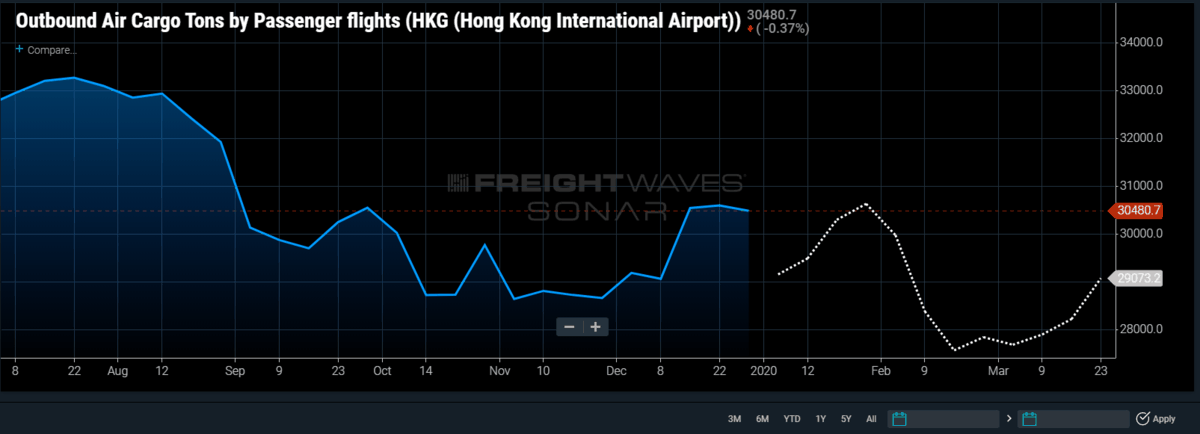
According to FreightWaves’ SONAR database, airfreight export capacity from Hong Kong on passenger planes is down 8.25% in the past six months.
The damage to Hong Kong’s reputation for efficiency, and the continuing uncertainty, is influencing some supply chain decisions, logistics professionals say. Shippers are nervous about the protests because they don’t want to be caught with trapped shipments that disrupt manufacturing or retail operations.
Alternative Gateways
“The threat of disruption is probably a bigger concern than the actual disruption because can you take the chance that a flight will be canceled or delayed?” said Bob Imbriani, executive vice president for international at Team Worldwide, a diversified logistics provider based in Winnsboro, Texas.
Some Chinese shippers, especially large e-commerce retailers, have told their freight agents they want to utilize other gateways in South China to mitigate the transport risk caused by protests, several airline and logistics executives said. But the change in ports has been modest, by most accounts. John Lui, general manager for airfreight at Infinity Cargo Express in China, said in an email that less than 5% of Infinity’s total throughput in the fall was routed through Guangzhou.
Freight industry sources say they don’t envision any structural shift of freighter fleets to other airports because Hong Kong likely will remain the dominant air hub in the region, but are noticing some carriers adding incremental capacity at nearby airports.
“The majority of the shippers still keep Hong Kong as the main port for airfreight, while a small percentage is shifting to other airports,” said Luca Ferrara, the head of multi-regional operations for cargo-partner, an Austrian-based forwarder.
Shippers depend on wide-body passenger aircraft like this Airbus A350-900 to move goods internationally.
Bourke said he’ll be closely watching what passenger carriers do in the first quarter and if any all-cargo carriers shift some capacity to other airports.
“If you take capacity out, airfreight prices will go up and there will definitely be a chokepoint of some kind until these freighters get repositioned or people look to other airports as their consolidation hub,” he said.
Neel Shah, the head of airfreight at tech-enabled logistics provider Flexport, predicted that more all-cargo operators will add frequencies or new freighters to fly cargo out of airports in Guangzhou and Shenzhen in the coming months. The capacity changes are typically happening quietly, without much advertising.
Over the past decade, China has built up airport infrastructure in the Pearl Delta and those airports now offer more direct flights to other global destinations. Guangzhou now is the second international hub for South China. It is the 17th largest cargo airport in the world with 1.9 million tons handled (1 million tons of international freight), compared with Hong Kong at 5.1 million tons (almost all of it moving internationally), according to figures from the Airports Council International.
Shenzhen ranks 25th in global cargo tonnage, but most of it is domestic.
Hong Kong enjoys many advantages over Guangzhou and Shenzhen, such as bigger and better cargo facilities, modern customs service, more international route coverage and frequency, and many more foreign carriers. However, it also costs 20% to 30% more to ship through Hong Kong.
“If Guangzhou Airport can attain higher efficiency while maintaining low costs, it will have every conceivable chance to cut into Hong Kong’s market share,” Ferrara told FreightWaves.
In 2019, Saudi Arabian Airlines resumed a weekly freighter flight to Guangzhou to meet growing demand for cargo service, in addition to its seven weekly freighter flights to Hong Kong.
The fierce competition in Guangzhou had made it difficult for higher-priced carriers, such as Lufthansa, to compete. Lufthansa Cargo closed its station in Guangzhou at the end of 2019. It had been flying MD-11 freighters twice per week in and out of the airport. The airline added extra flights to Hong Kong into the December peak season, but has not yet determined its summer schedule for freighters.
“We are clearly convinced of the future prospects of this market and are happy to have Cathay Pacific Cargo as our joint venture partner,” J. Florian Pfaff, vice president Asia-Pacific, said via email. “While we are shifting traffic out of Guangzhou, we will focus even more on the world’s largest air cargo airport in the future and strive to uphold our strong position in Hong Kong.”
Some airlines have started paying more attention to Shenzhen Airport. Turkish Airlines launched a twice-weekly freighter service with Airbus A330 aircraft in November from Shenzhen to Istanbul and in March Cargolux will operate a weekly freighter from Shanghai to Luxembourg with stops in Shenzhen and Budapest, according to several forwarders.
Cargo could increasingly be diverted to Macau, too, with the February 2018 opening of the Hong Kong-Zuhai-Macau Bridge, a 34-mile bridge-tunnel system linking three major cities on the Pearl River Delta, Ferrara noted. In November 2018, Qatar Airways Cargo began twice weekly service to Macau and onward to North America. It is the carrier’s fourth freighter destination in greater China after Guangzhou, Hong Kong and Shanghai.
Image by David Mark from Pixabay










