

• Latest
  • Trending
  • All
Recycling: Back to the basics

Recycling: Back to the basics

January 6, 2020
Last Mile Delivery Market Worth Observing Growth | UPS, FedEx, SF Express

Last Mile Delivery Market Worth Observing Growth | UPS, FedEx, SF Express

April 23, 2024
Top 5 Spend Analysis Software ranked in 2024

Top 5 Spend Analysis Software ranked in 2024

March 1, 2024
How Tesla And BMW Are Leading A Supply Chain Renaissance With Blockchain

How Tesla And BMW Are Leading A Supply Chain Renaissance With Blockchain

January 19, 2024
LATAM Cargo strengthens European cargo links

LATAM Cargo strengthens European cargo links

April 14, 2020
Ford making reusable hospital gowns from airbag materials as efforts against coronavirus expand

Ford making reusable hospital gowns from airbag materials as efforts against coronavirus expand

April 14, 2020
Don’t Sweat NBC’s Decision to Cut Back on Television Ad Inventory

Don’t Sweat NBC’s Decision to Cut Back on Television Ad Inventory

April 14, 2020
Software firms sharpen focus on AI, big data as IT spending drops

Software firms sharpen focus on AI, big data as IT spending drops

April 14, 2020
Navigating turbulent times in your supply chain (TL:DR version)

Navigating turbulent times in your supply chain (TL:DR version)

April 14, 2020
Last Mile Delivery by Drones Market is Booming Worldwide

Last Mile Delivery by Drones Market is Booming Worldwide

April 14, 2020
AIR CARGO MARKET SIZE, SHARE, DEMAND, TREND, LATEST INNOVATIONS & APPLICATION ANALYSIS AND INDUSTRY GROWTH FORECAST 2027 – Science In Me

AIR CARGO MARKET SIZE, SHARE, DEMAND, TREND, LATEST INNOVATIONS & APPLICATION ANALYSIS AND INDUSTRY GROWTH FORECAST 2027 – Science In Me

April 14, 2020
Wheat procurement in Patiala: 6,500 coupons issued to farmers – cities

Wheat procurement in Patiala: 6,500 coupons issued to farmers – cities

April 14, 2020
Pandemic, Plastics And The Continuing Quest For Sustainability

Pandemic, Plastics And The Continuing Quest For Sustainability

April 14, 2020
  • Supply Chain
  • Logistics
  • Warehousing
  • Procurement
  • Shipping
  • More
    • Strategic Sourcing
    • Spend Analysis
    • Inventory
    • Contact Us
No Result
View All Result
United States International Supply Chain Commission
Home Procurement

Recycling: Back to the basics

by usiscc
January 6, 2020
in Procurement
0
Recycling: Back to the basics
493
SHARES
1.4k
VIEWS
Share on FacebookShare on Twitter

By Olivia Neeley

[email protected] | 252-265-7879

There’s a wrong way to recycle and a right way. That’s why it’s vital to know the difference. County officials have spent the past year in re-educating the public on getting back to the basics of recycling.

“We’re trying to get everybody in line with back to the basics,” said Andy Davis, Wilson County Solid Waste Management director. “It used to be recycle more. Now it’s recycle right.”

Davis said most would be surprised what people put in their recycling bins each week. From lids to straws as well as to-go cups, plastic water hoses and cords, some residents are either recycling the wrong items or simply don’t care what’s trash and what’s recycling.

“I think a lot of it is that people don’t understand what plastics really are, what glass really is and what’s paper and what’s not and what’s considered cardboard,” Davis said.

Contamination is a growing trend for municipalities across the country.

“They see a plastic water hose, and they think it’s plastic and it can go in there,” Davis said. “It can’t. It contaminates the whole load when you’ve got plastics bottles and so forth in there, too.”

And that’s what officials are trying to educate the public on — recyclable contaminations. Davis said they see everything from textiles to folded up chairs in recycling bins. It doesn’t look like recycling at all, but pure trash, officials said.

“That’s what we are battling,” Davis said.

‘UNDERSTAND WHAT CAN AND CAN’T GO’

Every time a person puts the wrong item in the recycling bin, it costs the county more to recycle, and it contaminates the entire load.

“One of the biggest things I see as far as contamination are plastic bags,” Davis said.

Tammy Webb, who also works for Wilson County Solid Waste and educates the public about recyclables, said its the No. 1 culprit.

“The main thing is putting recyclables in a bag in the house and then taking the bag to the recycling bin,” she said. “When that gets dumped, the whole load is contaminated.”

Webb said if you want to change your recycling habits, try using an Amazon Prime cardboard box.

“You can put your box in your house, and put individuals recyclables in your box,” she said. “Then you can take the whole box to the recycling bin. You can break down the box and flatten it out. That’s a wonderful way to replace plastic bags.”

REDUCING LEVELS OF CONTAMINATION

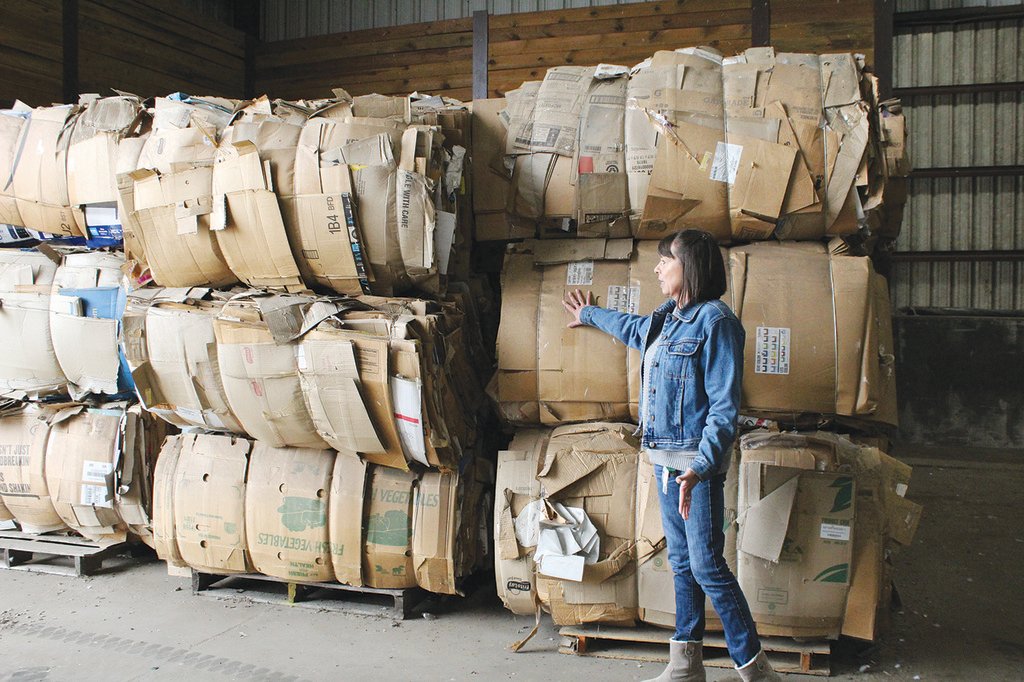
When your recycling is picked up, it goes to the Wilson County landfill. At that point, it’s loaded onto a tractor trailer and taken to a waste management facility in Raleigh, officials said. Then those items go to a material recovery facility.

“Once it gets there, it goes through a processing line,” Davis said. “They have to process the material, and sort the materials on that line of commodities.”

That facility separates and prepares single stream recyclable materials for markets. Davis said the facility looks at the entire load, and an audit is performed on those materials.

Reducing the levels of contamination lowers the cost of recycling for municipalities.

According to the state, a local government recycling program is a service provided to residents. And that service has a cost just like other services, including trash pick-up and utilities. The cost used to be offset by the revenue generated from the sales of recyclables, but with current market conditions, the average value is less than the cost to process recyclables.

Contamination, or placing the wrong items in the recycling bin each day, lowers the value and quality of the items municipalities receive when they take it to a facility for processing.

That’s why education is key.

“Take the contamination out,” Davis said. “Pay closer attention to what’s going into your containers, whether it’s curbside or at drop-off sites. Understand what can and can’t go.”

RANKING Improves

Six years ago, Wilson County was ranked 61st in the state when it came to recycling. Last year, Wilson County moved up to a better ranking, to 38th.

That figure, officials said, is calculated by the amount of tonnage of recycling vs. trash.

He said while Wilson’s ranking is better, a lot of it is due to the materials they are now recycling at the landfill, not necessarily individual households. But individual household recycling continues to increase. Larger recycling carts have helped that rate some, but it’s also increased contamination as well, a trend most municipalities are seeing.

‘WHEN IN DOUBT,
THROW IT OUT’

Davis said a lot of times people see a recycle symbol on an item and believe that it can go into their bins. But usually that means it’s made from a recyclable material.

“When in doubt, throw it out,” Webb said.

Other culprits include pizza boxes. Webb said pizza boxes should go in the trash, in addition to Styrofoam and any to-go items. Electronics also do not go into a recycling bin either. If you need to recycle electronics, the county’s landfill accepts them at no charge. Davis said stick with aluminum cans, plastic water bottles, milk jugs and cereal boxes (take the plastic insert out and throw it away), newspapers and bottles and jars (a quick rinse will do).

“We have to go back to the basics and stick with it,” Davis said.

What can I recycle?

Put in recycling bin

• Aluminum cans

• Plastic bottles, tubs and jugs (empty and rinse)

• Aren’t sure about a lid? Throw it away

• All paper, cartons and cardboard

• Bottles and jars (empty and rinse)

Keep these out of
recycling bins

• Disposable cups (plastic and coffee)

• Pizza boxes

• Frozen food boxes

• Plastic bags

• Shredded paper

• Tires, toys, scrap metal and wood

• Diapers

• Car batteries

Share197Tweet123
usiscc

usiscc

  • Trending
  • Comments
  • Latest
Escape From Tarkov – How to Rotate Items

Escape From Tarkov – How to Rotate Items

February 5, 2020
Supply chain examination: Planning for vulnerabilities you can’t control

Supply chain examination: Planning for vulnerabilities you can’t control

December 7, 2019
Procurement Project Manager job with Camden London Borough Council

Procurement Project Manager job with Camden London Borough Council

February 17, 2020
Art Battle Wichita Falls III at The Warehouse, 1401 Lamar.

Art Battle Wichita Falls III at The Warehouse, 1401 Lamar.

0
Global Industry Analysis, Size, Share, Growth, Trends, and Forecasts 2016–2024 – ZMR News Reports

Global Industry Analysis, Size, Share, Growth, Trends, and Forecasts 2016–2024 – ZMR News Reports

0
PHOTOS: Ottawa firefighters respond to warehouse fire

PHOTOS: Ottawa firefighters respond to warehouse fire

0
Last Mile Delivery Market Worth Observing Growth | UPS, FedEx, SF Express

Last Mile Delivery Market Worth Observing Growth | UPS, FedEx, SF Express

April 23, 2024
Top 5 Spend Analysis Software ranked in 2024

Top 5 Spend Analysis Software ranked in 2024

March 1, 2024
How Tesla And BMW Are Leading A Supply Chain Renaissance With Blockchain

How Tesla And BMW Are Leading A Supply Chain Renaissance With Blockchain

January 19, 2024
  • Privacy Policy
  • Terms of Use
  • Disclaimer
  • DMCA
  • Contact Us

Copyright © 2024 United States International Supply Chain Commission (usiscc.org)

This website uses cookies to improve your experience. We'll assume you're ok with this, but you can opt-out if you wish. Cookie settingsACCEPT
Privacy & Cookies Policy

Privacy Overview

This website uses cookies to improve your experience while you navigate through the website. Out of these cookies, the cookies that are categorized as necessary are stored on your browser as they are essential for the working of basic functionalities of the website. We also use third-party cookies that help us analyze and understand how you use this website. These cookies will be stored in your browser only with your consent. You also have the option to opt-out of these cookies. But opting out of some of these cookies may have an effect on your browsing experience.
Necessary
Always Enabled

Necessary cookies are absolutely essential for the website to function properly. This category only includes cookies that ensures basic functionalities and security features of the website. These cookies do not store any personal information.

Non-necessary

Any cookies that may not be particularly necessary for the website to function and is used specifically to collect user personal data via analytics, ads, other embedded contents are termed as non-necessary cookies. It is mandatory to procure user consent prior to running these cookies on your website.

SAVE & ACCEPT
No Result
View All Result
  • Supply Chain
  • Logistics
  • Warehousing
  • Procurement
  • Shipping
  • More
    • Strategic Sourcing
    • Spend Analysis
    • Inventory
    • Contact Us

Copyright © 2024 United States International Supply Chain Commission (usiscc.org)







