



• Latest
  • Trending
  • All
Why are people staying in their houses for so long?

Why are people staying in their houses for so long?

January 7, 2020
Last Mile Delivery Market Worth Observing Growth | UPS, FedEx, SF Express

Last Mile Delivery Market Worth Observing Growth | UPS, FedEx, SF Express

April 23, 2024
Top 5 Spend Analysis Software ranked in 2024

Top 5 Spend Analysis Software ranked in 2024

March 1, 2024
How Tesla And BMW Are Leading A Supply Chain Renaissance With Blockchain

How Tesla And BMW Are Leading A Supply Chain Renaissance With Blockchain

January 19, 2024
LATAM Cargo strengthens European cargo links

LATAM Cargo strengthens European cargo links

April 14, 2020
Ford making reusable hospital gowns from airbag materials as efforts against coronavirus expand

Ford making reusable hospital gowns from airbag materials as efforts against coronavirus expand

April 14, 2020
Don’t Sweat NBC’s Decision to Cut Back on Television Ad Inventory

Don’t Sweat NBC’s Decision to Cut Back on Television Ad Inventory

April 14, 2020
Software firms sharpen focus on AI, big data as IT spending drops

Software firms sharpen focus on AI, big data as IT spending drops

April 14, 2020
Navigating turbulent times in your supply chain (TL:DR version)

Navigating turbulent times in your supply chain (TL:DR version)

April 14, 2020
Last Mile Delivery by Drones Market is Booming Worldwide

Last Mile Delivery by Drones Market is Booming Worldwide

April 14, 2020
AIR CARGO MARKET SIZE, SHARE, DEMAND, TREND, LATEST INNOVATIONS & APPLICATION ANALYSIS AND INDUSTRY GROWTH FORECAST 2027 – Science In Me

AIR CARGO MARKET SIZE, SHARE, DEMAND, TREND, LATEST INNOVATIONS & APPLICATION ANALYSIS AND INDUSTRY GROWTH FORECAST 2027 – Science In Me

April 14, 2020
Wheat procurement in Patiala: 6,500 coupons issued to farmers – cities

Wheat procurement in Patiala: 6,500 coupons issued to farmers – cities

April 14, 2020
Pandemic, Plastics And The Continuing Quest For Sustainability

Pandemic, Plastics And The Continuing Quest For Sustainability

April 14, 2020
  • Supply Chain
  • Logistics
  • Warehousing
  • Procurement
  • Shipping
  • More
    • Strategic Sourcing
    • Spend Analysis
    • Inventory
    • Contact Us
No Result
View All Result
United States International Supply Chain Commission
Home Inventory

Why are people staying in their houses for so long?

by usiscc
January 7, 2020
in Inventory
0
Why are people staying in their houses for so long?
492
SHARES
1.4k
VIEWS
Share on FacebookShare on Twitter

Housing professionals and economists repeatedly assert that American homeowners are staying in the same houses longer and provide a few theories as to why.

One such theory is the rate lockdown thesis. It claims that Americans are staying in their homes longer to keep their lower mortgage rates. When mortgage rates rise, it becomes less desirable to move up to a bigger, more expensive home. 

Personally, I have never been a fan of this thesis. The idea that homeowners, en masse, are refusing to move due to their individual mortgage rates goes against well established economic fundamentals.

Logan Mohtashami
Logan Mohtashami, Columnist

The rate lockdown thesis is easy to test.  If it holds up, then when mortgage rates fall, homeowners who have been anxiously waiting will put their homes on the market, and inventory will open up. 

Except that has never happened in this cycle. Inventory always went down when rates lowered because demand got better. The only time inventory went up was when mortgage rates went higher, demand got softer and sales went down.

Makes sense, right?

We saw this in 2013-2014 and again in 2018-2019.  In each of these periods, when rates went higher, demand fell and inventory went up. However, when it went lower, demand got better and the monthly supply fell. We never saw the releasing of inventory that some had hoped for when rates went lower. 

The other fallacy of logic in this theory is that it assumes that homeowners believe they will be locked into a higher rate mortgage for the life of the loan. Maybe these theorists never heard of refinancing.  

The truth is that people moved when they need to. So why is housing tenure increasing?   

Well, if it is generally true that people move when they need to, then it is also true that people don’t move when they don’t need to. 

Americans are staying in their homes longer because the house they have is perfectly suitable for their family’s needs. For more than four decades, home sizes have been getting bigger while family size, as you can see below, has been in decline. 
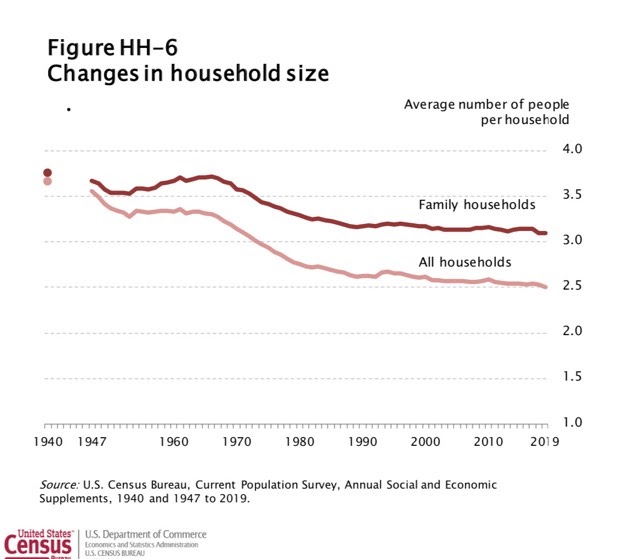
2019 Household

The so-called “starter home” these days may be big enough until the kids leave for college. The growth in multi-generational housing plays into this as well.

Unless the homeowner was living in a small single-family resident or condo, the four-decade push of bigger homes fit their needs.

As you can see below, we got as high as 2,698 for the average square feet floor area for single-family units in Q2 2015:
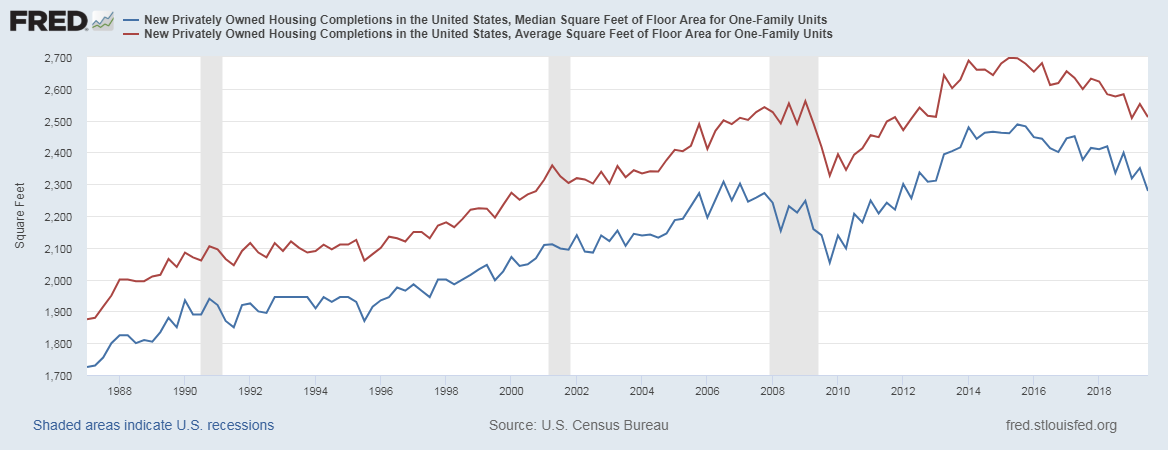
Jan 2020 Median size and average

It is true that after the housing bubble and crash, the lack of equity prevented some people from moving and led to an uptick in housing tenure.  

But that is an old story.

Today, people move because of kids, school, jobs or divorce. Aside from periods of a job loss recession, inventory for both new and existing homes has been steady since 1996.

Moving forward in this decade, we do have one possible positive trend that could facilitate more move-up buyers and an increase in inventory in the starter home market… Kids! 

The U.S. is entering into a big demographic patch of people ages 30-39 —  and with this age group comes marriage and kids. 

2018 Marriage Housing

An increase in children means more first-time homeowners should be move-up buyers if their current home is too small. Birth rates, while currently low, have the potential to grow in the next 10 years.

Housing marketers love “if-only” excuses for why the housing market is not at record-breaking highs. “If only the inventory were better, we would have more sales. If only interest rates weren’t so gosh-darn high, we would have more sales.”

I’ll leave you with this: Beware of the “if-only” excuses and stick to the data if you are really interested in understanding the U.S. housing market. 

Share197Tweet123
usiscc

usiscc

  • Trending
  • Comments
  • Latest
Escape From Tarkov – How to Rotate Items

Escape From Tarkov – How to Rotate Items

February 5, 2020
Supply chain examination: Planning for vulnerabilities you can’t control

Supply chain examination: Planning for vulnerabilities you can’t control

December 7, 2019
Procurement Project Manager job with Camden London Borough Council

Procurement Project Manager job with Camden London Borough Council

February 17, 2020
Art Battle Wichita Falls III at The Warehouse, 1401 Lamar.

Art Battle Wichita Falls III at The Warehouse, 1401 Lamar.

0
Global Industry Analysis, Size, Share, Growth, Trends, and Forecasts 2016–2024 – ZMR News Reports

Global Industry Analysis, Size, Share, Growth, Trends, and Forecasts 2016–2024 – ZMR News Reports

0
PHOTOS: Ottawa firefighters respond to warehouse fire

PHOTOS: Ottawa firefighters respond to warehouse fire

0
Last Mile Delivery Market Worth Observing Growth | UPS, FedEx, SF Express

Last Mile Delivery Market Worth Observing Growth | UPS, FedEx, SF Express

April 23, 2024
Top 5 Spend Analysis Software ranked in 2024

Top 5 Spend Analysis Software ranked in 2024

March 1, 2024
How Tesla And BMW Are Leading A Supply Chain Renaissance With Blockchain

How Tesla And BMW Are Leading A Supply Chain Renaissance With Blockchain

January 19, 2024
  • Privacy Policy
  • Terms of Use
  • Disclaimer
  • DMCA
  • Contact Us

Copyright © 2024 United States International Supply Chain Commission (usiscc.org)

This website uses cookies to improve your experience. We'll assume you're ok with this, but you can opt-out if you wish. Cookie settingsACCEPT
Privacy & Cookies Policy

Privacy Overview

This website uses cookies to improve your experience while you navigate through the website. Out of these cookies, the cookies that are categorized as necessary are stored on your browser as they are essential for the working of basic functionalities of the website. We also use third-party cookies that help us analyze and understand how you use this website. These cookies will be stored in your browser only with your consent. You also have the option to opt-out of these cookies. But opting out of some of these cookies may have an effect on your browsing experience.
Necessary
Always Enabled

Necessary cookies are absolutely essential for the website to function properly. This category only includes cookies that ensures basic functionalities and security features of the website. These cookies do not store any personal information.

Non-necessary

Any cookies that may not be particularly necessary for the website to function and is used specifically to collect user personal data via analytics, ads, other embedded contents are termed as non-necessary cookies. It is mandatory to procure user consent prior to running these cookies on your website.

SAVE & ACCEPT
No Result
View All Result
  • Supply Chain
  • Logistics
  • Warehousing
  • Procurement
  • Shipping
  • More
    • Strategic Sourcing
    • Spend Analysis
    • Inventory
    • Contact Us

Copyright © 2024 United States International Supply Chain Commission (usiscc.org)