






Even as the White House celebrates the president’s negotiating accomplishment, the “phase one” deal offers little relief for countless U.S. businesses — including chemical makers, apparel retailers and auto parts manufacturers — that will still face the same punishing tariffs they have confronted for some time.
“There was an assumption that this was a short-term situation,” said Ed Brzytwa, director for international trade at the American Chemistry Council, an industry group. “We’re now at the point where we’re telling our members they should expect these tariffs are going to stay in place for a long time. This has become the new status quo for us.”
In March 2018, when the president began imposing tariffs on Chinese goods — in a bid to force Beijing to abandon its discriminatory trade policies — chemical companies were building dozens of new plants and creating tens of thousands of good-paying jobs around the country.
Thanks to inexpensive shale gas, U.S. chemical makers finally were poised to shed their high-cost reputation and become the world’s preferred supplier.
But among the targets of the president’s tariffs were the Chinese raw materials that U.S. plants use to produce industrial chemicals and plastics. China retaliated with its own import taxes, closing off the industry’s fastest-growing export market.
Chemical makers such as Eastman laid off workers or delayed investments. Unable to find alternatives to their Chinese suppliers, others such as Celanese passed along price increases to their customers in the automotive, agricultural and construction industries, as the trade war’s impact rippled across the economy.
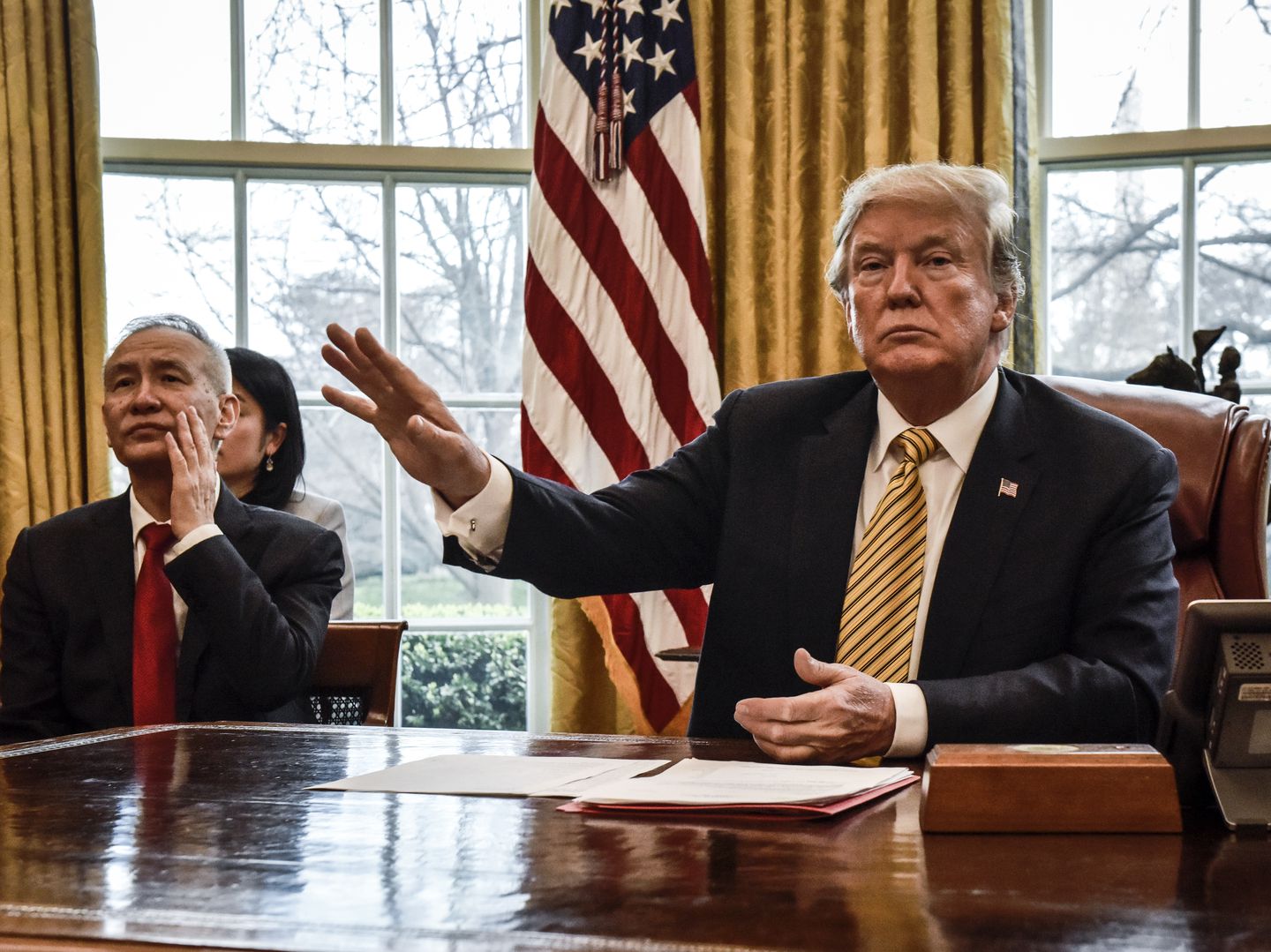
Wednesday’s White House ceremony will mark a political triumph for the president as he prepares for a reelection fight. His long-sought deal with Beijing also could produce a windfall for American farmers, energy producers and manufacturers if $200 billion in new Chinese purchases materializes over the next two years as U.S. officials hope.
To secure the initial trade deal, Trump agreed to suspend a planned December tariff on about $162 billion in Chinese goods and to cut in half an existing 15 percent levy on imports worth an additional $110 billion.
But the tariffs that remain in place will still cover the same $360 billion in Chinese goods that the administration taxed before the signing. Nearly two-thirds of everything Americans buy from China will be tariffed, compared with less than 1 percent before Trump began his anti-China campaign, according to calculations by economist Chad P. Bown of the Peterson Institute for International Economics.
The trade war started March 22, 2018, when Trump ordered the first round of tariffs on Chinese products. Accusing China of “economic aggression,” the president said his aim was to persuade Beijing to stop forcing U.S. companies to transfer advanced technologies to their Chinese partners and to overhaul its state-directed economy.
Since then, the two countries have traded tariff salvos and engaged in on-again, off-again negotiations. In December, after several false dawns, the president said he had reached a limited accord that would require China to halt its coercive technology-transfer scheme, buy huge amounts of U.S. farm and energy products, and open its financial services market to foreign companies.
The deal eases — but does not eliminate — the trade-related uncertainty that Federal Reserve Chair Jerome H. Powell has blamed for weak business investment and a manufacturing slump.
“We are now getting a degree of certainty in the China economic relationship that we haven’t had since mid-2017,” said Phil Levy, chief economist for Flexport, a freight forwarder. “Of course, ‘certainty’ is relative. Everything can be revoked with a tweet.”
Indeed, the president said last week that talks aimed at a second deal that would address China’s industrial subsidies and other economic policies might not bear fruit until after the November election.
“We’re keeping the tariffs on because we’ll use that for another one,” the president said at a Jan. 9 rally in Toledo, suggesting they could be adjusted as negotiating leverage.
As a consequence, the tariffs that have reshaped nearly $700 billion in U.S.-China trade are hardening into an enduring feature of the economic landscape.
Despite the pause in commercial hostilities, business executives said the outlook remains unsettled. Some tariffs could be rolled back if relations improve, or new tariffs could be imposed if China fails to abide by the accord, said business leaders who have followed the talks.
Robert E. Lighthizer, the president’s chief trade negotiator, said last month that Chinese officials want U.S. tariffs to be eliminated gradually as specific elements of the phase one deal are implemented. But he stopped short of saying that the administration had agreed to that phased reduction.
“They want to get the tariffs down, and we want to get the barriers down and the problems resolved,” Lighthizer told reporters.
The uncertainty complicates investment and hiring decisions, according to Ann Wilson, senior vice president for government affairs with the Motor and Equipment Manufacturers Association.
“Most of our members are planning for a longer-term tariff structure of some kind while they negotiate phase two,” she said. “We’re finding our larger members are delaying some investment decisions they have to make because of that uncertainty.”
Business groups also fear that even if the trade war’s China front remains quiet, the administration could impose new tariffs in a looming confrontation with the European Union.
The president repeatedly says that China is paying the cost of the tariffs, a claim that is contradicted by several studies and most economists.
Already, Trump’s tariffs have been a net drag on the economy and failed to achieve his stated goal of boosting domestic manufacturing, according to a new study by two Federal Reserve Board economists, Aaron Flaaen and Justin Pierce.
Any jobs saved or created in U.S. industries protected by tariffs are more than offset by jobs lost in companies that suffer higher input costs or lose export sales because of retaliatory tariffs, concluded the study, which was released last month.
“The tariffs have not boosted manufacturing employment or output, even as they increased producer prices,” the study found.
Years of rampant piracy, trade secrets theft and discriminatory treatment left many American executives eager for a confrontation with Beijing. Many welcome the deal that will be unveiled Wednesday with White House fanfare. But the persistence of the president’s favorite negotiating tool means any applause will probably be muted.
“There is an expectation that tariffs are going to be with us for a while. Nobody’s happy with that expectation,” said Stephen Lamar, president of the American Apparel and Footwear Association. “In fact, they’re quite upset.”










