








Organic waste diversion is a growing priority at landfills across the United States. Many states have enacted green waste restrictions or bans against landfill disposal, while others have mandated landfill diversion for certain organic material. On the far end of the spectrum, some states have even begun to push for food waste diversion to reduce the organics disposed at landfills.
With SB 1383, California has produced perhaps the most comprehensive set of requirements for organics diversion in the U.S. SB 1383, which was signed into law by Gov. Jerry Brown in Sept. 2016, established methane emissions reduction targets in a statewide effort to reduce emissions of short-lived climate pollutants (SLCP) in various sectors of California’s economy. The California statute is primarily driven by the expected climate change benefits from landfill diversion. The passage and implementation of SB 1383 is expected to create a need for 150 to 200 new organics recycling facilities across the state, but the quantifiable impacts regarding this legislation on landfill emissions are still being evaluated.
Although the predicted benefit of diverting and recycling organic waste is reduced greenhouse gas (GHG) emissions, very few studies have documented or confirmed that these benefits are real, achievable or even within the operational control of the entity conducting the waste diversion.
In addition, while GHG reduction may be the goal of various diversion policies, any organic management strategy must also evaluate changes in other pollutant emissions that may produce negative impacts. Therefore, it is critical that any analysis of GHG benefits via diversion include an evaluation of any peripheral criteria and toxic pollutant impacts.
With this in mind, SCS Engineers, Long Beach, California, set out to better understand various organic waste management strategies’ effects on landfill emissions.
SCS Engineers conducted analyses of typical landfilling and organic diversion options in terms of both GHG and criteria for air pollutant benefits and consequences. These analyses were run at SCS Engineers’ Sacramento, California, office using various computer models and tools. Multiple regulatory agencies provided these models, including the U.S. Environmental Protection Agency (EPA), the California Air Resources Board and the South Coast Air Quality Management District, among others. SCS ran the models with the most reasonable set of criteria inputs based on its insights and real-world experiences.
In an attempt to produce reasonably comparable results, SCS assessed emissions based on the assumption that each technology managed an equivalent amount of organic waste under each scenario (1 million tons).
The scenarios SCS evaluated include:
- Landfilling without a landfill gas (LFG) collection and control system (GCCS).
- Landfilling with an active GCCS, including an LFG flare, at a 75 percent LFG capture rate.
- Landfilling with an active GCCS and energy recovery using a LFG-fired engine at a 75 percent LFG capture rate.
- Landfilling with an active GCCS, including a LFG flare, at a 90 percent LFG capture rate.
- Landfilling with an active GCCS and energy recovery using a LFG-fired engine at a 90 percent LFG capture rate.
- Use of green waste as alternative daily cover (ADC) at a landfill (biocover) with a GCCS and flare at a 75 percent LFG capture.
- Open windrow composting of green waste without emissions controls.
- Open windrow composting of green waste with operational controls (compost cover).
- Green waste composting using aerated static pile (ASP) technology, including engineered controls with a biofilter.
- Open windrow composting of green/ food waste without emissions controls.
- Open windrow composting of green and food waste with operational controls (compost cover).
- Green and food waste composting using ASP, including engineered controls with a biofilter.
- In-vessel anaerobic digestion with energy recovery using biogas-fired engines.
- Biomass to energy through direct combustion of green waste.
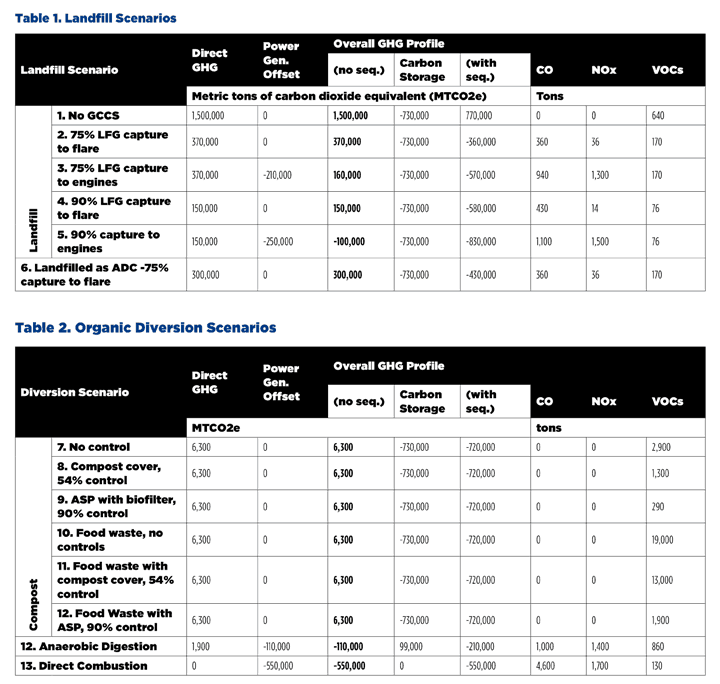
The results of SCS Engineers’ analyses are summarized in the tables above. Table 1 provides a summary of the various landfilling scenarios, while Table 2 summarizes the organics diversion options. Each of the scenarios was evaluated with and without carbon sequestration.
The data from the analyses shows that:
- Overall landfill emissions are highly dependent on the LFG capture rate. Landfilling without LFG collection and control has the worst GHG profile and high volatile organic compound (VOC) emissions, but it does not produce any combustion-derived emissions.
- Energy recovery improves the GHG profile for landfills but increases other emissions (e.g., nitrogen oxides) if LFG is combusted in devices such as engines. Other energy recovery options, such as conversion to renewable natural gas (RNG) or vehicle fuel, have better GHG/emission profiles because of the direct displacement of fossil fuel emissions.
- Green waste ADC as a biocover does not increase landfill emissions but increases oxidation of methane in the landfill surface, which reduces GHGs.
- Uncontrolled composting has the highest VOC emission rate, increasing with food waste composting, but has a strong GHG reduction profile. VOC emissions are reduced significantly when engineering controls are included with composting.
- Direct combustion has the highest criteria pollutant emission rates, but it also has the best GHG profile.
- Anaerobic digestion has a good GHG profile but does produce significant criteria pollutant emissions when the biogas is combusted in engines. As with LFG, this emissions profile can be improved through conversion to RNG or vehicle fuel.
- A significant amount of carbon is permanently sequestered in landfills, potentially making landfills carbon-negative. Composting also provides for significant carbon storage. However, carbon sequestration is not generally considered “creditable” to an individual facility—rather, it is part of the natural carbon cycle.
Looking at these findings, it is clear no magic bullet management option exists when it comes to reducing both GHG and criteria pollutant emissions. Some so-called “green” solutions, which are touted as offering GHG benefits, coincide with significant non-GHG pollutant emissions. As such, there may be tradeoffs that have to be accepted when utilizing organic diversion as a means to reduce GHG emissions, such as accepting increases in other pollutants to achieve the desired GHG reductions or spending more money on emissions controls to ensure that the chosen waste management strategy does not have ancillary negative impacts.
This article originally appeared in the Nov./Dec. issue of Waste Today. Patrick Sullivan is a senior vice president at SCS Engineers. He can be reached at [email protected].










