






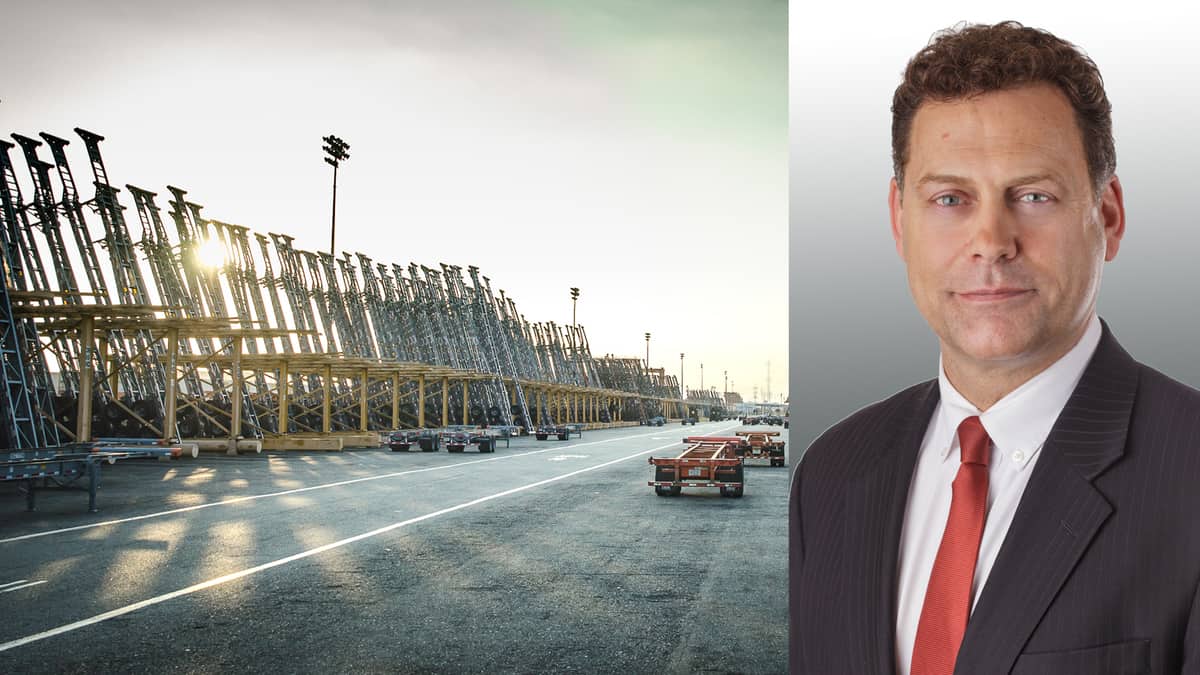
Consolidated Chassis Management (CCM), which manages chassis pools across the country, is upgrading the quality of chassis in its pool that serves the Southeast, including the ports of Savannah and Charleston.
Mike Wilson, president and CEO of CCM, said that by the end of 2021, chassis in its South Atlantic Consolidated Chassis Pool will be equipped with radial tires and LED lights, and by 2023 they will have antilock brakes.
The agreement to upgrade the chassis came after a proposal to create a new pool in the region fell apart because carriers were not comfortable with the cost structure of the pool.
The age of the fleet in the other five chassis pools CCM manages across the U.S. is similar, Wilson said, adding that CCM will be making recommendations for similar upgrades to equipment in those pools.
“When you upgrade to radials, you get better performance and lower cost over time,” with the higher cost of the radial tires offset by lower maintenance cost.
Wilson became CEO of CCM in April 2019 after a 26-year career with Hamburg Sud, which Maersk acquired in 2018. He was retained to help with the integration of the two carriers and then left last spring to head CCM. However, his association with CCM goes back all the way to its formation in 2005, and he was chairman of the group for eight years.
His leadership in the industry was recognized last year when he was awarded Intermodal Association of North America’s Silver Kingpin Award, and he has become a leading exponent for the benefits of fully interoperable, sometimes called “gray” chassis pools, like those that CCM manages. In an interoperable pool, several companies contribute equipment but share each other’s equipment and hire a single manager.
The upgrades of equipment in the chassis pools will involve adding new lights, tires and brakes to current chassis, totally remanufacturing existing chassis and purchasing new equipment, though Wilson noted chassis imported from China have become more expensive because of 25% U.S. tariffs imposed on chassis made in China.
However, CIE Manufacturing, a part of China International Marine Containers Group Co. Ltd., has been increasing the numbers of chassis it makes in the U.S. at manufacturing plants in South Gate, California, and Emporia, Virginia.
Frank Sonzala, president and CEO of CIE, told Forbes Magazine that CIE plans to make 60,000 chassis in 2020, up from just 6,000 in 2012.
Wilson explained that when CCM was formed, ocean container carriers owned their own fleets of chassis.
The carriers came together to form the Ocean Carrier Equipment Management Association (OCEMA) “to discuss, evaluate and reach agreement with respect to matters pertaining to the interchange, transportation, use and operation of carrier equipment in the U.S.”
They then created CCM using what Wilson calls a “utility-type model” to drive efficiency. By pooling equipment and staff, the carriers did not have to maintain large staffs individually to oversee chassis and could operate with fewer chassis.
“It was a much more efficient way to manage a national fleet of chassis,” he explained. “Supply chain velocity increases; it’s faster.”
Over the years, the container lines divested themselves of their chassis fleets to the point where only about 3% of chassis are owned by international shipping companies. (Domestic shipping companies like Matson and Crowley do continue to own chassis, Wilson noted.)
Today most chassis are owned by the “big three” leasing companies — Direct ChassisLink Inc. (DCLI), Flexi-Van Leasing and TRAC Intermodal — or by the North American Chassis Pool Cooperative (NACPC), which was formed by a group of 12 motor carriers. Those companies as well as Matson and Turkon Line contribute chassis to some or all of the CCM pools.
In addition to the South Atlantic Consolidated Chassis Pool, CCM operates five other interoperative gray chassis pools across the country. In total the six pools contain about 111,000 chassis. The other pools are the Chicago & Ohio Valley Consolidated Chassis Pool, Mid-South Consolidated Chassis Pool, Midwest Consolidated Chassis Pool, Denver Consolidated Chassis Pool and Gulf Consolidated Chassis Pool.
Wilson said the challenges that chassis providers face differ in ports around the country, but he contended that interoperative gray chassis pools, such as those operated by CCM, drive the highest level of efficiency and benefit shippers, railroads, ocean carriers and truckers.
Interoperable pools provide for more reliable flows of cargo, he said, and therefore chassis providers can maintain a smaller “buffer stock” of chassis, reducing the costs. Different chassis providers in the pool compete for customers through both price and service. And beneficial cargo operators can contribute their own chassis or have motor carriers do so on their behalf.
At “wheeled terminals” — terminals where containers are stored on chassis, such as those at rail ramps — when trains are being discharged, the operator can grab any chassis it wants, put a box on it and park it in the yard. That speeds the discharge and loading of intermodal trains, and CCM says logistics and maintenance are simplified and fewer chassis are needed.
“When you have multiple pools or multiple classes of assets, the hostler has to drive around looking for the right color chassis [that is, the chassis with the color of a particular owner of the chassis] before he brings it under the hook. This takes more time and impedes fluidity to that operation,” Wilson explained. “Off terminal, if once the motor carrier picks up a chassis, if it’s gray, he can hang onto that chassis and use it for any shipping line’s box that he wants.”
If there are multiple pools, a trucker who has delivered a container in the morning using a chassis from Company A may be required to return that chassis and get a different chassis from Company B to move a chassis later in the day.
“That causes a lot more gate moves in and out of terminals, which adds congestion,” Wilson said. It also increases air pollution and increases the carbon footprint of the transportation industry.
Unlike most ocean terminals where containers are stored on the ground, he estimates that in the interior of the country, at about 60% of rail ramps (or more) containers are stored on chassis. At CCM’s six pools, the percentage of containers that are wheeled ranges from 100 in the Denver pool to 10 in the South Atlantic pool.
While CCM pools operate throughout much of the country, they are absent from a number of major ports.
CCM does not have pools on the West Coast, nor in big East Coast ports such as New York and New Jersey, Boston, Philadelphia, Baltimore or Hampton Roads.
Wilson believes that the so-called “pool of pools” created by the big three chassis lessors in the nation’s two largest container ports, the Port of Los Angeles and Port of Long Beach, in 2015 has improved efficiency but still is not optimal.
He said this is, in part, because there are 12 different terminals in the two neighboring ports, and that results in a lot of “dislocation” where chassis picked up at one terminal end up getting returned to another.
As a result, many bare chassis, chassis without containers on them, have to be moved from one terminal where they are not needed to a terminal where there is demand for them.
In addition, each terminal needs to maintain a number of chassis for “working stock.”
Wilson said perhaps 45% of the 68,000 chassis in the pool of pools is required to maintain the working stocks.
“Better analytics might find a way to squeeze out some of the unnecessary repositioning,” he said.
So would moving chassis to off-dock container yards, something that port officials in Los Angeles and Long Beach have discussed and was done in the Port of New York and New Jersey.
While CCM does not operate in the Ports of Los Angeles and Long Beach, Wilson believes “the interoperable gray pool model is made to order for Southern California” and that the ports could benefit from a neutral pool manager.
“CCM is non-asset based. We don’t have assets where we are required to make a certain ROI. We are all about running the business of chassis, and because of that, our processes, our technology, and especially our people make our approach is much more efficient.”
He also believes the Port of New York and New Jersey would benefit from having an interoperable chassis pool as it would result in fewer truck moves.
But he said the big chassis providers “would rather operate in individual silos rather than via an objective third-party, neutral manager.”
Since he joined CCM as CEO, Wilson said, the organization has been able to articulate the importance of the interoperable gray pool model and get “buy-in from most of the stakeholders that this is the way chassis provision should look in a fair, equitable and efficient marketplace.”
Not everyone agrees with that, he said. “So I still have some work to do.”
The inland movement of containerized cargo can be accomplished with “carrier haulage,” in which the trucking and rental of a chassis is arranged by the ocean carriers. Or it can be performed as “merchant haulage,” in which the shipper or his drayage provider arranges the movement of the container to its final destination, including the rental of a chassis.
Since an ocean carrier may be arranging hundreds of thousands or a million truck moves, it naturally has more leverage when negotiating with chassis providers rather than smaller shippers or truckers acting on their behalf, leading to price disparities.
CCM several years ago created its Choice Program for cargo that moves as merchant haulage. It allows the customer to choose a chassis provider from pool members and negotiate rates with them.
The CCM website notes that previously the chassis customer often had “little choice” in choosing its chassis provider. A container is placed on a chassis at the rail or ocean terminal before the motor carrier arrives for pickup. Unless the container is taken off the chassis and placed on another chassis, the chassis provider is already determined by the ocean container.
CCM explains that within its pools “there are many chassis providers and some of them participate in a program that allows the customer to choose a chassis provider without having to lift the container onto a new chassis.”
However, in December, the American Trucking Associations’ Intermodal Motor Carrier Conference (IMCC), which represents drayage trucking companies, expressed concern that two major container lines — China Ocean Shipping Co. and Hyundai Merchant Marine — were moving in the opposite direction to private chassis pools.
IMCC Executive Director Tyler Rushforth said his group was appealing to the two companies to change their minds and was also approaching the Federal Maritime Commission about the issue.
Industry shippers and truckers in the area around Memphis, Tennessee, had highlighted chassis issues as a concern.
In May 2019, FMC Commissioner Rebecca Dye said a “supply chain innovation team” of industry representatives found that the most critical need for improvement in freight velocity and fluidity in and out of the rail ramps in Memphis is for a “single interoperable gray pool.” They called for “reasonable access to chassis” and “choice on merchant haulage.”
Dye noted “since over 50% of the freight movement in the mid-South is merchant haulage, meaning that the shipper or designated trucker bears responsibility for the freight delivery, this lack of ability to resolve problems is systemic. For this reason, I support greater chassis ‘choice’ for motor carriers and shippers on merchant haulage moves.”
Wilson said he expects conversations about chassis choice to be a major topic of discussion in the coming year.










