






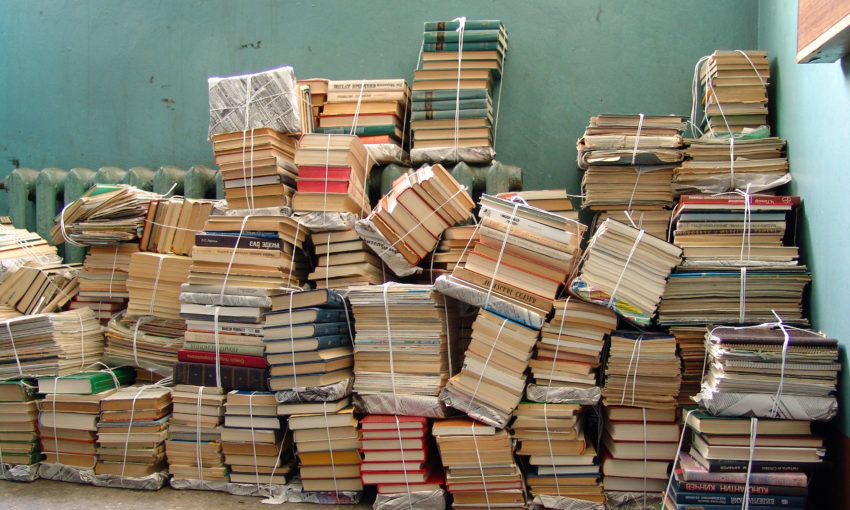
The National Library says it is ‘making room for more New Zealand and Pacific stories’ and hopes the books it’s purging might ‘spark joy’ for other people. David Larsen considers it a whacking great clear-cutting.
It would be irresponsible for me to tell you the National Library is about to burn six hundred thousand of your books. That is definitely not the plan. We can agree that the Library is a national treasure, staffed by sober-minded professionals of good character and intent, and that it would never, ever do a thing like this.
However.
Internal Affairs briefing, Hon Tracey Martin, Minister of Internal Affairs
Title: Management of the National Library’s Overseas Published Collections
Date: 11 December 2018
Action sought: Approve the removal of all overseas publications from the Overseas Published Collections, excluding those in subject areas identified as collecting priorities in the Overseas Collecting Plan, and in alignment with the 2015 National Library Collections Policy.
Note that due to evidence of low demand and the age of the material, secure destruction of removed items is the most likely outcome.
So apparently, in order to “manage” their overseas collection – which consists of all the books they hold published anywhere on Earth except New Zealand – the library is proposing to … get rid of their overseas collection. That’s management with teeth. If DOC took this approach to managing the country’s conservation estate, it would save the government a great deal of expense; also, kiwi and kakapo would be extinct. The library’s cull process is under way now, and is intended to be complete by the end of this year.
No one actually knows how many books, newspapers, pamphlets, magazines, letters, e-documents, and other things loosely definable as “publications” the National Library has. Cataloguing of the older material is often imprecise; but the number is well up in the millions. The Overseas Published Collections comprise only a small fraction of this, totalling about 710,000 items, of which the library wishes to dispense with roughly 625,000 (the remainder having been identified as high value). It’s stored across two locations: the basement of the main Library complex on Molesworth Street, Wellington, and Whanganui’s Wairere House.
Wairere House – formerly home to the National Law Enforcement System, New Zealand’s first centralised electronic database, and famous mostly as the target of an anti-Big Brother anarchist bombing in 1982 – is now, as the Library notes in its briefing to Tracey Martin, “at the end of its economic life and is built next to a flood prone river“. Why not take advantage of the situation? “The plan to exit Wairere House presents a prime opportunity to reduce pressure on overall storage capacity by reducing the volume of National Library’s Overseas Published Collections“. This would produce the happy outcome that the remaining books “could all be housed in fit-for-purpose owned or occupied buildings in the short to medium term“.
In other words, we need to move all our books out of this ageing building, which is a problem, because then we will have too many books and not enough buildings. We can solve the problem if we get rid of some of the books, which will be excellent, because then we will have fewer books to look after! So it will be easier to look after the books!
“We are looking to rehome them so that they might spark joy in somebody else’s life,” says National Librarian Bill Macnaught, of the books it’s purging now. Source: the National Library.
As small as they are in the context of the overall library holdings, the Overseas Published Collections have been built up to their current not-quite-three-quarter-million total titles over a period of eight decades. Under the National Library of New Zealand Act 2003, they have the same protected legal status as everything else in the library, which is why the minister of Internal Affairs has to sign off on any weeding out, or in this case wholesale clear-cutting, of the collections. The bulk of these books are well out of print, not that replacing them once they’re gone would be economically realistic in any case. I asked the library’s director of content services, Rachel Esson, whether they had checked that the titles they’re proposing to get rid of are internationally available through other libraries.
“We believe that the majority of them are.”
So some of them aren’t?
“We don’t know that.”
So if you get rid of them, and I’m a researcher and I need one of them, and it turns out the book you got rid of was the last available copy …
“I don’t know whether that would happen. I’d say that would be highly unlikely.”
I also asked how certain the library is that nothing on their cull list is relevant to their core mandate of ensuring “New Zealand’s knowledge assets, documentary cultural record and taonga are collected, protected and made available with integrity and care across time.” Pretty certain, Essen said. “We’ve gone through and made sure we’ve pulled out anything that is New Zealand and Pacific related.”
Do you imagine any books are slipping through?
“I think it won’t be 100 percent … It’s likely there will be some things that slip through. We’re doing our best.”
That’s a dubious assertion. I have no doubt library staff are making a good faith effort to implement this cull process as intelligently and diligently as possible, given the time and resource constraints they’re working under. But the parameters of the process are arbitrarily tight, both as to the time allowed for it and in terms of who has been consulted. A real “doing our best” process would involve safeguarding every last book New Zealanders are liable to find useful in the future. The most certain route to that outcome, given the unknowability of future researchers’ interests, would be keeping all the books. Find a replacement for Wairere House; or move all the irreplaceable New Zealand documents out, and use Wairere House as a last-ditch storage facility for books which would otherwise be lost.
Failing that, consult every relevant subject expert you can get hold of, and get the most complete list possible of the high-value “knowledge assets” hiding in this 625,000 title forest. New Zealanders are, famously, a nation of part-time expats: any number of Kiwis have contributed to this field or that by publishing books while living overseas. So if the goal is to keep “anything that is New Zealand and Pacific related”, that will require identifying a huge corpus of often obscure books published offshore.
Likewise, there are many overseas-published books by non-New Zealanders which touch on New Zealand or Pacific interests, often in ways obvious only to specialists. One local historian I asked about this commented that there are maybe half a dozen people in the country qualified to recognise the books relevant to his specialist field, and none of those people works for the National Library. He makes frequent use of the library for his research, but he has not been asked to vet the cull list, and neither have any other external researchers or academics. The library is trusting itself to find things it lacks the expertise to identify.
The only people outside the library who have been consulted on the process are librarians at other libraries up and down the country, who have been invited to “rehome” any of the cull books they like the look of. These other libraries, of course, are not legally required to retain books once they take them, and do not have anything approaching the shelf space or the resourcing of the National Library. The remaining books will be offered to community groups or charities for fundraising purposes, after which – “Note“, says the briefing advice to the minister, “that due to evidence of low demand and the age of the material, secure destruction of removed items is the most likely outcome“.
In other words, the assumption going into this process is that most of these books are ending up … not on a bonfire, it will be something far less flashy and dangerous than a bonfire; but basically on a bonfire.

Why is this being done so quietly? Why is it being done so quickly? The library asserts that these are books we no longer want, need, or can afford to house. But it hasn’t actually asked most of the people who might want continued access to them, and for most of the last year it’s kept very quiet about the process. (The library did put out one press release, a week before Christmas.* I had put in an Official Information Act request for all advice to the minister on this subject, which they were required by law to send me on the same day they issued their press release, but I expect that was just coincidence).
“One good suggestion that came from staff”, Esson told me, “was ensuring that we keep all the metadata for books that we don’t retain. So if at any point in the future people want to see what we did have, what that whole body of knowledge was, then we can provide that.”
Though not the knowledge itself, of course, which will have been destroyed. No doubt the researchers of the future will be thrilled.
*A page on the library’s website, giving details about the project, also appears to have been published on 18 December – it says that the window for expressions of interest in any of the books closed on 13 January.
The Spinoff Review of Books is proudly brought to you by Unity Books.
The Bulletin is The Spinoff’s acclaimed daily digest of New Zealand’s most important stories, delivered directly to your inbox each morning.










