






The sudden and rapidly spreading outbreak of the coronavirus respiratory disease, which started in China and has spread internationally, has drawn comparisons with the Severe Acute Respiratory Syndrome (SARS) outbreak of 2003, which was most severe in Hong Kong. It is too early to quantify the impact, as uncertainty about the nature of the virus and whether authorities can contain it quickly is extremely high.
But it is useful to consider the impact of earlier epidemics.
The International Air Transport Association (IATA, an industry trade group) said in a recent note that passenger air traffic (revenue passenger kilometers) was about 35% lower at the SARS outbreak’s worst point (around three months after it began) for airlines in the Asia-Pacific region. For 2003 as a whole, IATA estimates SARS cost those airlines 8% of their revenues (about $6 billion at the time). For certain airlines serving the most hard-hit cities, such as Hong Kong, the economic damage was worse.
We agree this is a plausible precedent, and it indicates there could be sharp, albeit hopefully only temporary, declines in revenues and earnings for selected airlines and regions. The combination of government-imposed quarantines (such as those in effect in China, particularly around the city of Wuhan), transportation restrictions, and an understandable combination of fear and uncertainty could cause traffic to plummet on selected routes. As a result, a decline in cash flow is probably already hitting airlines with meaningful exposure to China and the wider Asia-Pacific region, and will continue until the virus is contained and normal travel volumes resume. Any effect on air ransport is usually temporary following containment. IATA reports that traffic returned to precrisis levels nine months after the height of the SARS outbreak.
Indeed, the airline industry has proved resilient to shocks in the past. However, the impact on Asia-Pacific airlines and other operators will depend on how quickly the virus is contained and the extent to which it spreads outside China.
Wuhan, the epicenter of the outbreak, is an interior Chinese city with fewer direct air links to the rest of the world than Hong Kong had in 2003, potentially slowing international transmission. However, high-speed trains also connect major cities across China, including Wuhan, Beijing, Changsha, Shenzhen, and Hong Kong. Hong Kong has suspended high-speed rail service with mainland China, and flights, ferry service, and bus routes have been dramatically reduced. News reports suggest that about 5 million people left Wuhan before it was locked down, and many countries are working to evacuate their citizens. Moreover, the outbreak coincided with the lunar New Year holiday period, China’s largest annual travel period. This increases the risk of transmission, and we expect confirmed cases of the virus will continue to rise in at least the near term.
With the benefit of hindsight on the SARS episode, government and health officials may mobilize more quickly and act more effectively. On the other hand, the coronavirus is more difficult to identify, as we understand it can take 14 days before carriers show any symptoms, which increases the risk of wider transmission.
China’s air travel market is larger and better connected to the rest of the world than ever before, both in absolute terms and as a percentage of global aviation (Chinese airlines carry 15% of global air traffic). Hence, larger ripple effects are likely if the coronavirus continues. China’s economy will face at least a temporary hit, which will affect a variety of sectors including most notably transportation, tourism, and retail.
Most airlines rated by S&P Global Ratings have only moderate exposure to traffic to, from, and within China.
Among the big U.S. airlines, United Airlines Holdings Inc. (11.9% for the nine months ended Sept. 30, 2019) and Delta Air Lines Inc. (6.5%) derive the largest proportion of revenues from Asian routes. The airlines do not disclose revenues involving China separately, but we believe them to be less than half that, hence low- to mid-single-digit percents of the total. The rated U.S. airline with the highest exposure to Asia generally is Hawaiian Airlines Inc. (27.4%), mostly routes to and from Japan. Still, though the current focus is on China, there will probably be some spillover effect on other Asian markets. And a significant spread to other regions could widen the impact further. During the SARS episode, outbreaks in Canada noticeably hurt Air Canada’s traffic. Its Asian routes generate about 15% of total revenues.
Our rated European airlines do not have material exposure to China. Deutsche Lufthansa AG appears to be the most, but not significantly, exposed. It derives about 12% of its revenues from the Asia-Pacific region, including flights to and from China.
Airlines are starting to cancel such flights. British Airways PLC has suspended all flights to and from Beijing and Shanghai, following the U.K. Foreign Office’s advice against all but essential travel to mainland China. We expect other airlines may follow suit. We understand that International Airlines Group (parent entity of British Airways, Iberia, Aer Lingus Ltd., Vueling Airlines S.A., and LEVEL) has low direct exposure to China.
Turkish Airlines reports that the Far East accounts for about one quarter of its revenue passenger kilometers, so is likely to be more exposed.
In the region, Virgin Australia Holdings Ltd. has only modest direct exposure. Its operations focus on the domestic market, and it offers international service largely through airline partnerships. However, Chinese (and other) tourists to Australia often fly several domestic segments as part of their visits, profitable business that will decline.
Aircraft leasing is one sector that plays a more important role in global aviation now than it did during the SARS outbreak.
Leasing now accounts for 40% of the world’s fleet. The big aircraft leasing companies, which operate globally, lease large numbers of planes to Chinese airlines and others that carry passengers to and from the country.
TABLE 1
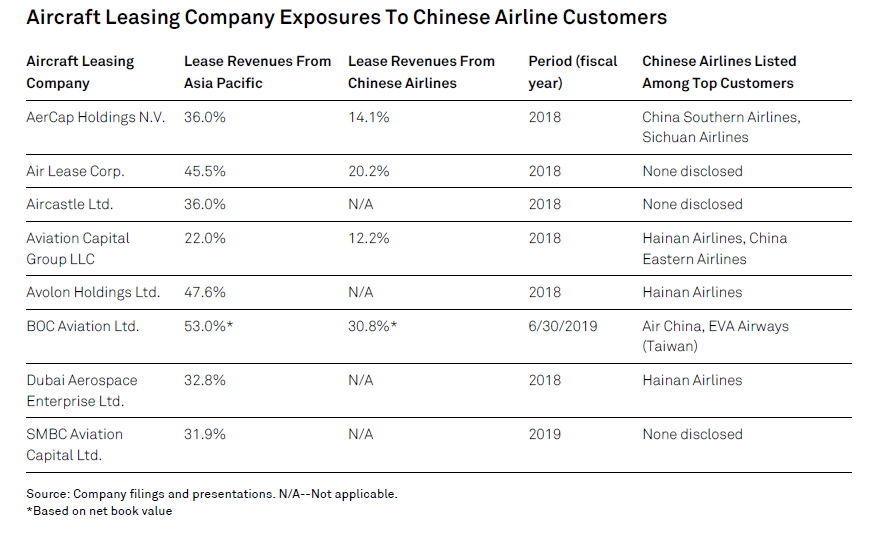
Leasing companies rarely show proportions of revenues from individual countries, but do so for overall regions (Table 1). The proportion of revenues derived from Asia-Pacific airline customers is substantial, about 25%-50%. Two lessors that provide more information on China exposure are Aviation Capital Group LLC (14% of lease revenues for the nine months ended Sept. 30, 2019) and AerCap Holdings N.V. (14% in 2018). The individual airline customer that appears several times among lessors’ top exposure lists is Hainan Airlines Co. Ltd., owned by the conglomerate HNA Group Co. Ltd. The lessor with the highest exposure to Hainan is Avolon Holdings Ltd. (6%), which is indirectly majority owned by HNA.
Leasing companies are used to dealing with airline customers that, for one reason or another, may run into financial trouble. Lessors are generally willing to defer rentals for a limited period if they believe the airline’s business model is fundamentally viable. We would expect this kind of situation to arise more frequently now with smaller or weaker Chinese airlines, and potentially others with significant business on routes to and from China. Some of these airlines may fail and turn back planes to the lessors.
With a shortage of narrowbody planes partly because of Boeing Co.’s grounded 737 MAX, some repossessed planes may quickly find new homes. Releasing widebody planes could take longer, because there is currently no shortage and Asia, with its large distances and populations, is a major market for such planes. A decline in traffic would weaken global demand at least temporarily.
We will continue to monitor the outbreak and related developments.










