

• Latest
  • Trending
  • All
First Afghan Cargo is a Game-Changer for Gwadar Port

First Afghan Cargo is a Game-Changer for Gwadar Port

February 1, 2020
Last Mile Delivery Market Worth Observing Growth | UPS, FedEx, SF Express

Last Mile Delivery Market Worth Observing Growth | UPS, FedEx, SF Express

April 23, 2024
Top 5 Spend Analysis Software ranked in 2024

Top 5 Spend Analysis Software ranked in 2024

March 1, 2024
How Tesla And BMW Are Leading A Supply Chain Renaissance With Blockchain

How Tesla And BMW Are Leading A Supply Chain Renaissance With Blockchain

January 19, 2024
LATAM Cargo strengthens European cargo links

LATAM Cargo strengthens European cargo links

April 14, 2020
Ford making reusable hospital gowns from airbag materials as efforts against coronavirus expand

Ford making reusable hospital gowns from airbag materials as efforts against coronavirus expand

April 14, 2020
Don’t Sweat NBC’s Decision to Cut Back on Television Ad Inventory

Don’t Sweat NBC’s Decision to Cut Back on Television Ad Inventory

April 14, 2020
Software firms sharpen focus on AI, big data as IT spending drops

Software firms sharpen focus on AI, big data as IT spending drops

April 14, 2020
Navigating turbulent times in your supply chain (TL:DR version)

Navigating turbulent times in your supply chain (TL:DR version)

April 14, 2020
Last Mile Delivery by Drones Market is Booming Worldwide

Last Mile Delivery by Drones Market is Booming Worldwide

April 14, 2020
AIR CARGO MARKET SIZE, SHARE, DEMAND, TREND, LATEST INNOVATIONS & APPLICATION ANALYSIS AND INDUSTRY GROWTH FORECAST 2027 – Science In Me

AIR CARGO MARKET SIZE, SHARE, DEMAND, TREND, LATEST INNOVATIONS & APPLICATION ANALYSIS AND INDUSTRY GROWTH FORECAST 2027 – Science In Me

April 14, 2020
Wheat procurement in Patiala: 6,500 coupons issued to farmers – cities

Wheat procurement in Patiala: 6,500 coupons issued to farmers – cities

April 14, 2020
Pandemic, Plastics And The Continuing Quest For Sustainability

Pandemic, Plastics And The Continuing Quest For Sustainability

April 14, 2020
  • Supply Chain
  • Logistics
  • Warehousing
  • Procurement
  • Shipping
  • More
    • Strategic Sourcing
    • Spend Analysis
    • Inventory
    • Contact Us
No Result
View All Result
United States International Supply Chain Commission
Home Shipping

First Afghan Cargo is a Game-Changer for Gwadar Port

by usiscc
February 1, 2020
in Shipping
0
First Afghan Cargo is a Game-Changer for Gwadar Port
493
SHARES
1.4k
VIEWS
Share on FacebookShare on Twitter

alt
Courtesy Chinese Consulate in Pakistan

By


The Lowy Interpreter


01-31-2020 03:40:00

[By Adnan Aamir]


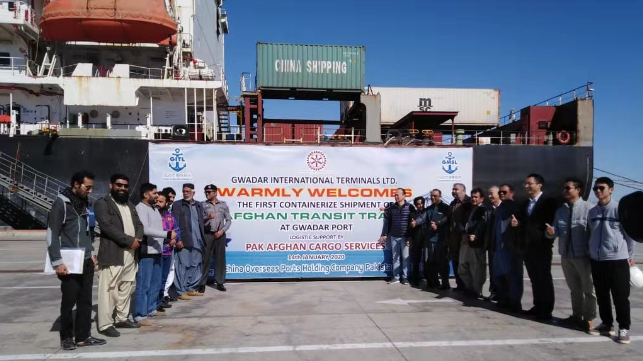
On a sunny Tuesday in the third week of January, a cargo ship named Diyala docked at Gwadar seaport, in south-west Pakistan. The enthusiastic port staff quickly unloaded the cargo. When the unloading was finished, Chinese officials operating the port, along with their Pakistani counterparts, posed for a photo with containers in the backdrop. The ship’s arrival received extensive coverage in local media, and the Chinese embassy tweeted about it.


Why are Pakistanis and Chinese so jubilant about one ship arriving at Gwadar port? It marks the beginning of the Afghan transit trade.


On 14 January, Gwadar port officially started taking cargo under the Afghanistan-Pakistan Transit Trade Agreement (APTTA). By this agreement, landlocked Afghanistan can import and export goods via Pakistani land routes. The first consignment unloaded at Gwadar port contained chemical fertilizers, which were transported to Afghanistan in trucks at the Chaman border crossing in Balochistan province. This marks the first operational use of Gwadar port for major trade activity, a success for both Pakistan and China.


Gwadar, a small coastal town in south-western Balochistan just 600 kilometres from the Strait of Hormuz, attracted global attention when China started building a deep-sea port here in 2002. The first phase of construction was completed in 2007, and in 2013 operations of the port and Gwadar Free Zone were handed over to the China Overseas Port Holding Company (CPOHC). The major breakthrough for Gwadar, however, came in April 2015, when Pakistan and China signed the $50 billion China-Pakistan Economic Corridor (CPEC), dubbed the flagship project of China’s ambitious Belt and Road Initiative (BRI).  Providing the shortest land route for sea access to Western China, as well as an alternative shipping route to the Malacca Strait, Gwadar port is the centrepiece of CPEC – without the port, there would have been no CPEC.


Surprisingly, Gwadar failed to achieve economic success in the last 5 years. As a result of armed attacks by Baloch separatists on Chinese interests, bureaucratic red tape, and poor governance in Pakistan, even the supporting infrastructure in Gwadar has not been fully built, and experts had ruled out the prospect of Gwadar succeeding anytime soon. Its use in the Afghan transit trade is therefore seen as the beginning of the economic revival of the project.


There are three main reasons Afghan trade is significant for the Gwadar port project. Firstly, it means that the project has finally started to pay off for its Chinese sponsor. China spent $250 million directly on construction of the port. COPHC gets 91% of revenue from Gwadar for the next 40 years, according to the agreement with Pakistan. The revenue from Gwadar port now coming in was only made possible by the Afghan transit trade.


Secondly, the use of the Gwadar port was made possible only after China lobbied for it with the Afghan government. Over the last four years, China has shown a growing interest in the Afghanistan situation, including inviting Taliban leadership to Beijing for negotiations to broker a settlement. If a peace deal were reached in Afghanistan, then it would result (among other things) in an increase in the volume of Afghan transit trade. China will likely take more interest in seeing an Afghan peace deal with the Taliban when it can also potentially benefit from increased activity at Gwadar port for Afghan transit trade.


Thirdly, the recent success of Gwadar port has effectively put the brakes on the Indian-aided venture of Shahid Beheshti port as a competitor to Gwadar port, 175 kilometres to the west in Chabahar, Iran. India invested $100 million in the development of the port, as a counter to the China-Pakistan partnership at Gwadar. It also invested in building infrastructure connecting Chabahar with Afghanistan. In October 2018, the first shipment of goods was exported by India to Afghanistan through Chabahar port. US sanctions on Iran, however, later made India reluctant to aggressively develop Chabahar port. And with Afghanistan now appearing to prefer Gwadar over Chabahar, India’s scheme is sunk – a geostrategic victory for Pakistan and China.


Afghan transit cargo can be a major source of revenue, but it’s not enough on its own to pay back the huge investment China has made in the project or to sustain the success of Gwadar port. Therefore, it’s crucial that Pakistan and China attract more economic activity for Gwadar port, in the model of a mini-Dubai or a mini–Hong Kong. Afghan transit is only a beginning. The question now is whether Pakistan and China can build on this success


Adnan Aamir is a journalist, researcher and analyst based in Quetta, Pakistan. He covers politics, economy, development, conflict, and security. His area of focus is the conflict in Balochistan and the Chinese projects in Pakistan. He has written for Financial Times, South China Morning Post, Asia Times, China-US Focus, Business Standard, among others. Adnan is also founder and Editor of Balochistan Voices, a community based online newspaper covering the issues of Balochistan that are ignored by mainstream media. 


This article appears courtesy of The Lowy Interpreter and may be found in its original form here. 

The opinions expressed herein are the author’s and not necessarily those of The Maritime Executive.


Share197Tweet123
usiscc

usiscc

  • Trending
  • Comments
  • Latest
Escape From Tarkov – How to Rotate Items

Escape From Tarkov – How to Rotate Items

February 5, 2020
Supply chain examination: Planning for vulnerabilities you can’t control

Supply chain examination: Planning for vulnerabilities you can’t control

December 7, 2019
Procurement Project Manager job with Camden London Borough Council

Procurement Project Manager job with Camden London Borough Council

February 17, 2020
Art Battle Wichita Falls III at The Warehouse, 1401 Lamar.

Art Battle Wichita Falls III at The Warehouse, 1401 Lamar.

0
Global Industry Analysis, Size, Share, Growth, Trends, and Forecasts 2016–2024 – ZMR News Reports

Global Industry Analysis, Size, Share, Growth, Trends, and Forecasts 2016–2024 – ZMR News Reports

0
PHOTOS: Ottawa firefighters respond to warehouse fire

PHOTOS: Ottawa firefighters respond to warehouse fire

0
Last Mile Delivery Market Worth Observing Growth | UPS, FedEx, SF Express

Last Mile Delivery Market Worth Observing Growth | UPS, FedEx, SF Express

April 23, 2024
Top 5 Spend Analysis Software ranked in 2024

Top 5 Spend Analysis Software ranked in 2024

March 1, 2024
How Tesla And BMW Are Leading A Supply Chain Renaissance With Blockchain

How Tesla And BMW Are Leading A Supply Chain Renaissance With Blockchain

January 19, 2024
  • Privacy Policy
  • Terms of Use
  • Disclaimer
  • DMCA
  • Contact Us

Copyright © 2024 United States International Supply Chain Commission (usiscc.org)

This website uses cookies to improve your experience. We'll assume you're ok with this, but you can opt-out if you wish. Cookie settingsACCEPT
Privacy & Cookies Policy

Privacy Overview

This website uses cookies to improve your experience while you navigate through the website. Out of these cookies, the cookies that are categorized as necessary are stored on your browser as they are essential for the working of basic functionalities of the website. We also use third-party cookies that help us analyze and understand how you use this website. These cookies will be stored in your browser only with your consent. You also have the option to opt-out of these cookies. But opting out of some of these cookies may have an effect on your browsing experience.
Necessary
Always Enabled

Necessary cookies are absolutely essential for the website to function properly. This category only includes cookies that ensures basic functionalities and security features of the website. These cookies do not store any personal information.

Non-necessary

Any cookies that may not be particularly necessary for the website to function and is used specifically to collect user personal data via analytics, ads, other embedded contents are termed as non-necessary cookies. It is mandatory to procure user consent prior to running these cookies on your website.

SAVE & ACCEPT
No Result
View All Result
  • Supply Chain
  • Logistics
  • Warehousing
  • Procurement
  • Shipping
  • More
    • Strategic Sourcing
    • Spend Analysis
    • Inventory
    • Contact Us

Copyright © 2024 United States International Supply Chain Commission (usiscc.org)






