






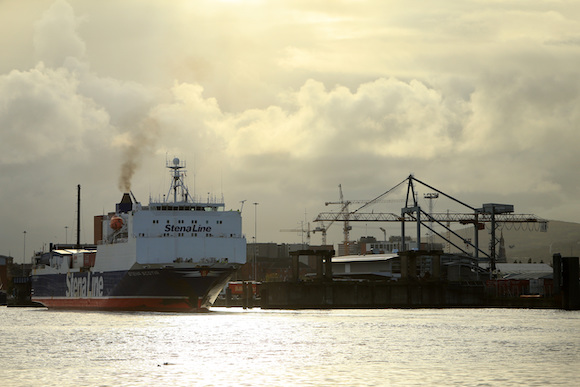
The Port of Belfast. Photo: Han Yan/Xinhua News Agency/PA Images
The status of Northern Ireland has proved one of the thorniest questions of the Brexit process. Theresa May’s attempt to carve out a special deal for the province sunk her premiership. We now enter the transition with Boris Johnson claiming he has struck the perfect agreement, which avoids a land frontier while guaranteeing unfettered access for NI and GB firms. All four parts of the UK have apparently left on equal terms; there will be no barriers to goods crossing the Irish sea.
This is a vital principle for an avowedly unionist prime minister. Yet critics accuse him of misrepresenting the truth. Northern Ireland will effectively be enforcing EU customs rules, they say, meaning paperwork and checks and controls will be required for goods crossing this border. GB and NI firms will soon face new frictions and the UK’s internal market will be compromised. The row has grown increasingly heated in recent weeks, especially after chief Brexit negotiator Michel Barnier reiterated that the EU expects substantial controls.
Who is right? Having spoken to politicians, civil service chiefs and independent experts in GB and NI it is the consensus position that Johnson’s promises ring hollow. A definite consequence of his deal is friction on the Irish sea border once the transition ends, with all the implications that that has for the integrity of the UK internal market. The only question is the extent of this. It is a shame the prime minister continues to obfuscate, and his decision to do so risks storing up trouble for the future.
The issue arises in the first place because of the need to avoid a hard Irish land border after Brexit. If Britain hopes to diverge from the EU then there will need to be some frontier between the two territories to protect the integrity of the EU’s market, but a land border is fraught with historic difficulty. Putting the border in the Irish sea is an alternative but is highly controversial with unionists, with the government keen to stress that formalities will be minimal. What is the reality?
For his part, Johnson has several times rebutted the idea his deal creates friction of any kind, saying at the outset “There’s no question of there being checks on goods going NI/GB or GB/NI” and later “no forms, no checks, no barriers of any kind.”
Yet for those I spoke to the truth of the matter is very different. David Lidington, until recently de-facto deputy prime minister in the government that negotiated the infamous “backstop,” told me that while there was substantial scope for mitigation, “there would have to be checks.” “That does concern me,” he said, “both for political and for economic reasons, cost to business and the political impact on unionism and loyalism in Northern Ireland…. my view is that the Johnson deal is more difficult for Northern Ireland, and particular businesses, than the May deal was.”
Philip Rycroft meanwhile, former permanent secretary at the Brexit department, recently told me “Clearly there will be some complexity, some cost in trade east-west, and possibly also some new procedures west-east.” Stewart Wood, the former adviser to Gordon Brown who led on NI affairs, was blunter: “The government’s position on GB-NI trade rules after Brexit is a heady mixture of confusion, obfuscation and contradiction.”
Trade across the Irish sea is substantial and has been growing in volume. In 2017 NI imported more than £10bn of goods from GB and exported almost £8bn to it (far more than travels across the NI-RoI land border). The NI Freight Transport Association has stressed to me the importance of unfettered access for NI firms.
Wood understands the problem better than most. Last year at a Lords committee he asked Stephen Barclay, then Brexit secretary, whether NI firms would have to fill out paperwork when exporting to GB. “He replied that they wouldn’t. Ten minutes later he corrected himself and said they would… we know there will be new bureaucracy and possibly new checks on goods into Great Britain from Northern Ireland.” Katy Hayward, a fellow of the UK in a Changing Europe research initiative based at Queen’s University Belfast, added “The UK government has promised ‘unfettered access’ into Great Britain for goods coming from Northern Ireland but we know that at the very least these goods will need to be accompanied by exit summary declarations, which means paperwork and thus cost.” Businesses in Northern Ireland would bear the brunt of this new bureaucracy.
Yet the most significant barriers relate to goods travelling in the other direction. Because while the UK has some freedom to minimise checks on goods coming into its own market, it is far harder to minimise checks going into someone else’s.
As Lidington put it, “if you’re going to reject” a solution like the backstop, “then simply the way in which the European treaties operate is that they deal with third-country external borders in a particular way… even Norway, because Norway isn’t in the customs union… So there are frictions on the Norway-Sweden border. The lorry waits are quite short, but there are waits.” The key, he continued, will be “EU agreement on reducing the level of checks from those that they would normally apply.” Improvement is possible but even with this there will be “some degree of friction.”
May’s deal sought to minimise this by keeping the whole of the UK in the customs union. Yet Johnson’s deal does no such thing. Instead the whole UK will be technically out, with a complicated dual-tariff arrangement in NI. Under this structure, GB businesses will pay the EU tariff if their goods are destined for Ireland or deemed at risk of ending up there. Meanwhile NI will be given the choice of whether to continue with the arrangement once every four years. “At the very least we know that customs declarations will be needed, and potentially checks too” in the GB-NI direction, said Hayward. “The truth is that there will be new checks for goods going into Northern Ireland from Great Britain,” said Wood.
Alarmingly, there could be yet more disruption depending on the agreement struck next. Much depends on the future level of alignment between the UK and EU in terms of regulations. Northern Ireland will remain bound by some EU single market rules but significant regulatory divergence with Europe is a professed aim of this government. The more the rest of the UK diverges, the more substantial the checks down the Irish sea will be. Hayward said “there could well be serious friction imposed on the movement of goods by the need for checks and controls that grow as the UK diverges from the EU’s rules.” “Any friction in trade and cost ultimately is born by businesses, ultimately by consumers,” added Rycroft.
This is the logical consequence of leaving the EU and avoiding a hard Irish land border. It is highly unpalatable especially to groups like the DUP, who did not hide their displeasure when I spoke to them for this piece. But if you insist on a hard Brexit there is arguably little alternative. Rycroft said “in a world of difficult choices this is probably the best one in terms of sustaining the Northern Irish economy.” Lidington’s mitigation measures will in my view be key. He suggested checks can be minimised and dedramatised through cooperation on both sides. There may be ways to make the best of a bad situation. Whether this will happen is an open question.
The deepest issue of all relates to the conduct of the prime minister. Johnson has taken Britain out of Europe and into the economic and constitutional unknown. It is an enormous shift with sensitivities on all sides. Any such project requires honesty upfront about the hard choices ahead. Instead Johnson has imposed a deal which is despised by all sides in NI and he is disguising the consequences. Such an approach risks undermining trust even further.
The government said “This issue has been addressed by our ministers a number of times in the House of Commons and in media interviews.” The secretary of state for exiting the EU “answered an urgent question on this, which you can find here.”










