






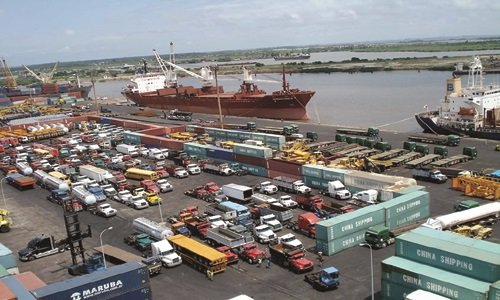
The huge number of overtime cargoes at the Lagos ports has become worrisome because of its ripple effect on port operations. Stakeholders in the industry have called on President Muhammadu Buhari and the Federal Executive Council (FEC) to order the Comptroller-General, Nigeria Customs Service (NCS), Col Hameed Ali (rtd), to auction the goods and thereby free up the Lagos ports. Oluwakemi Dauda reports
Over 2500 overtime cargoes are dumped at the various terminals at the Apapa Port Complex (LPC) and the Tin Can Island port in Lagos State.
Stakeholders have called for measures to address the issue.
Investigation revealed that the efficiency of the two ports is being threatened by the overtime goods. At APM Terminal in Apapa, there are over 1,100 overtime containers. The situation is not diffrent at Apapa and Tin Can Island port.
Cargoes are classified as overtime when they have stayed at the ports for more than 30 days without clearance and delivery.
Stakeholders, who spoke with The Nation at the weekend, appealed to President muhammadu Buhari and FEC to direct the Nigeria Customs Service to auction the cargoes as provided in the Customs and Excise Management Act (CEMA).
An exporter Mr Gbolahan Ajetunmobi, said: “The Customs Service is empowered by law to auction overtime cargoes to free up the space in the port and recover government revenue. Not auctioning those cargoes that have been in the port for more than a year does not serve the best interest of the people, government and of the operator.
I appeal to President Buhari to direct the Nigeria Customs Service to free up the space in the port by auctioning those overtime cargoes to bring efficiency to our port. Over N30 billion goods are rotting away at the port and the Federal Government is not doing anything about it.”
The National Vice President, Association of Nigerian Licensed Overtime Agents (ANLCA), Dr Kayode Farinto, confirmed that over 2000 cargo-laden containers worth billions of naira have been abandoned by some importers.
Findings revealed that overtime cargoes occupy over 30 per cent of the terminals in Lagos.
“Containers with very valuable items are not claimed for almost two years. This, to say the least, is very disappointing. This, to some extent, is irresponsibility on the part of those who are supposed to do the needful.
“The Federal Executive Council must ensure that the Act that established the Nigeria Customs Service (NCS), which has also prescribed a procedure for disposal of overtime goods and seized cargoes, is complied with. The only way to dispose the overtime cargoes is captured in the Act.
“Whatever that is defined in the Act is what should be done. It is the responsibility of the government to ensure that our ports are free of overtime cargoes and empty containers. We are talking of how to boost the economy and multi-billion naira goods are rotting.’’
Overtime cargoes
Before the ports were concessioned about 15 years ago, the issue of overtime cargo was rife. The NCS has the power to auction any cargo, which spends over 90 days at the ports without being cleared.
Before the concession, such cargoes could be found at any port and they stayed until the owners were ready to clear them. The demurrage was small then, and the owners could afford to play with time. Some importers falsified the date the goods arrived at the ports to reduce the demurrage.
But this changed when the terminal operators took over the ports. Any importer who delays in clearing his goods pays heavy demurrage. In some cases, some terminals have been accused of causing delays to create more room for the cargoes to stay at the ports and attract demurrage. But agencies-owned containers could be granted waiver on the intervention of the government.
A senior Customs officer who craved anonymity said the failure to clear them after a year might be as a result of bureaucratic bottlenecks in government departments. ‘’Some importers may have lost interest in clearing them because of the cost involved.
Sometimes, an importer may decide to forget some goods if the clearance will lead to more losses. This is when some trade goods enter overtime and accumulate more demurrage that clearing them will be expensive. The worth of overtime cargoes in the ports within and outside the Lagos ports is over N30billion.
“There is no doubt that the importers, particularly those who own the goods that are under prohibition list, may no longer be interested in the goods apparently because there is no way they can move them out of the port because of the eagle eyes of security officials at the ports.
“Also, there are some goods that have lost their value as a result of time. Although it is the duty of Customs to auction goods, the experience has been that only items that are valuable were sold off as quickly as possible to some highly placed Nigerians in the past.
“This does not appear to have been the same trend since the tenure of Col. Hameed Ali (rtd) as a Customs boss. And the reasons are obvious.
A highly placed source said Ali cannot carry out auction sales because he would need the approval of the Minister of Finance and that is why the President and the FEC must give an instruction to the ministers of Transport and Finance to ensure that the overtime cargoes are auction in no time.’
Why importers abandoned cargoes
Investigation show that many importers abandon their containers for various reasons. An importer, for example, may run out of funds to clear his goods. This often leads to more demurrage. Some cheat the government on any consignment.
In the process, they lose the goods as they are not able to settle the issue within the time allowed to clear the goods. Paying the amount on the Debit Note and the demurrage on the goods could be difficult. Some importers resort to bribing to buy the same goods at auction from the Customs.
It does not appear that such arrangement exists under the change mantra of the leadership of the Customs. Some importers even bring in prohibited goods, which are seized and left to rot at the ports.
NPA sources said there is hardly any port where there is no overtime cargo because of the unwholesome attitudes of importers.
Way out
Worried by the huge overtime cargoes, stakeholders said it was time for the Ministry of Finance to act.
A clearing agent, Mr Segun Ogunsanu, said the government should take stock of such items and empower the Service to auction them.
Ogunsanu said this would help decongest the areas where the goods were kept.
Another freight forwarder, Mr Sunday Albert, advised importers to shun any fraudulent practice that is responsible for seizure of goods at the ports.
He added that importers should be on top of any situation when their goods arrive to ensure that they are cleared on time before entering demurrage and overtime status.
The Chairman, Seaport Terminal Operators Association of Nigeria, (STOAN), Princess Vicky Haastrup, called on the government to intervene on the matter, saying if the issue was not tackled on time, terminal operators would be running their business at a loss.
Haastrup said because there were many laden containers at the terminals, the space for empty containers had be taken over. He explained that terminal operators make more money when they have more space for containers.
She stated: “Let the Nigeria Customs Service auction these overtime cargoes because they occupy commercial spaces at our terminals.
If that is taken care of, we can dedicate a large space for empty containers. Right now, because our members have so many laden containers, there is a limit to the number of empty containers they can take.”
Also the President, National Council of Managing Director of Licenced Customs Agents (NCMDLCA), Lucky Amiwero, said that there was need to ensure that overtime cargoes were transferred from the ports to government warehouses to decongest the terminals and bring efficiency to the port.










