







After declining for many years, the environmental damage costs linked to three of the biggest packaged food producers — Nestlé SA, Mondelez International Inc. and Danone SA — are once again starting to rise, challenging their stated ambitions to become more eco-friendly.
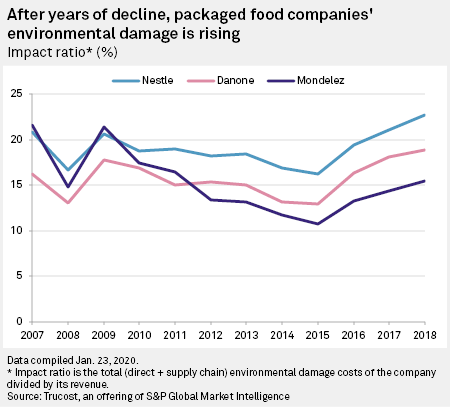
The analysis by S&P Global Market Intelligence shows that while the cost of environmental damage as a proportion of revenue linked to Nestlé, Danone and Mondelez fell at a sustained pace between 2009 and 2015, that cost has risen sharply since then. The vast bulk of this damage arises from the companies’ supply chains, not direct operations. The findings are based on data compiled by Trucost, a unit of S&P Global that measures risks related to climate change, water use and other environmental impacts.
“A lot of major global corporations have effectively outsourced their environmental impact to their supply chains,” said Dexter Galvin, global director of corporations and supply chains at CDP, a nonprofit group that collects environmental data from companies. “It’s a blind spot, which means that most of their carbon emissions, water use and impact on deforestation escape public scrutiny.”
Big food and drink players face increasing pressure from investors, regulators and environmental groups to operate in a more sustainable manner. The companies have responded by trying to lower greenhouse gas emissions, curtailing water use, reducing plastic packaging and cutting ties to beef, palm oil and other raw material suppliers linked to deforestation.
One recent report suggested that among nine of the largest publicly traded food and drink companies, Danone and Nestlé performed best across various environmental sustainability measures, while Mondelez was near the bottom of the list. Another CDP report published in January put Nestlé and Danone in a grouping of 179 “A list” companies for their efforts on climate change, while Mondelez was among the “C list.” The calculation of those grades, though, was “heavily biased towards their own operations, not the supply chain,” said CDP’s Galvin.
Danone has pledged to cut carbon emissions in its supply chain by 50% between 2015 and 2030, and to eliminate deforestation in its supply chain by 2020. Mondelez says it has adopted a science-based approach to cut absolute carbon dioxide emissions from manufacturing by 15% by 2020 and to reduce absolute water use by 10% at priority manufacturing sites where water is most scarce. Nestlé said its reduction in greenhouse gas emissions since 2014 is equivalent to taking 1.2 million cars off the road, and that it plans to achieve zero net greenhouse gas emissions by 2050.
“We are running out of time to avoid the worst effects of global warming,” said Mark Schneider, Nestlé’s CEO, in a September 2019 statement. “That is why we are setting a bolder ambition to reach a net-zero [emissions] future.”
The Trucost data suggests it could be a struggle.
A key measure is the impact ratio, a figure that captures the overall environmental damage costs attributed to a company for every dollar of revenue earned, and thus accounts for the business’ growth over time. It is calculated by adding up the company’s total (direct plus supply chain) environmental damage costs linked to factors such as greenhouse gases, air pollutants, water use and waste, and dividing it by its revenue. Trucost obtains the data from annual reports, earnings statements and other corporate disclosures.
Nestlé’s environmental impact ratio fell from 20.6% in 2009 to 16.2% in 2015, but then shot up to 21.1% in 2017 and 22.7% in 2018 — higher, even, than the decade-earlier level. The impact ratio shows a broadly similar pattern for rival Mondelez, owner of Nabisco, Oreo and Cadbury, and for yogurt maker Danone, which sells its products under the Dannon name in the U.S. For each of these companies, the 2018 figures are the latest available; thus, it was not possible to assess whether the same trend was sustained through 2019.
The rise in the impact ratio for the three companies may partly be explained by increased corporate disclosure of environmental data. But the figures also indicate that these companies’ far-flung supply chains, whose activities are much larger and tougher to track, are responsible for a growing amount of environmental damage. For example, Trucost data shows that the environmental damage cost of Mondelez’s own, direct operations in 2015 totaled $48 million, while costs ascribed to its supply chain added up to $3.13 billion. By 2018, its direct damage costs had barely changed, while the costs ascribed to the supply chain jumped 27% from $3.13 billion to $3.96 billion.
The three companies declined requests for interviews. Nestlé and Danone referred Market Intelligence to environmental information published on their websites. Mondelez declined to comment.
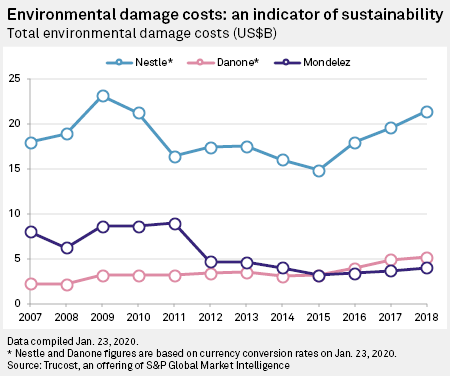
To measure the impact in dollar terms, Trucost says it uses estimates from published academic studies to calculate the financial cost of different types of environmental harm and thus arrives at “the consequential costs borne by society.” These are costs a company would at least partially be on the hook for, were it required to pay them. For investors, they increasingly represent material risks.
Trucost noted that there were some discrepancies in Nestlé’s 2016 and 2017 greenhouse gas emission, or GHG, data and similar figures for Danone in 2014 and 2015. However, it maintained that the overall trend observed in the 2007-2018 period was not undermined by the inconsistencies. Trucost said it had asked Nestlé’s and Danone for further clarification on the discrepancies, but did not get a response.
Nestlé is the world’s largest food and drinks company, and its annual revenue of CHF91.44 billion in 2018 was more than triple the revenue for either Mondelez or Danone. So it is no surprise that the maker of KitKat and Gerber baby food has a far greater environmental impact in absolute terms across its supply chain. That impact is rising: measured financially, Nestlé’s annual damage to the environment dropped from CHF22.37 billion in 2009 to CHF14.40 billion in 2015, before rising again to reach CHF20.71 billion in 2018.
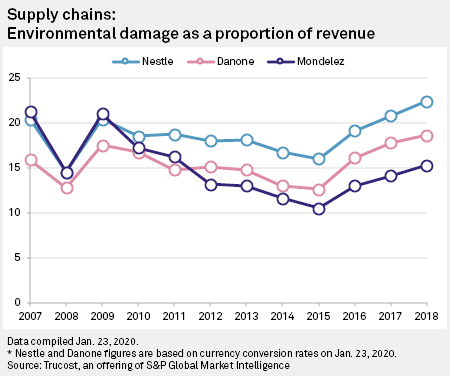
“Trucost methodology looks into environmental performance as a proportion of revenue,” a spokeswoman for Nestlé said in an emailed response. “To consolidate our environmental performance, we use operational control not a financial control. Thus, we use indicators per unit of production volume which provide with more consistent results for our sector.”
Nestlé does not publish data calculating its overall environmental impact across the entire supply chain, but it does closely measure the impact of its own, directly controlled operations. On that front, the Swiss company has made significant strides. According to Nestlé data, its factories’ total water withdrawal (in cubic meters) per ton of product fell 35.1% between 2008 and 2018, while its factories’ direct and indirect GHG emissions (measured in kilograms of CO2 equivalent) per ton of product fell 37.2% over that same period. Nestlé also noted that in 2018, 293 of its 400 factories had achieved zero waste for disposal and that 34% of its electricity came from renewable sources.
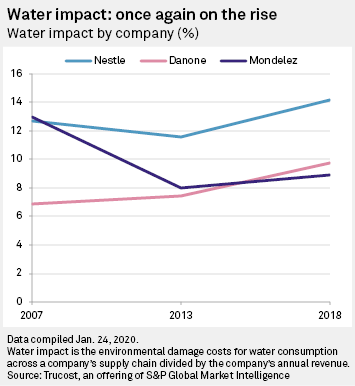
Heavy water use is a particular concern. Many companies around the world are now reporting water risks as withdrawals from freshwater resources climb at a worrying rate. That especially applies to packed food manufacturers, whose single biggest environmental impact is their supply chains’ impact on local water supplies.
For example, milk production accounts for more than two-thirds of Danone’s extended water footprint. To safeguard that milk supply, Danone says on its website that it “strives to protect broader water ecosystems in the places where we operate, especially when these areas are water-stressed.” It is working with The Nature Conservancy and other partners to put water fund models in place in water-stressed areas including Mexico, France, China and Indonesia.
The water gap has widened. In 2009, when Danone’s revenue was €16.24 billion, its supply chain’s external cost for water use was €1.40 billion, according to an analysis of Trucost data. In 2018, corporate revenue increased 52% to €24.65 billion but the supply chain’s water-related impact increased by a much larger 72% to €2.4 billion.
In its annual financial report for 2018, Danone said it had done a water risk assessment across 20 countries and over 8,000 farmers that led to a “detailed map of suppliers and dairy farms in potentially water-stressed areas under a 2030 scenario. The assessment drilled down into the details, looking at animal feeding methods … to pinpoint where the company might be able to reduce its water footprint.”
Mondelez is Kraft Foods Inc.’s former snacks business that was spun off into a stand-alone publicly traded company in 2012. Trucost figures prior to 2012 represent Kraft overall, before the spinoff. Today, Mondelez continues to rely heavily on water, and its website notes: “Our goal is to reduce absolute water use by 10% at priority manufacturing sites where water is most scarce.”
It might need to do more to hit its goal. Between 2013 and 2018, Mondelez’s revenue fell 26.5%, while the external cost of water used by its supply chain fell by a smaller 18.3%.
Trucost’s aforementioned GHG measure captures carbon intensity — the amount of greenhouse gases emitted by the supply chain for every million dollars of revenue earned by the company. The footprint is measured in financial terms. Nestlé’s direct and supply chain GHG footprint in 2009 was CHF912.5 per million Swiss francs of revenue reported. That figure rose to CHF1,047 in 2011 and dropped sharply to CHF776.3 in 2015. Then the GHG footprint reversed course, rising from CHF813 in 2016 to CHF839.7 in 2018.
A figure such as CHF839.7 of GHG damage for every million Swiss francs of revenue may not seem like much, but in the context of the CHF91.44 billion in revenue that Nestlé generated in 2018 alone, the impact on society is not insignificant.
“These companies’ business model depends on the sustainability of their supply chains,” said Ignacio Gavilan, environmental sustainability director at the Consumer Goods Forum, a network of consumer companies. “It’s in their own interest to do the right thing.”










