







The 2011 tsunami in Japan was one of the forces behind the electronics supply chain’s dedication to resilience – the ability to shift all or part of a supply chain as needed. That means people, materials, manufacturing lines, suppliers and even physical processing and aid centers. Global businesses now have entire departments dedicated to business continuity.
Nevertheless, experts predict the supply chain disruption from China’s coronavirus outbreak could last three to six months. The city of Wuhan, ground zero for the outbreak, is an important, global economic hub. Wuhan’s GDP reached $213 billion as of 2018 as the region moved to high-end manufacturing – everything from chip making to biomedicine, according to Bindiya Vakil, CEO of supply chain solutions provider Resilinc. Half of the Fortune 500 businesses have operations in that region.
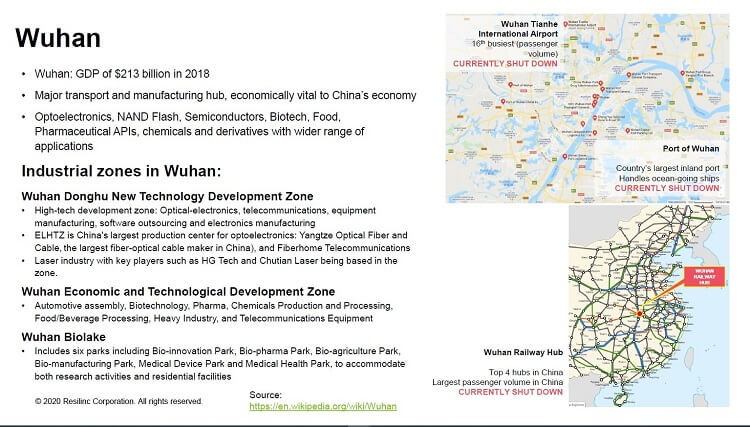
“Optoelectronics, semiconductors, chemical, life sciences and many of China’s advanced chip manufacturing plants are in Whuan,” Vakil said on a recent webinar. “We do expect NAND flash memory to have capacity constraints, and there are other notable manufacturers such as Foxconn and Jabil there.”
Electronics distributors are poised to ship products as soon as China’s borders open, Mike Long, CEO of Arrow Electronics Inc., told analysts during an earnings conference call. Arrow has no problem with inventory, he added, but it currently can’t be moved in and out of China. Borders reportedly will reopen on Feb. 10, and manufacturers such as Foxconn plan to resume production immediately. “We all hope that is true,” Long said.
Complicating matters is the celebration of the Chinese New Year, during which many businesses scale back production. The Chinese government has extended the normally two-week holiday by at least another week.
“Predicted supply chain disruption is one thing, but unexpected [disasters] with no clear light at the end of the tunnel is quite different,” one source told EPSNews. “We’re hearing about shortages in semiconductor materials already, about people trying to shift production at short notice. This is a prime example of the need for a robust and agile supply chain with a digital thread, so you can see in real time what is going on.”
The most optimistic forecasts predict “normalcy” returning by April.
What businesses can do
A Harvard Business Review Analytic Services (HBRAS) study commissioned by Basware found that businesses worldwide lack transparency in their supply chains. The majority of the 800 business leaders surveyed (60 percent) warn that poor visibility of who they do business with is a significant source of risk. Nearly a quarter (24 percent) admit they fail to effectively evaluate supplier business practices, with 45 percent citing manual processes that lead to incomplete data entry as a key cause.
Standing still is not an option for a technology industry renowned for innovation. Resilinc and other supply chain consultancies emphasize advanced planning as the basis of a resilient supply chain. If that hasn’t taken place, companies can still take steps to mitigate the impact of the outbreak, according to Resilinc:
- Develop and model likely scenarios, generate cross-functional playbooks for simulated scenarios
- Look outside your own organization: Don’t forget, your suppliers are part of your plan
- Communicate: Proactively notify leadership, customers and board about how the organization is preparing. Anticipating worst case and planning builds confidence
- Train: Set clear triggers for action, communicate with stakeholders (develop governance model, stakeholder touchpoints)
- Connect the dots: Ensure plans by various functional groups are in sync, hand-offs and dependencies are identified and incorporated into playbooks
- Joint planning with suppliers: Assess your suppliers’ pandemic planning preparedness measures, connect the dots to your own. Collaborate on realistic expectations
- Continuously monitor and adjust: Create internal updates, messaging and communicate cadence and discipline
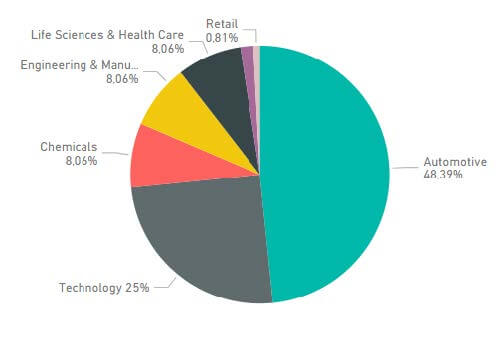
Locations in Wuhan and surrounding areas by industry sector; Source: Resilience360
Global logistics providers such as DHL have been working on disaster-management plans for years. The supply chain’s sphere of influence ranges from individual package delivery to materials flown into factories. But customer-facing organizations are on the front line when something goes wrong.
DHL’s Resilience360 visibility platform also offers recommendations to help supply chain managers mitigate further disruption to their operations:
Short term
- Identify key suppliers in areas affected by the lockdowns: Customers should start to analyze whether any of their critical suppliers, distributors, or warehouses are located within one of the lockdown areas in Hubei Province or in one of the affected areas, such as in Shanghai, Zhejiang, Jiangsu or Guangdong, and may be impacted by an extended production shutdown after the Lunar New Year.
- Secure alternative sources and increase inventory levels: Knowing the suppliers most exposed and vulnerable to the current situation can significantly reduce the response time needed to activate mitigation measures and leverage time as a competitive advantage when deciding to secure alternative sources from elsewhere in or outside of China and increase inventory levels. Although countries like Vietnam or Taiwan also celebrate the Lunar New Year, production is not halted entirely or for as long as in mainland China.
- Educate internal staff and key suppliers: Organizations should educate their staff as well as their key suppliers about the symptoms of the virus and enforce precautionary measures such as taking sick leave if symptoms show. Lost productivity from the absence of several employees due to sick leave can be significantly less expensive than a possible downtime from closing an entire plant because of sick employees or from disinfecting the site.
Long term
- Monitor potentially disruptive supply chain risks: Use real-time supply chain risk monitoring tools to continuously keep abreast of further developments regarding the city lockdowns, government shutdowns of industrial areas as well as potential transportation disruptions and assess its impact on one’s own manufacturing and logistics networks.
- Be mindful of using dual-sourcing strategies for key components: Reducing the number of suppliers has become a norm to allow for more strategic relationships with a handful of key suppliers. However, given the expanding nature of supply chain risks, firms should consider undertaking a strategic cost- benefit analysis to assess if the added cost of sourcing from different geographical locations and alternative suppliers can be worthwhile to prevent future shutdowns.
- Draft and test contingency plans for a supplier outage: Companies should make contingency plans in case a plant is, for instance, quarantined because of the virus. In the long term, it is recommended to set up good business relationships with logistics providers or contract manufacturers that have the capability to transport or manufacture similar products in nearby regions or countries.
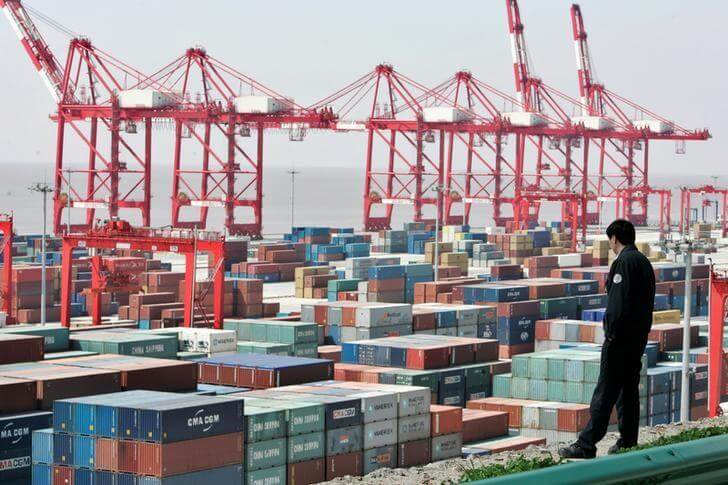
Source: Reuters
Accounts from inside and outside of China point to a global economic disruption from the coronavirus, but experts have yet to determine how extensive it will be.
“Two crucial mechanisms will decide the economic impact of the coronavirus – scope and uncertainty,” said Patrick Gourley, Ph.D., assistant professor of economics in the University of New Haven’s College of Business. “The first is straightforward. China is the key player in the international supply chain for thousands upon thousands of goods. ‘Made in China’ has become so ubiquitous it is the expectation for many of the durable products American consumers buy on a daily basis.”
The quarantine over the Wuhan area in China has the potential to disrupt many of these supply chains depending on its geographical size and duration, he added. The second, and more nebulous concern, is uncertainty in the financial markets.
“Thus far, China appears to be more forthcoming than they were during the 2002 SARS outbreak,” said Gourley. “The genome of the coronavirus has already been sequenced, and China has learned that cooperation and transparency are in their long-term interest. At the same time, there is still a question of how transparent China is willing to be. Until the disease appears to be waning, financial markets may pause, especially regarding companies that depend on China for production.”










