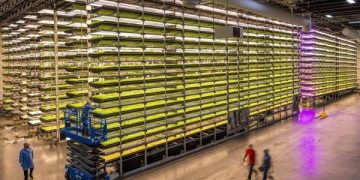







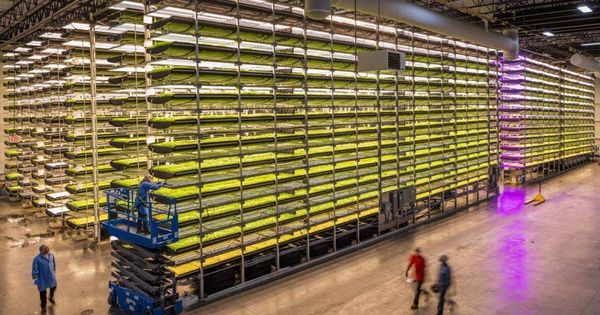
Indoor vertical farming has been around for quite some time, but leading companies in this industry are starting to garner a great deal of attention from the business press even as investors have poured money into the industry. As the world population continues to expand, so too does the amount of fruits and vegetables needed to feed the world. We are not creating new farmland to accommodate the increase in fresh food required. Vertical farming can be part of the solution to this problem.
Vertical Farming is a High-Tech Endeavor
Vertical farming is the practice of growing crops in vertically stacked layers. Vertical farming incorporates controlled-environment agriculture, which is a fancy way of saying that it provides protection and maintains optimal growing conditions throughout the development of the crop.
At the leading firms, vertical farming is a big data, high tech endeavor. At AeroFarms, a leader in the space, their plant scientists monitor millions of data points every harvest. The company says their LED lights are used “to create a specific light recipe for each plant, giving the greens exactly the spectrum, intensity, and frequency, they need for photosynthesis in the most energy-efficient way possible.” This lighting allows them to control size, shape, texture, color, flavor, and nutrition of their plants.
The company has received $100 million in venture capital and has two patents. The titles of their personnel sound much more like what you would find at a high-tech company than at a big farm conglomerate. They have a chief technology officer, engineers, scientists, risk managers, and even a director of intellectual property.
Why Vertical Farming?
As with any new or emerging technology, there needs to be benefits. Vertical farming has proven itself to beneficial in different way. In recent years, there have been a number of E. coli outbreaks from green, leafy vegetables. What many people may not have realized was just how the outbreak occurred. In most cases, the E. coli outbreak was related to washing practices of the vegetables. With vertical farming, this is a moot point; vertical farming is dirt-free and requires no washing of the vegetables. This alone can prevent foodborne illness outbreaks.
Vertical farming can assist in achieving maximum yields. First, plants only need about 10 minutes of darkness a day. Getting light all day long allows the plants to grow faster. Also, traditional farmers usually apply fertilizer once, water the crop and hope it grows. AeroFarms, meanwhile, applies fertilizers many times, adjusting along the way to optimize plant growth. AeroFarms at one point said they were making fertilizer adjustments every 15 minutes. They also tightly control humidity and water consumption.
Vertical farming enables more harvests throughout the year. Since harvests are not climate related, they can be done year-round. For some fruits and vegetables, this means having up to 30 harvests in a year rather than five or six. Consumers no longer have to wait for produce to be “in season.” There is also no worry about spoilage due to weather conditions, which enables maximized production.
Sustainability is a top concern for consumers and companies alike. Vertical farming plays a significant role in sustainability efforts as well as the greater good of the earth. According to recent studies, vertical farms use up to 70 percent less water than traditional farms. Additionally, given their isolated nature, pesticides and herbicides are not needed to thwart would-be pests.
Vertical Farming and the Farm-to-Fork Supply Chain
The benefits mentioned above do not even take the supply chain into account. From a supply chain standpoint, there are two major benefits to vertical farming.
First and foremost, vertical farms can reduce the number of miles fresh fruits and vegetables must travel in order to reach supermarket shelves. This also reduces fuel consumption, driving down the total cost to consumers. Studies have shown that the US imports about 35 percent of the produce that lands on supermarket shelves, with the average item traveling 2,000 miles. With this distance traveled, the produce has been picked roughly two-weeks before consumers can get their hands on it. Even for domestic produce, the time and cost to pick, pack and ship the produce from California to the East Coast is five to seven days. However, with a smaller footprint, vertical farms can be set up in urban areas, allowing for fresh produce to get to the shelf faster.
Secondly, as alluded to in the previous paragraph, less space is required for vertical farming. Every square meter of floor space of vertical farming produces approximately the same amount of vegetable crops as 50 square meters of conventionally worked farmland. According to a recent report by Cushman & Wakefield PLC., over the next few years, warehouse supply will outpace warehouse demand. This means that excess warehouse space could be turned in to vertical farming facilities. The use of vertical farms in densely populated places can get more fresh produce on supermarket shelves faster and could even spur home delivery to consumers. Think of it as a vertical farm share.
Of course, there are downsides to vertical farming as well. For instance, the start-up cost to get a facility up and running is a deterrent to many would-be vertical farmers. Also, while water consumption is significantly reduced, there is still the problem of using energy to run the facility. While traditional farms rely on natural sunlight, vertical farms do not. Renewable energy sources are one way these companies can try to offset the cost and environmental impact of traditional energy. And LED lights are becoming more efficient at a rapid pace.
The economics of vertical farming should not be overstated. Wegman’s organic kale sells for $2.89 for a five-ounce container. Dream Greens, an AeroFarm brand, Baby Kale retails for $4.50 at Shoprite. The premium some consumers are willing to pay appears to be more related to the quality, freshness, and the health benefits of these products.
Final Thought
Traditional farming is clearly not going away any time soon. In fact, if it did, the world be in a whole lot of trouble. However, as the population continues to grow, and more emphasis is put on environmental sustainability, vertical farming can help to fill that void. Vertical farms have shown the ability to eliminate foodborne illness outbreaks (especially E. coli), maximize crop yields, and reduce water consumption. From a supply chain standpoint, vertical farms are reducing the miles on our fresh produce as well as getting it on our shelves faster. The future of vertical farming looks bright. It will be an interesting market to watch over the next few years.
The primary author of this article was Chris Cunnane, a Research Director for Supply Chain Management at the ARC Advisory Group.