






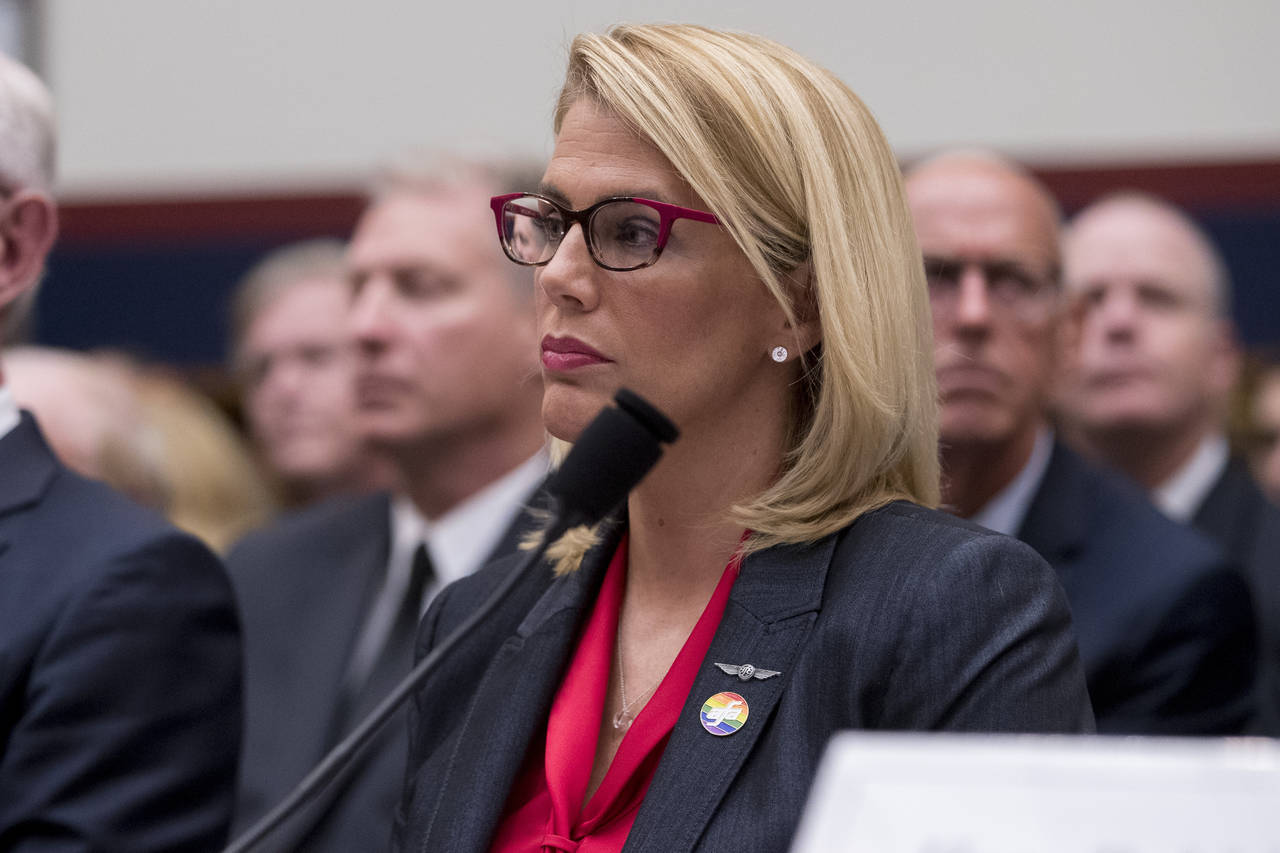
In this June 19, 2019, photo Sara Nelson with the Association of Flight Attendants-CWA appears before a House Committee on Transportation and Infrastructure hearing on the status of the Boeing 737 MAX on Capitol Hill in Washington. (AP Photo/Andrew Harnik)
The airline industry is among the most heavily unionized in the U.S. economy, and union members are seeking a bigger share of the airlines’ multibillion profits.
Sara Nelson, the president of the Association of Flight Attendants, says too many employees — especially at the smaller regional airlines — struggle to get by. She says there could be wildcat strikes despite a federal law that makes it nearly impossible for airline unions to conduct legal walkouts.
Nelson talked recently to The Associated Press. Her remarks have been edited for length.
Q. After losing billions, U.S. airlines have been very profitable over the last 10 or so years. How does that affect what workers want in contract negotiations?
A. Airline employees took incredible cuts during the bankruptcies (from 2001 through 2013) — 30% to 40% cut in pay, loss of pensions, a shift of costs and burden for health care — and not all of that has been recovered. Our staffing has been cut to minimums so that we are working harder than ever when we are at work, and we are all working longer hours to make the same amount of pay. The airlines are profiting in the billions of dollars, and we expect our fair share.
Q. Labor is already the biggest cost at most airlines. Should they be spending even more?
A. Labor investment has not rebounded to what it should be now that the airlines are making a substantial profit again. What has increased is the amount of stock buybacks that the airlines have announced. If you even took half of that and invest it in labor costs, it would make a huge difference for hundreds of thousands of employees.
Q. Many of your members own company stock, some get profit-sharing. How much responsibility do they feel to help the airlines prosper?
A. Every airline employee wants the airlines to do well and make a profit. They understand inherently that their paycheck depends upon that. … When the major decision-making for the business is centered in Wall Street and they’re talking about the short-term gains, decisions can be made for the airlines that are not good for its long-term success. I would say that the employees are more invested in the success of the airline than the boardroom or the shareholders or the investors. In many cases, the employees are the best advocates for the management who are trying to rebuild an airline network and plan for its long-term success.
Q. After losing before, your union is trying again to organize flight attendants at Delta Air Lines. How is that going?
A. I’m positive that this is going to be a successful organizing drive. There are some key factors that have changed since the last time we had a vote in 2010. More than 40% of the seniority list has been newly hired since that last election, and there is a general positive view of unions in this country, led by the youngest generation. So all of those factors lead to really ripe conditions for organizing at Delta.
Q. Contract negotiations seem to take longer and often wind up in federal mediation. What’s going on?
A. Airline management has come to believe that they can stall negotiations and actually put off increasing labor costs by doing so. They are absolutely emboldened by the position of the Trump administration in really taking the side of management and not helping to bring negotiations to a close. There is a breaking point on that though — this doesn’t help morale.
Q. Will we see an airline strike in the near future?
A. The Railway Labor Act provides a fairly fulsome right to strike for employees. The issue is accessing that right to strike, and this administration has not shown any any desire to give workers that right to strike. There is, though, a point at which it just becomes too much for people. And at a certain point, laws are not going to stop workers from standing up. There is a natural backlash to workers being pushed too far and feeling a common cause together and taking action on their own.
Q. So, there could be wildcat strikes if workers feel desperate?
A. I should be very clear that that’s not what I’m advocating for in any way, but that is the growing sentiment. I think it’s something that needs to be taken very seriously by everyone who is in a leadership position in this industry.
Q. Are flight attendants afraid to get back on the Boeing 737 Max?
A. Our members are very skeptical about getting back on the 737 Max. That’s not new news. We have been very clear that trust was really broken in this process. Flight attendants need to see that pilots and engineers and worldwide regulators and our airlines are all on board with (Boeing’s fix for the plane) and the plan to return it to service. We need to be able to explain to the traveling public what that fix is and that we feel confident in getting back on the plane.
Q. Flights are crowded and planes have more seats. Is the job of a flight attendant getting harder?
A. The passengers’ travel space is our workspace. So we have a real concern over how comfortable passengers are because it directly relates to their experience, their mood and how much time we need to spend with de-escalating conflict and resolving these concerns. And it is harder to do all of that because we have 25% to 50% less staffing on domestic flights and we are seeing cutbacks on staffing on international flights, too. So, yes, our jobs are harder than they have ever been because each one of us is doing more with more people on board in conditions that lead to greater conflict.
Copyright © The Associated Press. All rights reserved. This material may not be published, broadcast, rewritten or redistributed.










