

• Latest
  • Trending
  • All
Coronavirus Shakes World’s Tech Supply Chain

Coronavirus Shakes World’s Tech Supply Chain

February 10, 2020
Last Mile Delivery Market Worth Observing Growth | UPS, FedEx, SF Express

Last Mile Delivery Market Worth Observing Growth | UPS, FedEx, SF Express

April 23, 2024
Top 5 Spend Analysis Software ranked in 2024

Top 5 Spend Analysis Software ranked in 2024

March 1, 2024
How Tesla And BMW Are Leading A Supply Chain Renaissance With Blockchain

How Tesla And BMW Are Leading A Supply Chain Renaissance With Blockchain

January 19, 2024
LATAM Cargo strengthens European cargo links

LATAM Cargo strengthens European cargo links

April 14, 2020
Ford making reusable hospital gowns from airbag materials as efforts against coronavirus expand

Ford making reusable hospital gowns from airbag materials as efforts against coronavirus expand

April 14, 2020
Don’t Sweat NBC’s Decision to Cut Back on Television Ad Inventory

Don’t Sweat NBC’s Decision to Cut Back on Television Ad Inventory

April 14, 2020
Software firms sharpen focus on AI, big data as IT spending drops

Software firms sharpen focus on AI, big data as IT spending drops

April 14, 2020
Navigating turbulent times in your supply chain (TL:DR version)

Navigating turbulent times in your supply chain (TL:DR version)

April 14, 2020
Last Mile Delivery by Drones Market is Booming Worldwide

Last Mile Delivery by Drones Market is Booming Worldwide

April 14, 2020
AIR CARGO MARKET SIZE, SHARE, DEMAND, TREND, LATEST INNOVATIONS & APPLICATION ANALYSIS AND INDUSTRY GROWTH FORECAST 2027 – Science In Me

AIR CARGO MARKET SIZE, SHARE, DEMAND, TREND, LATEST INNOVATIONS & APPLICATION ANALYSIS AND INDUSTRY GROWTH FORECAST 2027 – Science In Me

April 14, 2020
Wheat procurement in Patiala: 6,500 coupons issued to farmers – cities

Wheat procurement in Patiala: 6,500 coupons issued to farmers – cities

April 14, 2020
Pandemic, Plastics And The Continuing Quest For Sustainability

Pandemic, Plastics And The Continuing Quest For Sustainability

April 14, 2020
  • Supply Chain
  • Logistics
  • Warehousing
  • Procurement
  • Shipping
  • More
    • Strategic Sourcing
    • Spend Analysis
    • Inventory
    • Contact Us
No Result
View All Result
United States International Supply Chain Commission
Home Supply Chain

Coronavirus Shakes World’s Tech Supply Chain

by usiscc
February 10, 2020
in Supply Chain
0
Coronavirus Shakes World’s Tech Supply Chain
493
SHARES
1.4k
VIEWS
Share on FacebookShare on Twitter

On any normal morning, thousands of workers stream in and out of the huge gates of Foxconn Zhengzhou Science Park, a 1.4 million square meter compound in the central Chinese province of Henan.

But on Tuesday, there was only one man at the gates: a customs official standing guard. As Chinese authorities scramble to contain an outbreak of novel coronavirus, factories have been ordered to remain shut following last week’s lunar new year holiday. This heart of the global technology supply chain has stopped beating. 

This episode is going to make it even clearer to Apple that there is overconcentration in China and they may want to address that.

Don Yew, analyst, Morningstar, Singapore

The customs inspectors normally make it easy for Apple to quickly export the smartphones made here — the world’s largest iPhone factory — each day. But the official did not know when work at the plant would resume. With its heavy reliance on production networks in China and outsourcing geared toward just-in-time shipments, the technology industry is among the hardest-hit by the disruption of normal economic life. 

“Since the top provinces in terms of infections include Zhejiang, Guangdong and Henan, which are so important for tech manufacturing, there obviously is a big problem,” says Don Yew, an analyst at Morningstar in Singapore. “This episode is going to make it even clearer to Apple that there is overconcentration in China and they may want to address that.” 

If Foxconn is unable to restart production soon, Apple will have to delay the launch of its next iPhone, planned for March, by several weeks, Yew adds. Foxconn declined a request for an interview about the impact of the outbreak on its business “due to time constraints.” Apple did not immediately respond to a request for comment.

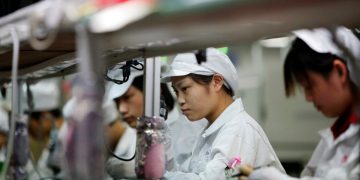
This photo taken on May 27, 2010 shows C

Foxconn still hopes to resume operations this week but the municipal government has announced that anyone arriving in the city from elsewhere in the province would have to self-quarantine at home for seven days. Those arriving from provinces where the epidemic is more severe would be required to isolate themselves for 14 days. The company has already reduced its internal forecast for revenue growth from an expectation of up to 5 percent to under 3 percent. 

The apartment complexes where the factory
workers live near Zhengzhou have closed all but one entrance, which is
monitored by security guards. Workers who have been to Hubei province, where
the outbreak started, are not allowed out. Others can leave and return but are
not allowed to gather in groups, according to Jin Boyang, a member of the local
epidemic control committee.

Foxconn has large plants in more than a dozen other Chinese provinces, and global tech companies including Apple, Huawei and Samsung have several other manufacturing partners, such as Pegatron and Wistron. 

Most of that capacity is located in regions that are under the same kind of restrictions as Henan. Even if customers wanted to shift orders elsewhere, it would take several months, experts say. “This requires engineers from the customer companies spending some time on-site, but right now many pull their engineering staff out and reduce travel,” says an executive at a Taiwanese component maker. 

The raft of quarantine rules and
transport restrictions announced by authorities at different municipal levels,
and differences in how they are implemented, have caused further
confusion. 

“It is unclear when work will restart and whether we can go back then,” says Li Yi, an employee of Biel Crystal, a screen supplier for Apple’s iPhone headquartered in Hong Kong. He says management at the company’s factory in Huizhou, in Guangdong province, had told workers not to return before Feb. 10. “I can’t go back even then,” Li says, who is stuck in his hometown of Jingzhou, one of the 15 cities in Hubei province under lockdown.

Some companies are less vulnerable in the short term. Semiconductor and liquid crystal display (LCD) panel fabrication plants, or fabs, do not stop operations during holidays because of the huge costs of halting some production equipment.

But the display industry is hugely exposed to Wuhan itself, where five display fabs are located. BOE Technology, the world’s largest LCD panel maker which accounts for 17 percent of global supply, started ramping up its Wuhan facility only in November. The company’s plan to start mass production in January has been hit by the virus outbreak. 

This could help ease a supply glut. “We will see a price increase of at least $1 to $2 this month for panels under the size of 65 inches,” says Eric Chiou, a display expert at TrendForce, a tech sector research company. 

Some believe the current crisis will
bring much larger changes. 

Wilbur Ross, the U.S. commerce secretary, sparked controversy last week when he said the crisis could provide a boost to the American economy as companies move some operations and jobs back from China.

“This may become the straw that breaks the camel’s back,” says Nick Vyas, an expert on global supply chain management at the University of Southern California Marshall School of Business. “Since it is China and lacks transparency, there is added uncertainty and fear. Given how we have streamlined things and reduced inventory and grown more globally intertwined, this produces end-to-end disruption. 

“This outbreak will force them to factor
the cost of failure into their calculation, and might well strengthen the case
for more onshore or near-shore operations,” he added.


+

By Kathrin Hille, Ryan McMorrow and Qianer Liu

OZY partners with the U.K.’s Financial Times to bring you premium analysis and features. © The Financial Times Limited 2020.


Share197Tweet123
usiscc

usiscc

  • Trending
  • Comments
  • Latest
Escape From Tarkov – How to Rotate Items

Escape From Tarkov – How to Rotate Items

February 5, 2020
Supply chain examination: Planning for vulnerabilities you can’t control

Supply chain examination: Planning for vulnerabilities you can’t control

December 7, 2019
Procurement Project Manager job with Camden London Borough Council

Procurement Project Manager job with Camden London Borough Council

February 17, 2020
Art Battle Wichita Falls III at The Warehouse, 1401 Lamar.

Art Battle Wichita Falls III at The Warehouse, 1401 Lamar.

0
Global Industry Analysis, Size, Share, Growth, Trends, and Forecasts 2016–2024 – ZMR News Reports

Global Industry Analysis, Size, Share, Growth, Trends, and Forecasts 2016–2024 – ZMR News Reports

0
PHOTOS: Ottawa firefighters respond to warehouse fire

PHOTOS: Ottawa firefighters respond to warehouse fire

0
Last Mile Delivery Market Worth Observing Growth | UPS, FedEx, SF Express

Last Mile Delivery Market Worth Observing Growth | UPS, FedEx, SF Express

April 23, 2024
Top 5 Spend Analysis Software ranked in 2024

Top 5 Spend Analysis Software ranked in 2024

March 1, 2024
How Tesla And BMW Are Leading A Supply Chain Renaissance With Blockchain

How Tesla And BMW Are Leading A Supply Chain Renaissance With Blockchain

January 19, 2024
  • Privacy Policy
  • Terms of Use
  • Disclaimer
  • DMCA
  • Contact Us

Copyright © 2024 United States International Supply Chain Commission (usiscc.org)

This website uses cookies to improve your experience. We'll assume you're ok with this, but you can opt-out if you wish. Cookie settingsACCEPT
Privacy & Cookies Policy

Privacy Overview

This website uses cookies to improve your experience while you navigate through the website. Out of these cookies, the cookies that are categorized as necessary are stored on your browser as they are essential for the working of basic functionalities of the website. We also use third-party cookies that help us analyze and understand how you use this website. These cookies will be stored in your browser only with your consent. You also have the option to opt-out of these cookies. But opting out of some of these cookies may have an effect on your browsing experience.
Necessary
Always Enabled

Necessary cookies are absolutely essential for the website to function properly. This category only includes cookies that ensures basic functionalities and security features of the website. These cookies do not store any personal information.

Non-necessary

Any cookies that may not be particularly necessary for the website to function and is used specifically to collect user personal data via analytics, ads, other embedded contents are termed as non-necessary cookies. It is mandatory to procure user consent prior to running these cookies on your website.

SAVE & ACCEPT
No Result
View All Result
  • Supply Chain
  • Logistics
  • Warehousing
  • Procurement
  • Shipping
  • More
    • Strategic Sourcing
    • Spend Analysis
    • Inventory
    • Contact Us

Copyright © 2024 United States International Supply Chain Commission (usiscc.org)






