






Teetering on the precipice, countries across the world are desperately seeking a resolution for the ongoing and hastening threat of climate change. But with technologies such as the industrial internet of things (IIoT) already reducing carbon emissions and boosting energy efficiency across industries, the bigger picture could start to look a little more promising.
How IoT can help combat climate change
Industrial IoT measures the impact of industrial processes and human activity through sensors that can monitor a whole range of factors, including everything from air and water quality, to assessing pollution levels around factories, rivers and cities. The technology can also identify the more indirect impacts of climate change by measuring things such as flood and river levels, wind speed, land erosion, the activities of bees and beehives, and tracking animals or vegetation in impacted areas.
“The internet of things is the digital skin of our planet,” says Alex Gluhak, head of technology (IoT) at Digital Catapult. “By measuring the real state of the world through sensors, we become aware of existing issues and can track them over time as we use specific interventions to combat these issues.”
Industrial IoT can also have a significant impact on reducing the carbon footprint of processes. It does so by minimising the use of natural resources, including raw materials, electricity, fossil fuels and water. Alongside this, the technology can reduce production waste and plays a key role in the tracking of material flow in the emerging circular economy.
Susanne Baker, associate director climate, environment and sustainability, at techUK, says: “IoT is increasingly recognised as an essential element in our transition to a net-zero economy.”
When combined with other digital applications, such as 5G and artificial intelligence (AI), IoT could help cut carbon by 15 per cent, according to the World Economic Forum.
“IoT can help make sense of the raw data produced every minute by the thousands of connected devices that make up business operations, supply chain and connected products,” says Andy Stanford-Clark, chief technology officer at IBM, UK and Ireland. “IoT technology, especially when paired with AI, can improve resource efficiency, reduce pollution, and stimulate new thinking and innovation.”
Where is IoT tech tackling environmental issues?
In farming, precision agriculture is used to minimise the use of water, fertiliser and pesticides. The technology monitors soil minerals, temperature and moisture. This helps improve and increase yields, and minimises the use of both resources and land. IoT sensors in the soil and environment, alongside the use of algorithms, or “grow recipes”, can improve the management of farm resources.
Industrial IoT could also help reduce the harmful impact of greenhouse gases produced by livestock. “There’s potential for reduced methane from ruminants through livestock health monitoring, for example monitoring dietary health and temperature of animals to identify and treat animals, which helps to reduce greenhouse emissions,” explains Dr Nilufer Tuptuk of the Department of Computer Science, University College London.
IoT is the digital skin of our planet
In the manufacturing industry, sensors are used to order products autonomically, thus optimising production. Industrial IoT is also being used to monitor the energy consumption of manufacturing equipment, enabling operators to identify inefficient equipment. Further precise monitoring of external factors can reduce errors, resulting in less waste and more efficient use of materials.
“Logistics companies can shorten delivery routes through intelligent route planning, tracking can shorten delivery times through new insights into the supply chain, products can be located, fewer products are lost, which ultimately has a positive effect on the climate by reducing total direct and indirect energy consumption,” says Pascal Vögeli of the ZHAW Zurich University of Applied Sciences, Switzerland.
In the energy and utilities market, smart street lighting is being used to reduce consumption, and leakage sensors in water and gas pipes are used to detect and repair losses caused by leaks.
Extension of the lifetime of goods can also be attributed to the introduction of IoT solutions. Predictive maintenance of goods, including cars, electrical goods and construction equipment can enable longer utilisation cycles. This means fewer breakdowns and replacements, and ultimately a reduction of waste. 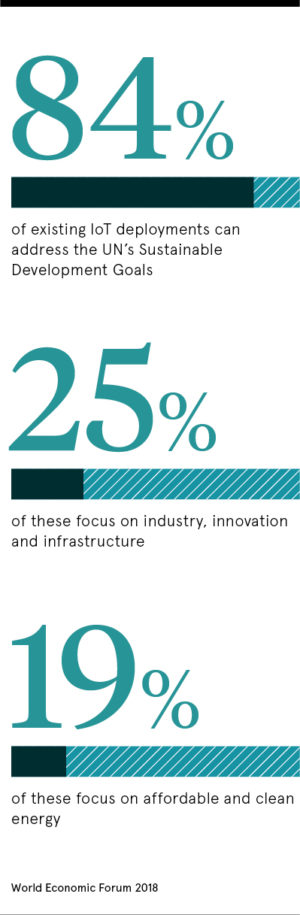
On the surface, Industrial IoT appears to generate only benefits. But the technology itself can contribute to product waste. That’s because millions or even billions of sensors, and their batteries, will need to be disposed of once their lifespans end.
Could IoT have an adverse impact?
“There’s the consideration that building IoT components themselves requires resources that might have an adverse effect on the planet,” says Digital Catapult’s Gluhak. “There is already a lot of research on energy harvesting for IoT devices to get rid of batteries completely or replace them with biodegradable materials.”
Gluhak believes that it’s only a matter of time before enough breakthroughs are made to minimise these potentially harmful environmental impacts.
However, there is also an argument to say that more efficiency, stimulated by emerging technologies like Industrial IoT, can result in more production and therefore more consumption.
“Any technology that supports efficiency and productivity improvements could in turn potentially drive higher levels of production and consumption,” says techUK’s Baker. “It is important therefore that these risks are properly understood in the context of our national and sector planning to move to a post-fossil-fuel society.”
The ability to cut waste, make better use of resources and reduce carbon emissions makes the deployment of IoT across industries a largely positive step towards combating climate change. But alone, the technology is certainly no silver bullet. It must be aligned with the right policies and actions to maximise its potential and be managed closely to ensure its benefits are not offset by lurking environmental flaws.










