






Berkshire Grey’s chief executive, Tom Wagner, used to work for the Pentagon as a robotics program manager. And he has hired several hundred people — he won’t be specific about the number — from top robotics companies like Amazon Robotics, DEKA Research & Development, iRobot, and Rethink Robotics.
“We are recruiting people from Silicon Valley to come here,” Wagner says proudly.
For the company’s first few years, Wagner says, the company was trying to keep such a tight lid on its plans that it was hiring robotics experts without telling them exactly what they’d be working on.
The problem that Berkshire Grey is trying to solve is one that you create every day. When you order a pair of ski goggles or a tube of sunscreen on your phone, you set in motion a process that involves a fair number of humans touching that item on its journey from where it is made to the warehouse where it is stored to a series of FedEx or postal facilities to your front door. And humans, from a logistical perspective, are problematic: They need training, they take lunch breaks, they belong to unions so they can’t work 24/7, and they get injured. Often, during crunch times — like the holiday shopping period — you can’t hire enough of them.
That’s one reason that in 2012, Amazon paid $775 million to acquire a Massachusetts startup called Kiva Systems. It wanted to reduce the amount of time humans spent walking the aisles of its warehouses to track down individual items, and instead use robots to transport the item that you ordered to a human standing in one spot, who would put it in a box. Amazon rebranded the company as Amazon Robotics, and today it has supplied several hundred thousand robots to the online retailer’s warehouses.
Amazon has been working for several years on how to automate the “putting it in a box” task. But it’s a big challenge for robots to both identify an item — ski goggles or sunblock? — and pick it up without damaging it. In 2015, Amazon started sponsoring a series of competitions that invited university teams and startups to build robots that were up to the task. Amazon dangled tens of thousands of dollars in prize money. Berkshire Grey opted not to participate.
“We already had all kinds of answers that other people had not found,” Wagner says, “and we still have answers others haven’t found. There was no reason for us to share or show what we were developing.”
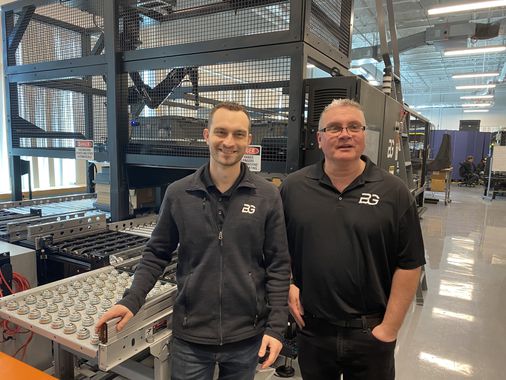
Berkshire Grey doesn’t plan to manufacture its own robots, cameras, or conveyor belts; it is designing new warehouse automation systems, and will have contract manufacturing partners build the actual gear. Berkshire will then assemble, test, and ship complete finished systems to customers, and install them on-site with its own teams of employees. The company’s “secret sauce,” Wagner says, is custom-crafted software, and a set of cameras and sensors on an industrial robotic arm that enable it to identify and pick up a wide range of items, from jars of Marshmallow Fluff to T-shirts in plastic bags to mesh shower loofahs. At the end of the robotic arm is a vacuum-powered suction cup, rather than anything that resembles fingers. When it needs to, the robot can “auto-swap” one kind of suction cup for another, improving its ability to pick up a given item based on its weight or size, explains Kevin O’Brien, a senior program manager at Berkshire.
The system still isn’t perfect: In watching a short demo, I noticed that Berkshire Grey may have stacked the deck in its robot’s favor by sticking an extra UPC bar code on the items the robot was trying to identify. And when it couldn’t “see” one of the items sitting in a plastic bin, a human employee had to nudge the item into a different position; after that, the robot identified it and picked it up.
Wagner says that the company’s technology can be installed in a modular way — just automate a segment of warehouse activity — or purchased as a complete soup-to-nuts system. Without announcing it, the company has deployed hundreds of robots in the United States that have already touched millions of items on their way through the supply chain to the doors of customers. During my visit, three large robotic modules sat in Berkshire’s assembly and testing building being prepared to be shipped to the company’s first overseas customer facility. Wagner says Berkshire can’t disclose any of its customers: Installing this kind of technology “is about competitive advantage,” he says, and customers don’t want to tip their hand to rivals. Wagner says the company expects to be able to sell its technology to e-commerce companies, to companies that operate retail stores and also sell online, and to businesses that handle packages and run warehouses for customers, like FedEx and UPS.
Wagner, characteristically tight-lipped, won’t disclose the total amount of money that his company has raised. But the $263 million it brought in last month is likely the largest venture capital round a New England robotics company has ever raised. The lead investor is SoftBank, a Japanese tech conglomerate that has also put money into WeWork, Uber, and Slack. SoftBank also owns Boston Dynamics, the Waltham company best known for YouTube videos of humanoid and animal-inspired walking robots.
“It’s a stunning amount of money to raise for such an unheard of group,” says Charles Grinnell, chief executive of the agricultural robotics company Harvest Automation in North Billerica.
“Kiva-Amazon Robotics has been such a big thing, in terms of quantity of robots deployed and impact on operations that everyone is hoping to fund the next similar success,” says Bruce Welty, founder of Devens-based Quiet Logistics, which designs automated warehouses. While it’s an open question how many customers will want to spend the money (and time) to install one of Berkshire’s completely automated warehouse systems, Welty says that there remain “a lot of unautomated warehouses in the world, and the volume of goods is growing because of all these small e-commerce orders coming in from everywhere. No one in the industry feels like the potential is constrained in any way.”
But $263 million is a rather substantial chip to plunk down on the roulette table, and it’s clear the bettors expect a big return.
Scott Kirsner can be reached at [email protected]. Follow him on Twitter @ScottKirsner










