








The world’s biggest meat company has frequently been accused of links to deforestation. Now JBS is facing growing pressure from Brazilian politicians and environmentalists to address the information gaps and transparency failings in its supply chain.
Critics say these deficiencies mean JBS is unable to ensure it does not buy cattle from farms involved in illegal deforestation over a decade after promising to do so.
Senator Fabiano Contarato, who presides over the environment commission, has called for Brazil’s environment and agriculture ministers to attend a Congress hearing. “These facts are serious and they should be investigated rigorously,” he said. “This is a form of cattle laundering.”
Amid mounting outrage over damage to the Amazon from deforestation and fires linked to cattle farming, the meat company’s lack of transparency is increasingly out of step with global finance. The world’s largest asset manager BlackRock has now made sustainability integral to investing. The climate crisis dominated the 2020 World Economic Forum at Davos.
But JBS remains unable to monitor a significant proportion of its suppliers despite operating deep in the Amazon. It is a problem for the entire meat industry in Brazil, but other companies, such as Marfrig, have come clean about the scale of the issue, and are taking action to resolve it. Meanwhile, JBS has refused to answer direct questions about exactly how much of its beef comes from so-called “indirect suppliers”.
Further criticism has been levelled at the audits done on the JBS supply chain, which state openly that there is “no verification system” in place for indirect suppliers.
“This is totally against ethical principles in relation to its consumers,” said Marina Silva, a former environment minister who won international awards for reducing deforestation and called for a certification programme. “These audits end up as more of a smokescreen.”
Last year joint investigative work by the Guardian, Repórter Brasil and the Bureau of Investigative Journalism showed the way that global meat demand was driving Amazon deforestation and revealed that fires were three times more common in Amazon beef farming areas.
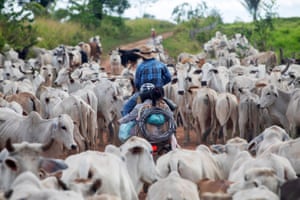
JBS operates sophisticated checks for cattle reaching its slaughterhouses from Amazon “full cycle” farms – where cattle are reared from birth to slaughter. These farms are also called “direct suppliers”.
“The JBS monitoring system in the Amazon covers more than 280,000 sq miles, an area larger than Germany, and assesses more than 50,000 potential cattle-supplying farms every day,” the company said. “To date, we have blocked more than 8,000 cattle-supplying farms due to noncompliance.”
But this is only part of the picture. JBS does not monitor indirect suppliers in its supply chain. These are farms where cattle are birthed, or those who sell to farms where cattle are fattened, who then sell on to other farms or to slaughterhouses.
Marfrig, JBS’s biggest competitor admits that half its cattle in the Amazon come from such suppliers, but JBS so far has refused to give figures to the Guardian’s direct question. And that, say environmentalists, prosecutors and researchers, is a big problem.
“Cattle supply chains are really fluid and producers can move between the different roles and commonly sell as both direct suppliers and indirect suppliers,” said Holly Gibbs, a professor of geography at the University of Wisconsin who has monitored Amazon cattle supply chains for a decade. Her research showed that 80% of direct suppliers in the Amazon bought from other properties – on average up to 15 of them.
“Direct suppliers often own multiple properties but only one is property is monitored,” she said. “The vast majority are either adjacent or within 1km.”
She compared the system to using air conditioning in a heatwave but leaving the windows open. “The cattle companies are monitoring direct suppliers but there are so many loopholes that the indirect suppliers can just come in and out,” she said.
Last year Marfrig told the Guardian that 53% of its cattle purchases came from indirect suppliers. But JBS refused to discuss how many of its cattle came from indirect suppliers and declined to make a spokesperson available for interview.
“JBS is committed to eradicating deforestation, ensuring sustainable livestock practices and improving the livelihoods of farmers in the Amazon region,” the company said by email. “We have worked for more than a decade on the frontlines, driving meaningful, responsible change in the region. We urge those who share the common goal of ending deforestation to seek solutions rather than criticism. We will only meet this collective challenge and preserve this important biome through collaboration and action.”
But the company has been making these promises for more than a decade. In 2009 a devastating report from Greenpeace led to JBS, Marfrig and Minerva (another Brazilian meat giant) signing a landmark cattle agreement with the environmental NGO. The meat companies promised not to buy from any direct suppliers involved in deforestation and to expand that commitment to include indirect suppliers within two years.
The same year federal prosecutors in Amazon states signed agreements with more than a dozen meat companies, including JBS, Marfrig and Minerva.
“It was a watermark,” said Greenpeace Brazil’s senior forest campaigner Adriana Charoux.
Deforestation fell afterwards, said Daniel Azeredo, a federal prosecutor who played a key role in the prosecutors’ deal.
But he noted: “It talked about the direct suppliers, those that sell to slaughterhouse, not those who sell to another farm.” A clause in the deal requiring companies to start monitoring indirect suppliers had no deadline, he said.
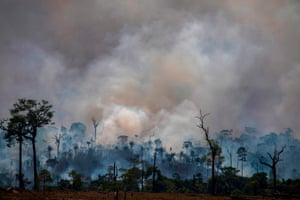
In 2017, JBS was fined R$24.7m (£4.2m) by Brazil’s government environment agency Ibama for buying 49,000 cattle in the Amazon state of Pará from illegally deforested areas – some via indirect suppliers. Following the fine, Greenpeace abandoned the cattle agreement. “Our credibility would have been completely at risk if we continued with them,” Charoux said.
The deal with prosecutors still stands, but Azeredo believes meat companies should be doing more. “All the companies working in the Amazon know that indirect suppliers is a serious problem,” he said.
When asked about these issues, JBS points journalists to the independent audits performed by Norwegian company DNV.GL, the latest of which reported that no irregularities relating to deforestation in 7,140 Amazon cattle transactions were found during 2018. The same company audits Marfrig.
But the 2019 audit added a caveat, as it also did in 2018. “Regarding indirect suppliers, JBS and the industry in general does not yet have in place a verification system in these cases,” it said.
Critics questioned an audit that failed to check out the entire supply chain. “Nobody is going to buy the animals if they don’t know where they are from, or if they are healthy,” said Prem Sikka, a professor of accounting and finance at the University of Sheffield. “If there is a trail, that makes the auditors’ omission even more damning.”
DNV.GL has been doing audits for Marfrig since 2011 and for JBS since 2018. “Our role is to assess adherence to the ‘minimum criteria for transactions with cattle and beef products on an industrial scale in the amazon biome’,” a spokesperson said in an email, referring to the terms of the deal with Greenpeace signed in 2009 – but crucially, not the promise to start monitoring indirect suppliers within two years, by 2011.
“Indirect suppliers’ information was requested, however the companies do not have this information,” DNV.GL said. “In both cases a non-conformity was raised.”
“In the case of indirect suppliers, JBS has not yet been successful in implementing traceability processes,” the audit’s “non-conformity” entry read.
Since 2013, Marfrig has used a self-declaratory mechanism called a request form of information (RFI) in which the farm delivering the cattle is required to supply the name of its supplier, including tax number and the name of the farm. A spokesperson said last year that 30% of its cattle supply from the Amazon came with the form, which it is working with the World Wildlife Fund and other non-profit groups to improve.
“For me, RFI is a good tool even though it is voluntary,” said Mauro Armelin, executive director of Friends of the Earth Brazil. “It has a good chance of success.”
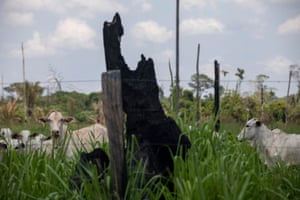
Armelin said monitoring systems could also make use of state and federal government information on cattle movements, produced for sanitary controls. But last year, the Brazilian government restricted access to sanitary control documents that had previously been accessible.
“It’s critical that this data stays available,” Gibbs from the University of Wisconsin said. “It’s very challenging to monitor indirect suppliers.”
DNV.GL stated that the government documents “are not public” and that JBS and other companies have been trying to get access to them from the ministry without success.
But other researchers have succeeded in accessing them in the past.Using these documents and information from Brazilian government registers and databases, University of Wisconsin researchers and the US National Wildlife Federation developed their own monitoring system: Visipec; a free cloud-based tool that can be plugged into cattle companies’ current monitoring systems.
“Increasingly, they’re open and there’s a lot of discussions happening,” Gibbs said of the meat companies. But so far, she said, not one of them has taken it up.
It was announced on Thursday that JBS is buying American meat-packing company Empire Packing Company for $238m (£185m).










