







World Benchmarking Alliance
There is now a general consensus that the private sector has a critical role to play in accomplishing the 17 Sustainable Development Goals (SDGs). Doing this is easier said than done, starting with the fact that 17 is a large number of variables to focus on. In addition, there are no well-established metrics to determine the extent to which a company is contributing to or detracting from any particular SDG.
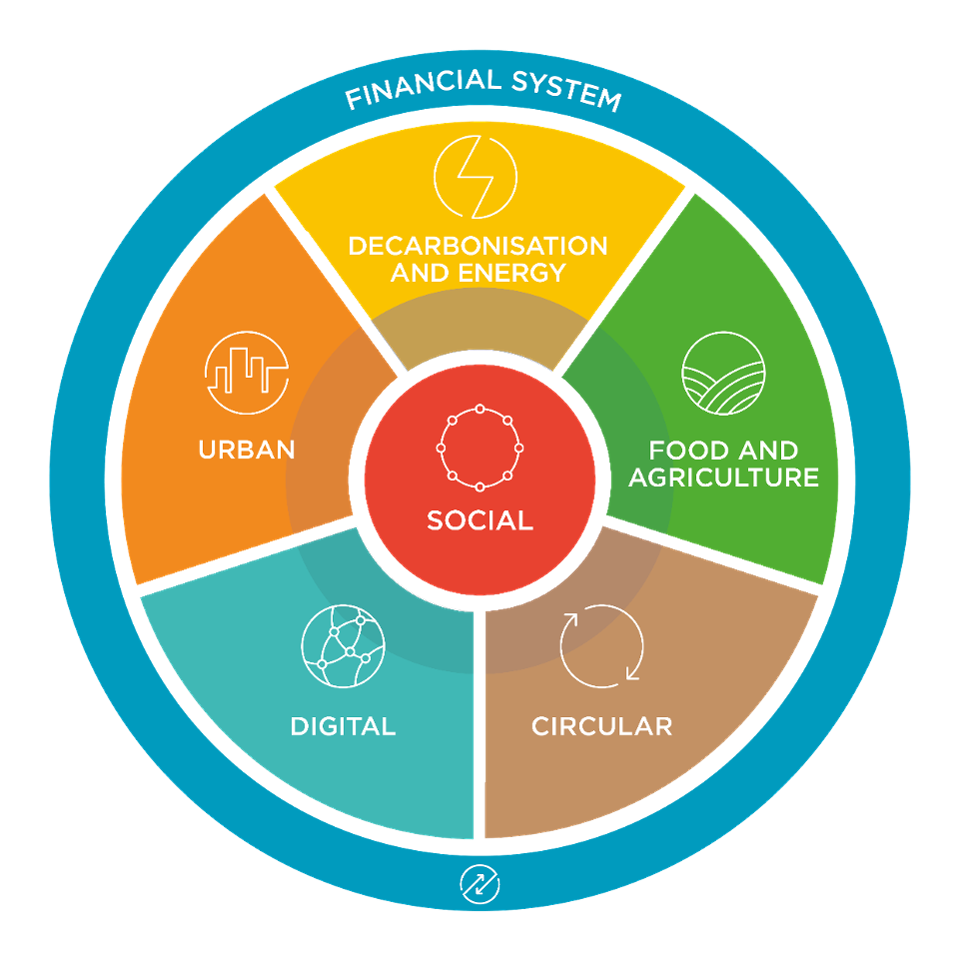
The World Benchmarking Alliance (WBA) established in 2018 and funded by Dutch, Danish, UK, Swedish and German governments as well as Porticus and the Aviva Foundation has developed an innovative approach to addressing these problems. It uses a five-step approach. First, it has aggregated the 17 SDGs into seven systems that need to be transformed: social, food and agriculture, decarbonization and energy, circular, digital, urban, and financial. Second, the starting point for each of the seven systems transformations was to identify the most relevant industries that can positively and/or negatively impact the transformation. Based on this it has identified 2,000 “keystone” companies in 74 countries with $43 trillion in revenues that will play a critical role in whether the SDGs are accomplished or not. 505 companies are relevant to three or more systems.
World Benchmarking Alliance
Here the are five criteria for identifying these companies:
- The company dominates global production revenues and/or volumes within a particular sector.
- The company controls globally relevant segments of production and/or service provision.
- The company connects (eco)systems globally through subsidiaries and their supply chains.
- The company influences global governance processes and institutions.
- The company has a global footprint, particularly in developing countries.
Using publicly available data, company questionnaires and reliable third party sources, the WBA strictly rank orders the companies from first to last within a particular system. These rankings are available for free on the company’s website. Fourth, the WBA provides a “Keystone company scorecard” which provides an explanation of a company’s ranking and suggestions of how it can improve.
Their theory of change is a simple but effective one. By “grading” these companies in a very public way in front of investors, customers, employees, NGOs, regulators, trade associations, and other stakeholders, companies will have an incentive to improve. Laggards will feel the pressure first. Leaders shouldn’t rest on their laurels since their ranking will fall if that of those below the rises. Since rankings are based on absolute scores, as best practice evolves it will be possible to raise the bar for even the top performers. The intent is to have the rising tide lift all ships.

World Benchmarking Alliance
According to Executive Director Gerbrand Haverkamp, “For the first time, we have identified the who – the 2000 most influential companies. These are the companies that are going to shape our future – for better or worse – and have the potential to drive forward systems’ change. Companies themselves can use WBA Benchmarks to assess their progress against their peers and use our methodologies as guidance of what science and society expects of companies. The benchmarks will visibly show these companies’ performance which will encourage a race to the top and allow stakeholders to hold laggards to account.”
The WBA is still in the early stages of creating benchmarks that cover all 2,000 companies in the seven systems but its results so far are very interesting. To date it has created a Seafood Stewardship Index, the Automotive Benchmark, and the Corporate Human Rights Benchmark. In all of these cases, companies are given an aggregate score based on multiple factors relevant to the system, along with an indication of whether they are trending up, stable, or down. By 2023 every company will have been benchmarked at least once.
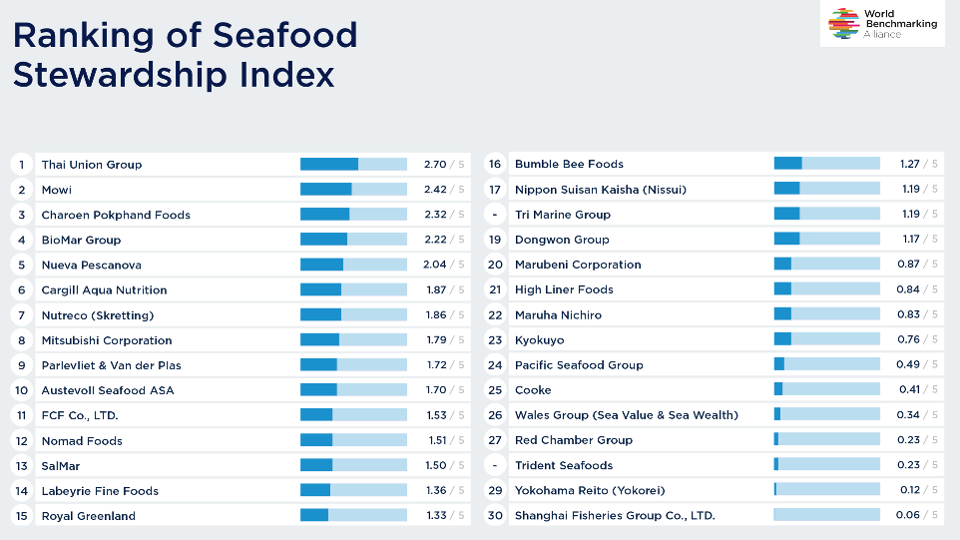
There is some good news in the Seafood Stewardship Index which ranks the 30 most influential companies in the seafood industry which three billion people (40% of the world’s population) rely on for an essential part of their diet. There is some good news in the five key findings. Twenty-eight of these companies make reference to their responsibility for sustainability but only 15 have published forward-looking sustainability strategies. Also good news is that 22 have human rights commitments in place, but most (80%) lack procedures for ensuring these commitments are made. Also good is that 28 of these companies work with sustainability certification programs although public disclosure about these programs is highly inconsistent.
World Benchmarking Alliance
What is bad is that is that only one-third of these companies can demonstrate they have mechanisms in place to prevent Illegal, Unreported, or Unregulated (IUU) which amounts to 26 million tons annually. To some extent this is due to the finding that complexity of seafood operations and supply chains increases environmental and social risks. Many of these companies are part of complex and diverse company structures with questions such as: (1) Who owns the company? (2) Who is overseeing the company’s seafood operations? And (3) Who is responsible for implementing the sustainability strategy?
Putting this into broader perspective, and showing the power of this approach, the top five companies on the list (Thai Union Group, Mowi, Charoen Pokphand Foods, BioMar Group, and Nueva Pescanova) only score between 2.70 and 2.04 on five-point scale based on the measurement areas of governance and management stewardship practices, stewardship of the supply chain, ecosystems, human rights, and working conditions, and local communities. The bottom 10 score less than 1.00, the bottom four less than .25, and the lowest one (Shanghai Fisheries Group) scores a barely registerable .06. Clearly even the best have substantial room for improvement and are failing to explain how they are not causing serious damage to the seafood system.
The five findings for the Automotive Benchmark are nearly all bad and ugly. “This benchmark shows that the 25 auto manufacturers are not on track to meet the goal set by the Paris Agreement. We see that most companies have a low carbon vehicle, but there is very little investment in this market.”
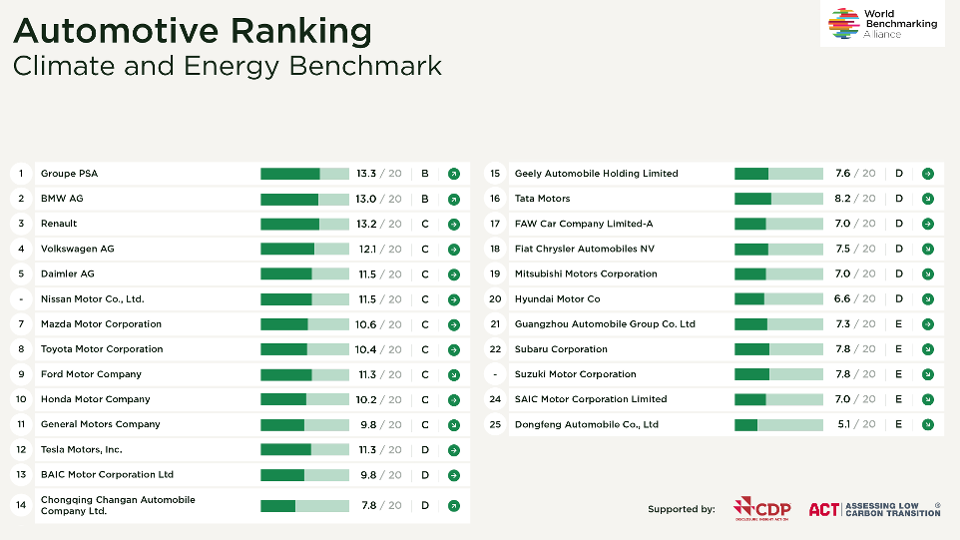
These companies are assessed on a 20-point scale based on the modules of targets, material investment, intangible investment, sold product performance, management, supplier, client, policy engagement, and business model – this gives their performance score. They are also awarded a narrative (A-E) and trend (+, =, or -) score and then ranked accordingly. The highest rated company is Groupe PSA (13.3 B +) followed by BMW AG (13.0 B +), Renault (13.2 C =), Volkswagen (12.1 C +), and Daimler and Nissan tied with 11.5 C =. The highest rated U.S. automotive company is Ford (11.3 C -) followed by General Motors (9.8 C -); the trend is negative for both of them. Twelve of the 25 companies have a performance score of less than 8.0. Holding a solid lead on last place is Dongfeng Automobile Company (at 5.1 E -).
World Benchmarking Alliance
The bad here is very bad. Twenty-four of these companies realize over 90 percent of their sales from vehicles primarily using a fossil fuel internal combustion engine and for most of them low-carbon vehicles only represent one percent of sales. All automotive companies need to set targets aligned with the low-carbon pathway and transition to selling low-carbon models.
The ugly is also very ugly in two ways. First, in an industry renowned for its marketing prowess, little of this is being directed to persuading customers to shift to low-carbon vehicles. Less than half of the companies assessed show that they are doing anything noticeable in this regard. Second, the industry as a whole is hesitant to adopt a proactive approach to climate change. In fact, some of these companies are even lobbying against climate-positive legislation.
The one potentially good finding is that auto manufacturers have a huge opportunity in creating a new model for mobility, based on low-carbon vehicles and other business models such as car-sharing, car-pooling, and vehicles-as-a-service business models. However, at this point this seems more hope than reality. The ranking of Tesla at #12 (with a performance score of 11.3, a narrative score of D and a ‘=’ trend score) illustrates the robustness of the methodology since it looks at all of the relevant factors a company must take into account to contribute to the SDGs. It is not enough to sell electric cars, however wonderful these may be. Tesla gets top marks for intangible investment, sold product performance, and client. These account for 10.2 of its total performance score points. It gets 0.8 out of 1.8 for business model and 0.3 out of 1.2 for supplier. It scores zero on everything else.
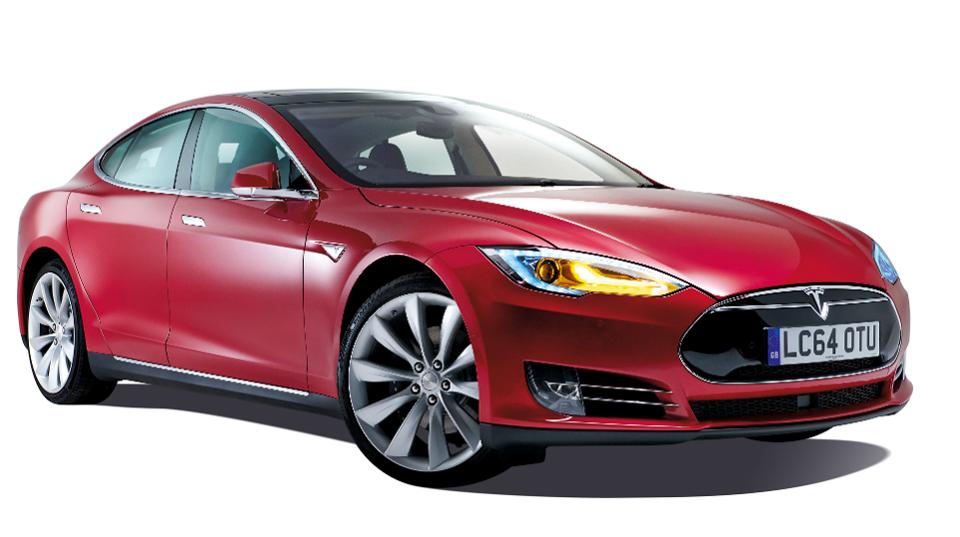
A Tesla Model S electric car, taken on January 22, 2015. (Photo by Neil Godwin/T3 Magazine/Future … [+]
Future via Getty Images
The ranking of Tesla at #12 (with a performance score of 11.3, a narrative score of D and a ‘=’ trend score) illustrates the robustness of the methodology since it looks at all of the relevant factors a company must take into account to contribute to the SDGs. It is not enough to sell electric cars, however wonderful these may be. Tesla gets top marks for intangible investment, sold product performance, and client. These account for 10.2 of its total performance score points. It gets 0.8 out of 1.8 for business model and 0.3 out of 1.2 for supplier. It scores zero on everything else. I will be reviewing further benchmarks as they come out. This year this will include the Gender Benchmark (how the apparel industry’s most influential companies promote gender equality and women’s empowerment), the Digital Inclusion Benchmark how ICT companies are contributing to digital inclusion on four dimensions: access, use, skills and innovation), and the Climate and Energy Benchmark (ranks companies against the climate and energy transition required to meet the Paris Agreement). This year the latter will focus on companies in the electric utilities sector.
But I also want to note that while the work of the WBA is important, its benchmarks are simple one element of the larger change strategy they envision. People need to use and act on the information they are providing through the choices they make as suppliers, employees, and customers. NGOs can use these data to engage with companies and help them improve their management practices. Especially important, in my view, is the role of investors (and banks since not all of the keystone companies are listed). This is especially true of so-called “universal owners,” asset managers with large passive holdings and pension funds with long-term liabilities. The SDGs are about maintaining a viable environment to support a viable human society. Failure here will have system-level effects which will make it impossible for these investors to earn the returns they need for their beneficiaries. The WBA is doing useful work for the investment community but it is up to the investment community to take advantage of it. The financial sector as a whole will be put on notice itself since there are 400 Keystone companies in the financial system.










