







How to slate demand and supply initiatives and techniques into your procurement strategies.
Designing and implementing a Lean procurement process can significantly change the way a company does business.
Having a standardized process to source materials or parts and using just-in-time (JIT) inventory policies can help with the balance sheet to minimize variability in the entire supply chain.
Selecting and assessing suppliers the same way has the same reliable purchasing structure and can be more easily integrated into flexible production processes, giving companies a competitive advantage.
Organizations can use a variety of Lean tools to identify and reduce or eliminate waste, such as:
- Value stream mapping (VSM) diagrams the flow of materials and information from customer to supplier through your organization, separating value-added and non-value-added activities. A VSM of internal procurement and purchasing processes can create a future state that is both streamlined and improved.
- Quality at the source, based on the concept of performing quality checks at every stage of a process, allows early supplier integration and problem-solving competence by expanding the viewpoint to the total cost of quality.
- One-piece flow, or batch size reduction, can be created by establishing local suppliers to assist with flexible manufacturing and supply chain strategies for shorter inbound transportation distances and consistent deliveries to help smooth demand fluctuations.
Why You Need a Lean and Agile Management Process
Companies expect their procurement and purchasing organizations to provide materials and assemblies on time, and to meet their demands. By applying Lean principles to procurement and purchasing processes, businesses experience multiple benefits throughout the supply chain.
For example, one consulting firm found the following results after applying Lean principles to various clients’ procurement processes:
Lead time: Implementing inventory reporting and accuracy standards allowed for faster decision-making and ordering, thereby reducing lead time for non-standard items by four hours (50%).
Optimizing an insurance company’s claims process decreased average throughput time from nine business days to less than four business days (56%).
Quality: Optimizing and standardizing a business-to-business data exchange process decreased supplier-caused defects by 98% during the entire process.
Lean materials requirements planning (MRP) solutions minimized inventory reconciliation to an annual activity, increasing inventory data quality.
Optimizing an insurance claims process decreased errors by 98% over the entire process.
Costs: Inventory accuracy improvements from a Lean MRP solution reduced inventory by €2.5 million (www.fourprinciples.ae, 2016).
Lean Procurement is Demand Driven
Traditional manufacturing and distribution was forecast-based and salesdriven, with product “pushed” through the supply chain to the market.
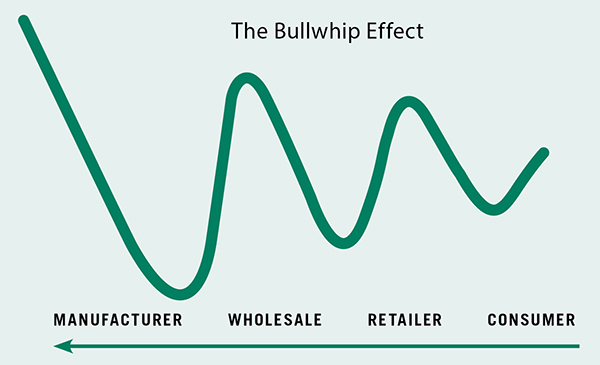
This can cause an unstable supply chain due to what is known as the bullwhip effect (see chart below), where demand variability increases as one moves up the supply chain away from the retail customer, and small changes in consumer demand can result in large variations in orders placed upstream.
Eventually, the network can face very large swings, as each organization in the supply chain seeks to solve the problem from its own perspective, leaving inventory shortages or excesses, and often resulting in increased cost and poorer service.
A demand-driven supply chain, on the other hand, is:
Driven by customer demand where products are “pulled” to market by customers: The companies in a supply chain work more closely together to sense and shape market demand by sharing information and collaborating with each other. By doing so, they achieve greater and more timely visibility into demand.
Flexible and responsive: Companies minimize the effect of long material lead times by adopting postponement strategies.
Efficient, with waste minimized in the procurement cycle: Without Lean procurement, buyers spend much of their time on nonstrategic processes such as tracking down order statuses, entering purchase orders, and maintaining individual spreadsheets for analysis. As a result, they often miss opportunities for mutually beneficial supplier negotiations and process efficiencies.
To reach the goal of a Lean, demand-driven supply chain, one can focus on these characteristics and try to come up with improvements, from either the demand side or the supply side.
- On the demand side, companies try to get a better sense of actual market demand and, in some cases, can attempt to shape it through tools such as promotions, discounts, and everyday low pricing.
- On the supply side, companies try to become more flexible and agile to be able to use more of the actual demand, thus becoming less reliant on forecasts.
Lean and Technology Opportunity
While cost reduction and efficiency is always an area of focus for procurement, technology can help enable a Lean procurement strategy to reap the full reward.
A growing number of companies are adopting innovative procurement technologies to increase efficiency in these uncertain times, according to a 2016 Deloitte Global CPO Survey.
Most procurement executives said they were investing heavily in innovative technology solutions:
- 70% were investing in self-service portals
- 45% were investing in cloud based computing
- 42% were investing in mobile technologies
- 16% were investing in social media technology
Spend analysis is the largest focus for technology investments (38% of executives responding to the survey said this area is most likely to receive investment), followed by contract management (37%), e-sourcing tools (30%), supplier relationship management technology (29%), and requisition-to-pay solutions (24%).
However, the majority of procurement organizations do not have a clear digital strategy in place—60% of procurement executives stated that they hadn’t yet formulated such a strategy.
Surprisingly, while involvement in risk management and mitigation is a growing area of focus for procurement executives, only 25% are involved in it now.
This lack of focus in a digital strategy and a low level of risk management and mitigation involvement can result in significant disadvantages to an organization in today’s volatile global supply chain (McAvoy, 2016).
Ultimately, Lean tools such as VSM, SS-workplace organization, visual workplace, Kaizen, standard work, and technology are a means to an end. The focus should be on strategy, leadership, culture, and people first, before implementing the appropriate tools and technology.
Lean Procurement Strategy
Strategic sourcing, as opposed to Lean procurement/sourcing, is a term that has been around since the 1990s. It is a systematic, data-driven approach to enhance a supply base and improve the overall value proposition. It focuses on analyzing spend, inventory data, holding costs, and personnel expenses to find opportunities for savings, and considers geopolitical and financial risks for suppliers based on product or service type.
In many cases, this is followed by supplier rationalization to obtain volume discounts and improve product and service delivery.
Strategic sourcing and Lean procurement philosophy don’t necessarily conflict. In fact, a Lean procurement strategy requires a long-term commitment to combining elements of strategic sourcing with Lean principles.
Strategic sourcing is more of an initial step to identify long-term supply partners and coordinate purchasing efforts with operations and manufacturing. In a global supply market, conditions change, and companies need to regularly go to market to identify, qualify, benchmark, and select global suppliers with the greatest capability and competitiveness.
What might a Lean procurement strategy look like? At the very least, it should focus on the following objectives:
Collaboration with key functional areas: Lean sourcing involves creating a strategy for future success through internal collaboration (for example, purchasing and operations working more closely together). This is accomplished by streamlining procurement operations and purchasing while at the same time improving financial performance.
Identify and implement sourcing savings: Use Lean Kaizen strategies to reduce costs in areas such as logistics management through shipment consolidation, improved inventory planning and management, and cost analysis. Lean sourcing relies on effective, sustainable cost reductions that don’t reduce quality or reliability, while balancing sourcing and operations requirements.
Improve quality and reduce waste: Lean sourcing relies heavily on reducing waste in all forms, including time, efforts, and capital. These issues can be addressed by compliance and process improvements and standardization.
Achieve ongoing additional cost reduction and process improvement opportunities through collaboration with supply partners: Lean sourcing involves collaborating with suppliers to develop better contract terms, optimize transport costs, and build a stronger and more effective supply network, minimizing the chance for disruptions.
Lean procurement organizations need to understand and select suppliers based on factors that influence total enterprise cost, both tangible and intangible. Elements of total enterprise cost include:
- Sourcing supply cost, quality, service, and risk factors
- Tariffs, trade, and duties
- Logistics cost, quality, service, and risk factors
Organizations that have gone down the Lean procurement path have learned to combine aspects of Lean and strategic sourcing. Lean factors to consider include:
- Supplier integration and demand management
- Reduced product complexity
- Synchronized processes
- Part standardization/SKU rationalization
- Reduced inventory
- “Pull” most products
- Joint product design
- Collaborative cost takeout
Strategic sourcing factors include :
- Company-wide approach
- Proactively managing supply risk
- Total cost of ownership/request for quotes
- Global reach
Lean procurement provides opportunities for process improvements and savings. It can improve contract compliance and develop better, sustained partnerships with suppliers and other business partners.
 Excerpted with permission from Lean Demand-Driven Procurement, How to Apply Lean Thinking in Your Supply Management Processes by Paul Myerson.
 ABOUT THE AUTHOR
A regular contributor to Inbound Logistics, Paul Myerson has been a successful change catalyst for a variety of clients and organizations of all sizes. He has more than 30 years of experience in supply chain strategies, systems, and operations that have resulted in bottom-line improvements for companies including General Electric, Unilever, and Church and Dwight (Arm & Hammer).










