






Decades of globalization have created supply chains so deeply interconnected that a shock event like the coronavirus is now harder to control and could have a dramatic ripple effect on global commerce, economists are warning.
“We tend to think about the economy as countries selling to countries. But the reality of business today is that companies get their parts from other companies, and sell to consumers or again to other companies, through a network of complex, deeply integrated global supply chains,” said Craig Alexander, chief economist at Deloitte Canada.
Key manufacturing regions in China — the world’s second-largest economy and perhaps the most integral player in the global supply chain — have been in shutdown mode for the past month in an attempt to control the spread of coronavirus outside its point of origin in Wuhan, where tens of thousands have been infected and hundreds have died.
The country extended its Lunar New Year holiday by two weeks this year, and forced major economic centres to halt production in early February — it was only this week that the work resumption rate in megacities such as Guangdong and Shanghai climbed back over 50 per cent, according to Chinese officials.
But the cascading effect of Chinese manufacturing centres coming to a brief standstill is already apparent in North America, at least anecdotally.
IPC, a trade association that represents electronics manufacturers in the U.S., said in a report this week that 65 per cent of its members have been told by suppliers that there will be delays of shipments of parts, due to coronavirus.
A report from research firm Dodge Data and Analytics suggested that construction delays in the U.S. will escalate given that nearly 30 per cent of products used in U.S. building construction are imports from China.
Auto manufacturer Hyundai, which has in recent years increased its dependence on China to supply auto parts to its manufacturing hub in South Korea signalled this week that there might be delays in getting specific parts from Chinese factories. South Korea — a major electronics parts manufacturer itself — saw a surge in coronavirus cases over the weekend, complicating supply chain issues further.
Paul Ashworth, chief North American economist, Capital Economics


“It takes somewhere between two and four weeks for a cargo container to travel from China to the U.S. and certainly, it is a full month by the time you unload the cargo and get it to go where you want. We’re in the fourth week of the Chinese shutdown, so, soon, you’re going to start seeing how severe the supply chain disruption could be for North American companies,” said Paul Ashworth, chief North American economist at Capital Economics.
“It is the indirect effect through the supply chain of goods and commodities that will adversely impact our economy,” Alexander said. “If there is a product our importers are trying to sell in the domestic market and the shipments aren’t arriving, that creates major inventory challenges,” he added.
For example, says Alexander, a Canadian company selling inputs to an American business could be affected if demand from that U.S. business declines.
“This is exactly what we saw in the U.S.-China trade war. Tariffs on Chinese goods did not just impact Chinese businesses, they had a ripple effect on Canada,” he said.
According to Ashworth, it is still too early for the coronavirus effect to show up in North American economic data, but a recent survey conducted by Capital Economics in mid-February indicated there had been no impact yet on U.S. consumer confidence.
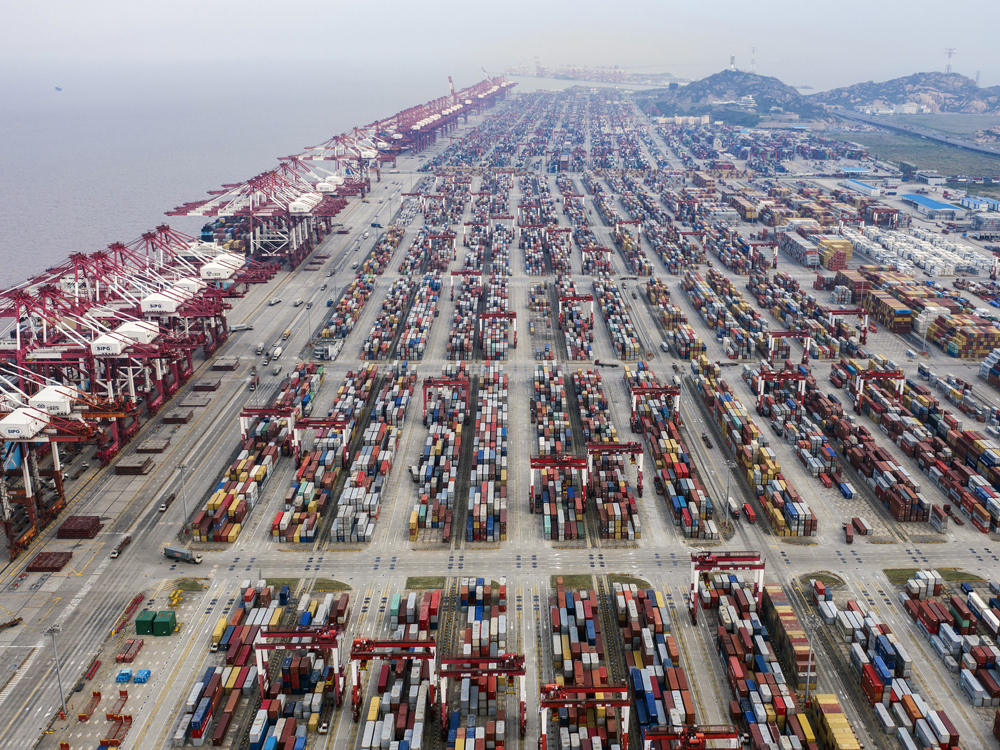
Shipping containers stand in a terminal at the Yangshan Deep Water Port in Shanghai, China.
So far, the economic impact of coronavirus has been seen most significantly in the commodity sector, given that China is a massive importer of raw materials and that the price of commodities are set in world markets. Oil prices, for instance, have fallen by almost five per cent since the virus emerged, to US$51 per barrel as of Wednesday.
The potential reduction in Chinese demand for luxury goods has sent some retail stocks such as Canada Goose into a tailspin but economists are not particularly concerned, considering that Canadian exports to China are just 1.6 per cent of overall GDP. U.S. exports to China are just 0.7 per cent.
Ashworth believes that even if China was, hypothetically, “permanently closed for business,” the impact, because of the missing Chinese demand, would be low. “I’m more worried about two other things — supply chain disruptions in the next month or two months if the Chinese economy remains closed, and if this becomes a pandemic in America or Canada and affects local consumer demand for goods,” he said.
Global markets stabilized Wednesday after a two-day plunge on news that the virus had rapidly spread outside Chinese borders, to 37 countries including Italy, Germany and Iran, creating fears of a pandemic.
The U.S. Centers for Disease Control and Prevention warned Tuesday that American “businesses, communities and hospitals” should begin preparing for the possible spread of the virus, even though there are only 57 infections in the U.S. currently.
“If the containment in China works, and we see fewer cases in China,” Alexander said, “then we could likely see a rebound in economic activity in April. At the moment, it looks like this will be at least twice the economic impact that SARS was 17 years ago … the weight of the Chinese economy on Canada is four times what it was then.”
Opher Baron, a supply chain expert at the Rotman School of Management, believes that the growth of China’s own domestic market could create an additional backlog for international customers, as much of the post-coronavirus production might first go to Chinese consumers before being shipped internationally.
“They might say, we’re going to use just half of our capacity to reduce international backlog, and the rest we’ll use here,” he said.
“This (coronavirus) is a very significant problem. Think about it: one-third of the world’s manufacturing capacity was idling for weeks and is still idling. That’s a big deal.”