






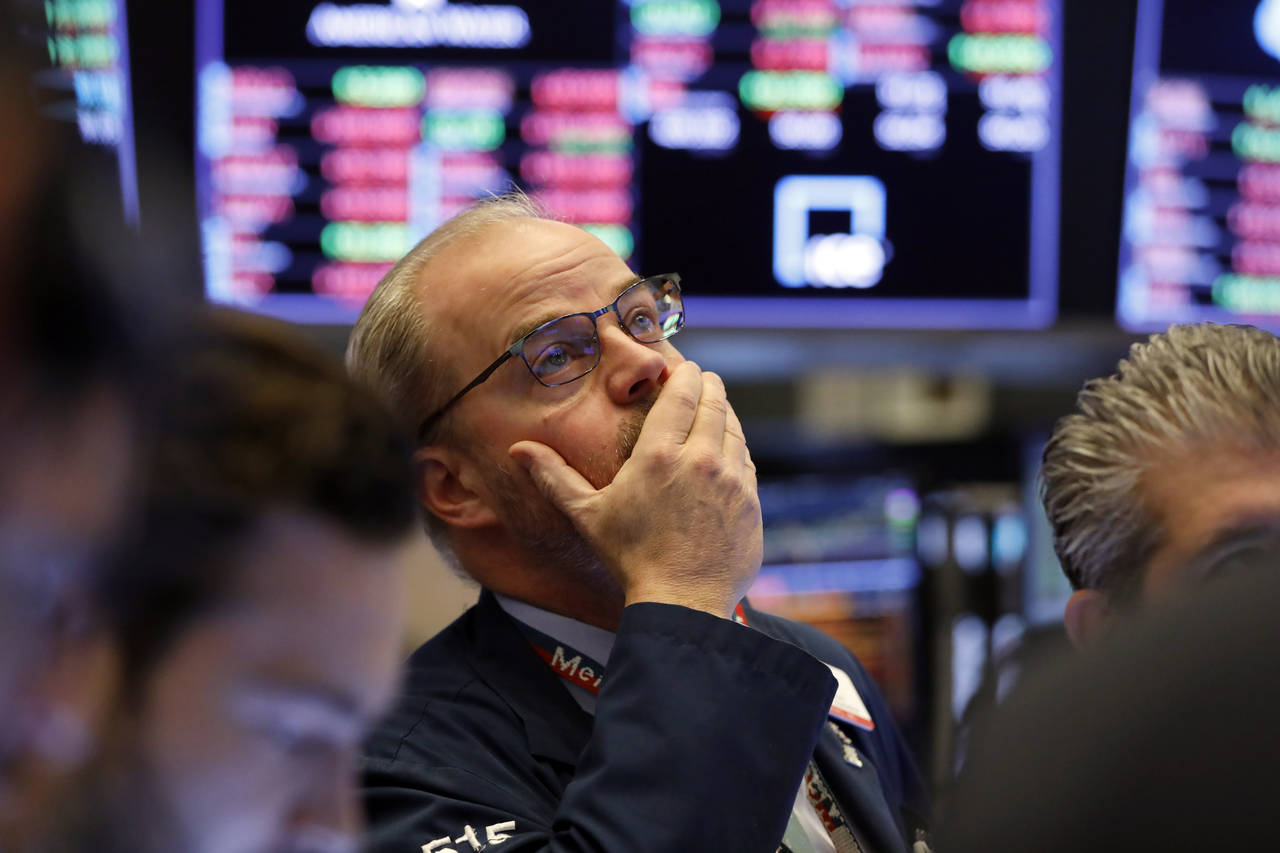
Trader David O’Day works on the floor of the New York Stock Exchange, Friday, Feb. 28, 2020. Stocks sank again after another wild day, extending a rout that left Wall Street with its worst week since October 2008. (AP Photo/Richard Drew)
NEW YORK (AP) — As stocks around the world tumble on worries about a fast-spreading virus, investors have been clamoring for the superheroes of the financial world to ride to the rescue once again.
Yet this time, there are doubts: Can central banks really fix this crisis as they have so many others?
As much as anything, the Federal Reserve and its counterparts around the world have helped drive up stocks over the past decade with their interest-rate cuts, stimulus programs and promises of support. Through the 2008 financial crisis, the 2011 European debt crisis and intermittent worries about a looming recession, actions by central banks have helped place a floor under stock prices. And one result was the longest U.S. bull market on record.
Now, with the Standard & Poor’s 500 stock index having just plunged 12.8% in barely more than a week — the dizziest such fall since the 2008 financial crisis — many investors are calling for the Fed to swoop in yet again with rate cuts and perhaps other stimulative actions.
“We need the Fed to come out and say, basically, ‘Guys, we got your back,’” said Gene Goldman, chief investment officer at Cetera Financial Group.
Traders are pricing in a 100% certainty that the Fed will cut interest rates at its next meeting on March 18. A month ago, those traders had seen less than an 8% likelihood, according to CME Group.
“The Fed is being called into action,” BofA Global Research economists wrote in a report Friday.
They expect the Fed to cut short-term interest rates by half a percentage point at its next meeting and possibly even before then. That would be the steepest rate cut since the financial crisis was still at full bore in 2008.
The hope — and expectation — that the Fed can provide the ultimate backstop for stock prices isn’t surprising given its recent history of serving just that role. Its abrupt reversal from having raised rates four times in 2018 to cutting them three times in 2019 helped launch the S&P 500 into one of its most dazzling years in decades — a 31.5% return.
But this crisis is distinct from most others. And some investors say the tools at the Fed’s disposal aren’t ideally suited to address the economic damage from a viral outbreak verging on a global pandemic.
That reality has set the market up for a series of potential disappointments. One is that the Fed won’t yield to expectations for a rate cut, perhaps so as not to appear unduly beholden to investor demands. The Fed’s dual mandate as an institution is to maximize employment and keep prices stable, not to serve Wall Street.
“It’s dangerous when the expectation is 100% that we’re going to get a cut,” said Ann Miletti, head of active equity at Wells Fargo Asset Management. “When expectations get disjointed from reality, that gets problematic.”
That risk might have been lessened after the central bank put out a statement Friday that pledged to “use our tools” to support the economy, a sign that Fed officials may indeed decide to cut rates soon.
Yet what if they do? Lower rates can lead people and businesses to borrow and spend, which can boost economic activity. But they can’t make sick people healthy, reopen factories whose workers are kept home because of quarantines or restart supply chains in areas of the world struck by the outbreak.
“From an optics perspective, maybe a rate cut makes a difference in psychology” for investors, said Debbie Cunningham, chief investment officer of global liquidity markets at Federated Hermes. “I don’t think, on a quantitative basis, it makes a hill-of-beans difference.”
The virus is squeezing sales and profits for many companies, large and small, around the world. Sharp drops in tourism have hurt shopkeepers from Bangkok to Venice to Seoul.
Economists worry that if COVID-19 breaks out as a global pandemic, panicky consumers would avoid shopping malls and restaurants, while businesses would close as workers stay home. Many companies would delay hiring, expanding and investing. Collectively, those trends could tip the U.S. and global economies into recession.
The Fed would face such a downturn with interest rates already low. Its benchmark short-term rate is in a range of 1.50% to 1.75%, down from 2.25%-2.50% in late 2018 and from 5.25% before the Great Recession. That means the Fed would have less ammunition in the form of rate cuts — even if lower borrowing rates were the right prescription for this crisis. Other central banks have even less monetary firepower after having already cut their benchmark rates below zero.
Ultimately, some investors say, the markets will be able to recover only after the virus has been contained — regardless of what the Fed does in the interim.
Melda Mergen, deputy global head of equities at Columbia Threadneedle Investments, said she is optimistic that the market’s sell-off will let up soon. Still, she suggested, investors are likely monitoring the number of new infections outside China. If that number were to accelerate, stock prices will likely head further down, regardless of what the Fed does.
“Maybe it helps the market on a short-term basis because people say, ‘OK, the Fed is reacting, and we need them to do that,’” said Miletti of Wells Fargo Asset Management. “They’re important, but they can’t solve all the problems.”
One potential source of support for the market is the federal government in the form of spending programs on infrastructure or a new tax cut. Yet given that Capitol Hill is essentially paralyzed by partisan gridlock in an election year, few expect anything to get done anytime soon.
That leaves the central banks. Stock prices rise and fall with how much profits companies make, along with how much investors are willing to pay for each $1 of those earnings. When the Fed cuts rates, it can encourage investors to pay higher prices than they otherwise would for stocks because bonds become less attractive as rival investments. But by several measures, stocks are still trading at above-average prices relative to their earnings, even after last week’s plunge.
Still, some investors who are hopeful for a robust market recovery if the virus can be contained soon note that the U.S. economy has been relatively healthy. Corporate profits are still near record highs even if they aren’t growing quickly anymore. The unemployment rate is low. And economists have been expecting a pickup in growth as trade tensions diminished.
All of that is why some analysts say that even if the coronavirus tips the economy into recession, they expect a relatively quick rebound. Most acknowledge, though, that it’s particularly hard to forecast how the economy and any response from the Fed will unfold.
“This is something that’s very unprecedented, both globally and in the U.S.,” said Kathy Bostjancic, chief financial economist at Oxford Economics.
___
Rugaber contributed from Washington. AP Business Writer Damian J. Troise in New York also contributed to this report.
Copyright © The Associated Press. All rights reserved. This material may not be published, broadcast, rewritten or redistributed.










