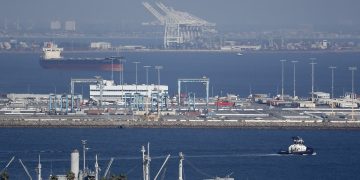







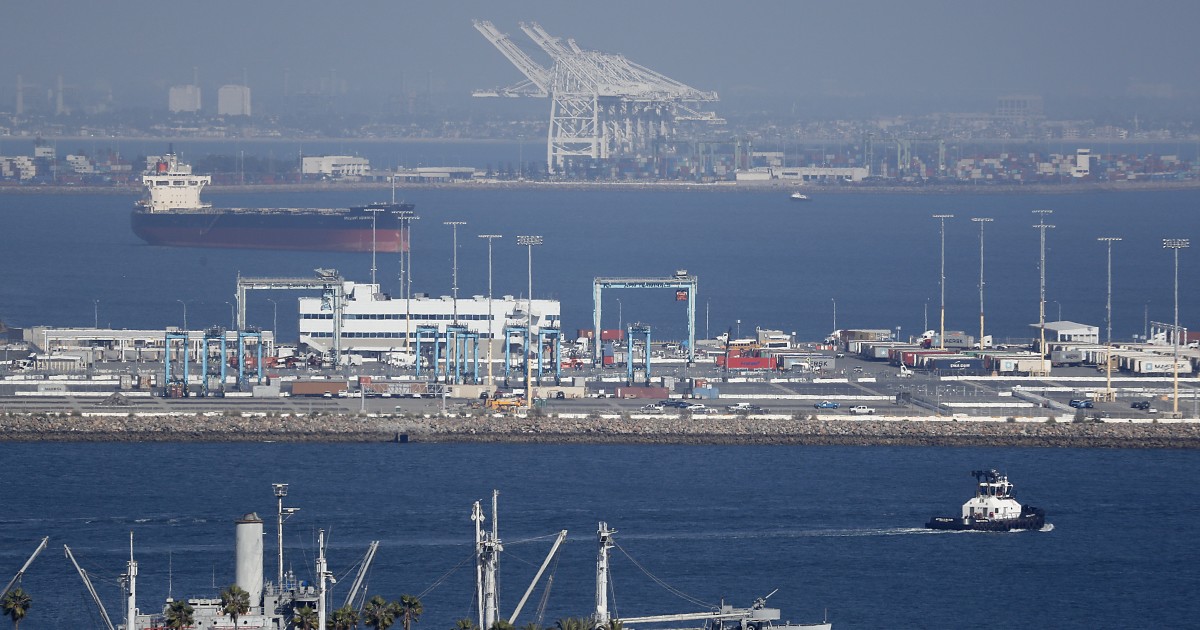
On a bright morning early this week, Eugene Seroka, executive director of the Port of Los Angeles, gazed through the big picture window of his office at the sprawling docks below.
Where he would normally see as many as a dozen ships in the harbor with giant cranes hoisting one container of goods after another, just four had docked.
“It’s very quiet,” he said.
The nation’s largest port is hurting. That may be a leading indicator of the pain that’s in store for Southern California and the U.S. economy as businesses hunker down to deal with the rapidly expanding new coronavirus.
Many American companies had bulked up inventories last year in advance of the Trump administration’s steep tariffs on Chinese imports, and have plenty of goods on hand. But they could soon face serious consequences of the virus: a dearth of crucial parts for American factories, shortages of consumer products on store shelves and less demand for U.S. exports.
Trade with China normally accounts for roughly half of the containerized goods flowing through the twin ports of Los Angeles and Long Beach. Now, with Chinese factories operating at about 40% of capacity, business at the San Pedro Bay complex is dwindling. The two ports project a 15% to 17% plunge in cargo volumes in the first quarter of this year, as compared with the first three months of 2019 — a drop of more than 500,000 container units.
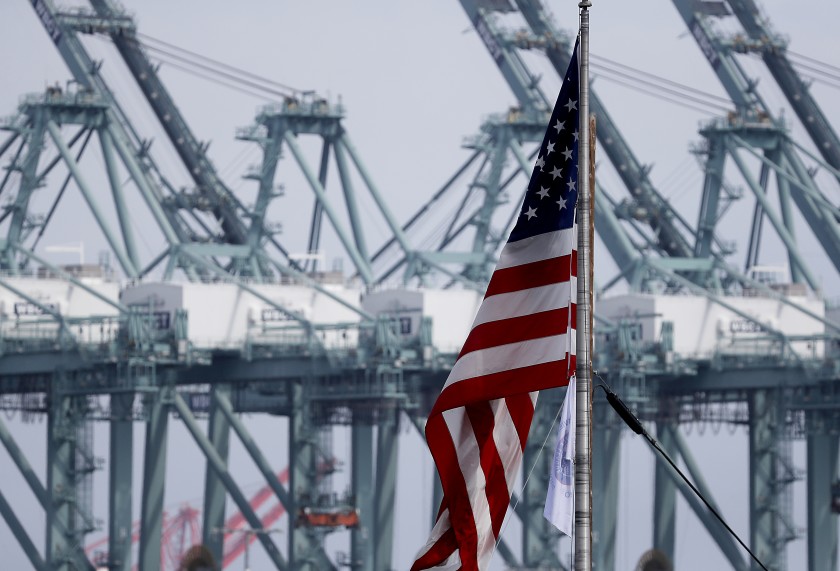
The L.A. and Long Beach ports project a 15% to 17% plunge in cargo volumes in the first quarter of this year, compared with the first three months of 2019.
(Luis Sinco / Los Angeles Times)
Imports usually slow around the Chinese New Year, but shippers have canceled 60 vessel sailings for the first quarter of this year —nearly twice the normal number. The 12 terminals across the two ports have been shutting down for days at a time.
“The overall impact is not only on the regional economy, it is on the national economy,” said Mario Cordero, executive director of the Port of Long Beach. “We are ground zero for Asian imports. We were already down because of the trade war. With the coronavirus, we’ve gone from uncertainty to potential chaos.”
In the Los Angeles region, the pain is already acute. Seroka pointed out that 1 in 9 Southern California jobs are tied to the ports, including people who work on the docks, drive trucks and move boxes in warehouses.
“That’s a million jobs,” he said. “Less cargo means fewer jobs. The truck drivers are not pulling as much freight. The longshoremen are not being called out to work as frequently as they normally would be.”
At a time when job growth is already slowing in California — after a decade of expansion — the coronavirus threatens to make things worse.
On the docks, work shifts are down by a fifth in the first 10 weeks of this year, compared with 2019, according to the Pacific Maritime Assn., an industry trade group, although the trade war and competition from East and Gulf Coast ports are also factors.
Strong contracts with the International Longshore and Warehouse Union prevent layoffs among the 8,600 members staffing the twin ports: They are paid 40 hours a week regardless of the drop in shifts. But the slowdown has dramatically affected a group of some 3,500 dockworkers known as “casuals,” contingency workers who have yet to become regular longshore workers. Their shifts have dropped from more than 2,000 a week to about 200.
The crisis is most severe for the 13,000 truckers who ferry goods from ships to warehouses and rail yards across Southern California. Some 80% are independent contractors who own their trucks and get paid per load. As cargo has dwindled and work has dried up, they are panicking. A Facebook page with 5,800 drivers, mostly Latino immigrants, is filled with photos of locked terminal gates and posts offering big rigs for sale because the owners are unable to meet mortgage payments.
“We are in a state of emergency,” said Ron Herrera, president of the Los Angeles County Labor Federation. “If there’s no cargo, no one gets paid. For independent contractors, it is especially devastating. They are not eligible for unemployment, unlike employee drivers.”
But even the 300 Teamsters who serve the ports are not immune. On Feb 25, Carson-based Shippers Transport Express texted its 145 unionized drivers, telling them they would be laid off two days later.
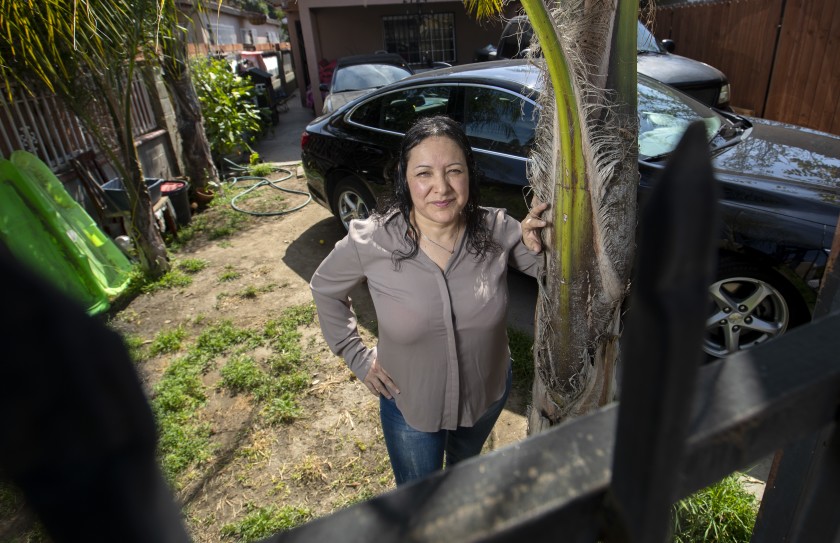
Nicolasa Huerta, 47, was laid off from her job as a truck driver transporting goods from China.
(Brian van der Brug / Los Angeles Times)
Nicolasa Huerta and her partner, Benny Cruz, who drove night shifts for Shippers, are among those who lost their jobs. “They had us working two days a week,” said Huerta, 47. “Then it was one day. Then they told us to stay home a week. Then we got the text.”
Huerta was earning $29 an hour. Unemployment benefits won’t pay as much, and she is afraid she will be unable to afford the $2,000-a-month mortgage on her small Compton home, not to mention a $315 monthly car loan and $600 in monthly credit card bills.
“Oh my goodness, I worked so hard to get the house,” she said. “I don’t want to lose it because of this virus.”
For her daughters, ages 16 and 9, Huerta tries to remain calm. “My kids need to see me strong,” she said. “I cannot just collapse. This is happening to all of us. If there’s no ships coming in, there’s no work, so companies have no choice. We’re holding on in hopes they will call us back.”
Weston LaBar, chief executive of the Harbor Trucking Assn., a trade group for about 100 large drayage companies, estimates “business is down 60% to 70% for the last week of February and into March. The coronavirus has already cost our industry millions upon millions of dollars in lost productivity and administrative costs.”
Terminal closures mean truckers can’t return empty containers and chassis, the flat steel beds they sit on. “Every terminal has an appointment system that regulates what containers you pick up and drop off,” LaBar said. “If your appointments are at a closed terminal, then you can’t operate.”
Trucking companies are being charged daily fees for late returns, leading to fights with ocean carriers and customers over who should pay. “They’re facing six- and seven-figure equipment bills,” he added. “Everything is going downhill. The longer this goes on, certain companies may go out of business.”
The snafus exceed what the ports experienced during a 2014 slowdown amid contentious union negotiations or in 2018, when docks were clogged with extra cargo in anticipation of Trump’s China tariffs, LaBar said.
“I’ve never seen such disruption,” he added. “We’re in an unprecedented situation.”
Big companies aren’t the only victims of the spread of the coronavirus. Thousands of small businesses depend on the twin ports, from freight forwarders to warehouse owners to trucking brokers.
At his office in Santa Fe Springs this week, Michael Marchica, the owner of MFB Transportation, a small logistics agency, stared disconsolately at a live feed from the ports on his desktop monitor. It displayed five open and five closed terminals. Even the open ones showed few trucks in line.
In the past, he said, the feed would show “pictures where you couldn’t even see the streets because of so many trucks.”

Michael Marchica, owner of MFB Transportation, has lost as much as $200,000 in revenue since January because of a decline in cargo shipments at the ports of Los Angeles and Long Beach.
(Gina Ferazzi / Los Angeles Times)
Before the coronavirus hit, Marchica was dispatching up to 60 truckers a day to pick up imports from China — pressure cookers, shoes, clothing, even paddle surfboards. Now, he said, “we’re deader than a doornail. I haven’t seen anything from my customers in three weeks. The factories in China have shut down or the sailings have been canceled.”
Two weeks ago, Marchica laid off one of his three dispatchers and one of his two billing clerks. He has cut the hours of the others. His out-of-work truckers, all independent owner-operators, “are hurting. They’re back on their rent. I know a couple of guys are doing Uber.”
Meanwhile, he added, “Drivers I haven’t talked to in years are calling me day and night asking me if I have business for them.”
Marchica figures his company has lost as much as $200,000 in revenue since January. He has dipped into personal savings to support his family of four, at the same time as he faces medical bills for his wife’s breast cancer treatments.
“It’s really, really, really bad,” he said. “It’s wiping me out, quick. But everyone’s in the same boat.”
Exporters are also affected by the closures and snarled supply chain. National companies that ship meat, poultry and hay to China through California ports, along with California farmers who export oranges and other produce, report that refrigerated containers are in short supply and cold storage facilities are overflowing with inventory.
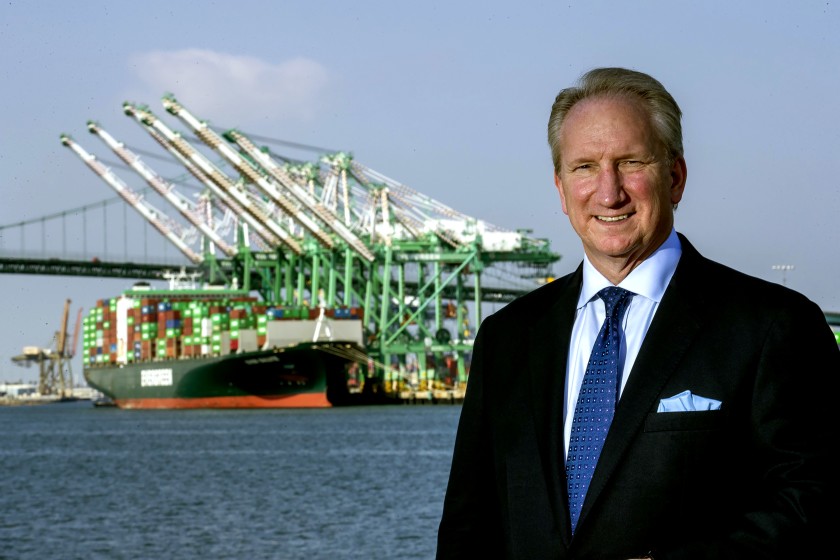
“Less cargo means fewer jobs,” said Gene Seroka, executive director of the Port of Los Angeles.
(Allen J. Schaben / Los Angeles Times)
“Our farmers have product stuck on the docks,” Seroka said. “We’re working diligently with the liner companies to put vessel services in place so we can move the exports and evacuate the empty containers.”
But even as port officials scramble to cope with the current disruption, they are also worrying about what happens when the virus subsides, Chinese factories ramp up, and delayed cargo floods through the ports.
“We’re going to witness a really big pendulum swing,” Seroka said. “It will mean a strong wave of imports. We need to have all hands on deck to capture those and push them through the port with high velocity.”
Railroad executives, trucking company owners, terminal operators and ship operators are meeting with port officials to discuss what might happen next. That includes, he said, “when we’re going to schedule ships, how sailings are going to come into place. We’ve got a lot of empty containers and more importantly, a lot of exports that have to move from these docks.”
For the twin ports, which serve more than 200,000 businesses shipping some $500 billion in cargo, the fear, Cordero acknowledged, is “a repetition of what we experienced in the last quarter of 2018,” when importers front-loaded orders to avoid tariffs.
“There weren’t enough dockworkers to unload all the containers,” he recalled. “There weren’t enough trucks to get this stuff off the docks. We have to prepare to recuperate from the coronavirus situation.”










