






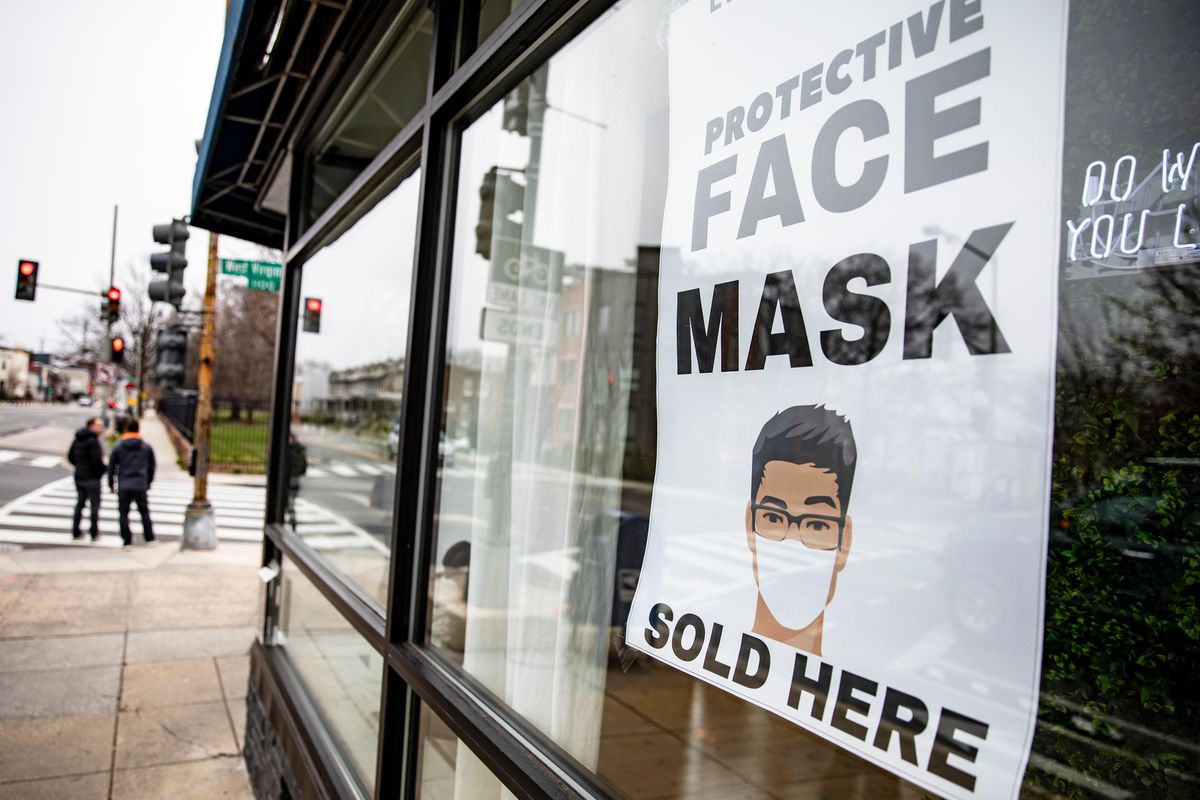
WASHINGTON, DC – MARCH 06: A sign advertising protective face masks is taped in the window of the … [+]
Getty Images
As the spread of COVID-19 nears pandemic proportions around the world, crossing more than 101,900 confirmed cases and 3,400 deaths, normal life and businesses are grinding to a halt in 94 countries and counting. Indeed, the rapid economic spillover effects of the latest virus to leap from the animal kingdom to our species shows the world’s inherent vulnerability and low levels of pandemic preparedness and biodefense. This rapidly developing event also underscores just how tightly interwoven the global economy is and how we cannot decouple the fortunes of companies from countries, let alone protect people from a sneeze halfway around the world. In short, we are in this together and must urge prudence, not panic.
In 2017, a bi-partisan review of pandemic preparedness in the U.S., co-chaired by Secretary Tom Ridge and Senator Joe Lieberman, found low levels of readiness in the U.S, along with low levels of spend and cross-sector collaboration for a potential threat that could imperil millions of lives and the global economy. While the emergence of COVID-19 is certainly an acute global event, it is by no means a surprise and many public health authorities, governments, business leaders and households have been caught flat-footed.
To the scientific and risk management communities, it was never a matter of if, but rather a matter of when a global pandemic would seize up the arteries of globalization and the global economy requiring bold, collective and concerted action to combat a scourge that neither recognizes borders, any more than it recognizes the political or economic stripes of its hosts (what some refer to as Disease X). COVID-19 is precisely such a threat, but if we exercise prudence, follow the advice of trusted public health authorities and allow containment, prevention and science to take their course, we can regain the upper hand.
Prudence Not Panic
The incidence rate of epidemics, pandemics and vector-borne diseases are a part of our modern reality in an increasingly urban, interconnected and heavily populated world. These need not sow panic however, since many of the tools and approaches to guard against them and preserve wellbeing are as ancient as quarantines and self-isolation. Therefore, exercising prudence in business and personal decisions, such as practicing good personal hygiene, abiding by frequent (and correct) handwashing and choosing to self-isolate if unwell can make a material difference in combating COVID-19 or the common cold. Even though the rapidly evolving picture of COVID-19 and its mathematical mortality and infectiousness may spare the majority of its hosts with mostly mild symptoms, these steps are about protecting vulnerable populations and slowing its spread.
The truth remains that with operational bottlenecks and differing approaches to testing for COVID-19, the numerator and denominator of affected populations is as yet unknown. This may put the real size of affected people into the hundreds of thousands and the real geographic dispersion of COVID-19 at the scale of an unchecked pandemic. With a 12 to 18-month time horizon for effective vaccine development, coping with the prospect that COVID-19 or some variant of its strain may be here to stay, implies that the world will need to prepare for potential seasonal reemergence.
Germaphobia Not Xenophobia
Viruses like the Zika-carrying mosquitoes that plagued parts of the U.S. in 2016 and cast a specter of fear over the Olympic games in Brazil are indiscriminate. They do not check in with passport control or at border crossings and are entirely color blind as to who they might target. This is part of what sows the seeds of xenophobia or the fear of others in the spread of diseases and the attendant breakdown of social norms that might follow. While the germophobes who have long carried the highly coveted personal-sized hand sanitizers or disinfectant wipes will feel justified in their personal hygiene decisions. Xenophobes, sadly, have also been emboldened to claim certain people from certain national or ethnic origins are the cause and the hosts of COVID-19 due to their “dirty” habits. This is not only wrong, it adds embers of social breakdown to a challenge that requires an arm-in-arm, whole of society solution. So be like the germophobe and frequently wash your hands for at least 20 seconds and shun the vile tendencies of the xenophobe who is quick to blame others for our social ills.
Containment, Curtailment, Cancellations
The spread of COVID-19 like other novel viruses before it, is as much an epidemiological event, as it is a business and societal interruption event. In a little more than 3 months, COVID-19 brought the global economy to its knees, prompting rapid and coordinated economic interventions from central banks, as well as international bodies like the IMF, which has readied a $50 billion war chest to help shore up the global economy and ensure developing economies can shoulder the effects and costs of the outbreak. Nature is not without a sense of irony that in a time of national retrenchment, it has thrown the world a highly infectious curve ball requiring deep global collaboration.
One by one large scale events have been cancelled, countries have imposed bans on large gatherings, whether for business or religious congregation, and travel has been curtailed. Indeed, China’s quarantine of more than 60 million people, is ostensibly the largest in human history. The airline, hospitality and tourism industries have been particularly hard hit by the spread of COVID-19, which is already forecast to be a $113 billion loss to airlines alone without leaving a smoking crater. This is very much the first order economic and business impacts. Second order effects, which we should be prepared for will emerge downstream where small and medium-sized businesses will be particularly hard hit. The cancellation of SXSW, which brings more than 400,000 people to the city of Austin takes with it an estimated $350 million of economic activity from the city.
As more and more large companies shutter their center city offices advising their staff to work from home and school and university closures affect entire countries, like Japan and Italy, communities are learning to cope with large-scale social distancing. Once rare human resources practices like remote work, telecommuting and paid medical leave, must now become the norm in order to keep certain sectors of the economy churning. This also shines a light on national employment policies, minimum wage standards and minimum protections that are necessary to build personal resilience irrespective of household income. In the age of pandemic risk, not having paid medical leave requirements at a national scale (not to mention high rates of under-insurance) may imperil vulnerable communities as hourly workers may fail to heed quarantine calls to make ends meet. Here too, prudence and not panic are the order of the day.
Correlation ≠ Causality
The difference between risk and uncertainty, is that you can measure risk. Uncertainty, whether financial, social or political, is what creates panics and fear. This partly explains why long lines have been forming outside supermarkets and wholesalers like Costco, which now have empty shelves of water, disinfectants and non-perishable goods in many communities. Indeed, as the specter of COVID-19 dawned on city and local leaders, people across the U.S. have received public health notices calling for storing up food, medicine and basic necessities in preparation for community-scale social distancing. This type of public health advice, on balance, is prudent to the extent that it is always better to have something and not need it, rather than need it and not have it. The challenge, however, and this is where panic ensues, is how much and for how long as imaginations run wild about what pandemic preparedness really means.
Herein, the other risk management adage to share can help strike a more balanced psychological approach between appropriate levels of household, business and community level readiness versus full-blown hermitism. Simply put, correlation does not equal causality. Just because someone sneezes next to you on a crowded subway car or airplane, does not mean they are a carrier of COVID-19 or some other dread disease and that you will get it. The very basic personal hygiene rules that have kept our species safe from millennia of common colds and influenza can help us cope with the latest novel virus to plague the world.
Epidemics, Pandemics and Infodemics
Finally, and perhaps most importantly, just as pandemics and vector-borne diseases spread like wild fires across borders, information, misinformation and disinformation spread with equal ease. This makes it difficult for people to parse through fact from fiction and sound public health advice from hoax. The viral, interconnected echo-chambers many people rely on for information, including a panic-inducing 24-hour news cycle whose screens and ticker tapes have all turned red, can be the enemies of trustworthy advice sowing panic, fear and bad decision making. Combating the infodemic scourge will require as much prudence and personal judgment as arresting the rise of COVID-19. To be clear, this is not a fire drill, “Silver Solution” is not a cure and heeding the right amount of sound public health advice we can regain the upper hand and settle in to our new normal.










