






Across the globe, at any given time, it is inevitable that teams of lawyers are toiling away on Nike’s dime in an effort to fight the seemingly endless supply of counterfeit goods that have saturated the market, sometimes being offered up in close proximity to some of the nearly $40 billion in authentic products that Nike sells each year. When it comes to counterfeits, footwear is routinely among the most heavily-targeted types of products in the world, and since the Beaverton, Oregon-based sportswear behemoth that is Nike lives at the tippy-top of the footwear totem pole, it is only natural that it is one of the most heavily-targeted companies in the $1.2 trillion-plus fake trade.
Alongside luxury names like Louis Vuitton, Hermeś, and Rolex, Nike has consistently earned itself a seat at this doubled-edged-sword of a table – where companies are both so well-known and so heavily plagued by fakes – thanks to its arsenal of instantly recognizable, and thus, enormously valuable trademarks. From its name and world-famous swoosh logo to slogans like “Just Do It,” and thanks to truly large-scale marketing endeavors and the roster of the world’s most esteemed athletes (and non-athlete designers and endorsers) on its payroll, Nike has so thoroughly tapped into the consumer consciousness that its trademarks are rife with reputation and all but begging to be knocked-off en masse.
In Nike’s words, its “exclusive and extensive use” of its trademarks had caused those very marks to become “well-known to the consuming public as identifying and distinguishing Nike, exclusively and uniquely, as the source of the high-quality products [upon] which the marks appear.” It is against that background and in light of the sheer scope of the efforts to replicate its coveted creations that Nike has hired cadres of in-house lawyers and high-profile outside firms, who routinely trudge in and out of court with the sole purpose of policing unauthorized uses of the sportswear giant’s almost-priceless intellectual property.
Nike’s aggressive fight against fakes dates back decades, with efforts heating up in the late 1980s, when “multinational companies from all industries started outsourcing production to factories in the coastal provinces of Fujian, Guangdong and Zhejiang,” the New York Times previously reported, reflecting on what would become an enormous shift for the U.S. companies and consumers. Sneaker companies were part of that mass manufacturing exodus, and as they set their sights on cheaper labor that existed beyond the borders of the U.S., “a new brand of factory, [ones] specializing in fakes, began copying authentic Nike, Adidas, Puma and Reebok shoes.”
“Counterfeiters played a low-budget game of industrial espionage, bribing employees at the [brands’ official] factories to lift samples or copy blueprints,” the Times’ Nicholas Schmidle wrote in 2010. “Shoes were even chucked over a factory wall, according to a worker at one of Nike’s factories [in the eastern Fujian province of Putian]. It wasn’t unusual for counterfeit models to show up in stores before the real ones did.” And depending on where the counterfeits were headed, the quality could be quite striking. The fake Nike sneakers being exported from factories in Putian to the U.S. were “high-end … so sophisticated that it [could be] difficult to distinguish the real ones from the counterfeits.”
Sneaker brands were put on high alert, and so were their lawyers.
With the rise of large-scale counterfeiting operations and the ability of counterfeiters to hide behind fake identities facilitated by e-commerce, brands have evolved their strategies, and over the past 10 years, Nike’s enforcement efforts have come to include an number of interesting – and inventive – elements that go beyond the traditional cat-and-mouse game that sees trademark holders uniformly chasing counterfeit sellers, such as those that populate online e-commerce marketplaces and counterfeit havens, such as New York’s Canal Street.
One new tactic fashioned by the sportswear giant, in particular, started to emerge in 2010, when “Nike [began] approaching licensed U.S. customs brokers and requesting the broker’s assistance to provide it with information regarding a specific (or multiple) shipments,” Deanna Clark-Esposito, an international trade attorney, reported at the time. “In an effort to assist Nike, brokers (naively) handed over information, only to be later ‘thanked’ by Nike in the form of a lawsuit with allegations ‘supported’ by the very papers the broker provided it with.”
In each of those lawsuits, all of which centered on the transport of counterfeit goods, Nike sought millions of dollars in damages from the customs brokers on the basis that “due to the increase in identity theft, it was without knowledge of who the actual importers of record/consignees [were]” in each of the instances of counterfeit shipments uncovered and seized by U.S. Customs and Border Protection (“Customs”), per Clark-Esposito.

In the wake of these early customs broker lawsuits, Nike has only ramped up its activity, and consistently expanded its net to include this larger pool of potential defendants, albeit not without pushback from relevant parties. The National Customs Brokers and Forwarders Association of America, for instance, has expressed discontent with Nike’s broadening approach to laying legal blame, citing “concern with both the merits of the claims being raised against the brokers and the potential precedential value that a successful claim could have on the industry. “
Nonetheless, the wildly-protective Nike – with a $160 billion valuation to its name – has blazed ahead, filing additional suits against customs brokers, including a new case initiated this month in a New York federal court, in which the sportswear giant is accusing a broker, as well as a freight forwarder and non-vessel operating common carriers, of engaging in the “unlawful transportation and importation of counterfeit Nike sneakers in four shipping containers from China to the United States for their own financial gain.”
In lieu of naming the individual counterfeit manufacturers, presumably because it cannot identify them (yet), Nike asserts that it is bringing “this action to hold [the defendant customs broker and non-vessel operating common carriers]” – namely B&H Customs Services, Hana International Logistics, and Shine International Transportation – accountable because they “participated in the importation, distribution, and/or transportation in interstate commerce of footwear and packaging bearing unauthorized reproductions, copies, counterfeits, and colorable imitations of Nike trademarks.”
As for how exactly, the defendants’ far-reaching (alleged) scheme worked, one that saw them “engage in a deliberate effort to cause confusion and mistake among the consuming public as to the source, affiliation, and/or sponsorship of counterfeit Nike sneakers and to gain the benefit of the enormous goodwill associated with the Nike trademarks,” Nike claims is went down a little something like this …
“Beginning in or around July 2017 and continuing through September 2018, the defendants caused and/or arranged for the transportation from China to the U.S. of at least four shipping containers of [millions of dollars’ worth of] counterfeit Nike sneakers.” According to Nike, the defendants worked together to facilitate the transport of the sneakers from China to the U.S., and to ensure that they were likely to bypass U.S. Customs without being seized.
At the heart of the plan was “filing and/or assisting in the filing of the fraudulent entry documentation related to the four shipments … with U.S. Customs [by the defendants] for the direct purpose of transporting and importing the counterfeit Nike sneakers into the United States.” For starters, this took the form of the labeling of the sneakers in official export/import document: “in the transportation records for all four shipments, the contents were lamps to be delivered to a company operating under the name Artiva US, Inc.” The issue, per Nike: “The shipping containers did not contain ‘lamps,’ and they were not destined for Artiva.”
Hardly random products assigned to a randomly-selected company, the defendants had done their homework. Artiva is a real company in the business of routinely “importing and selling lamps and furniture manufactured primarily in China” by way of its retail outlets in the U.S. This fact was likely to help the defendants to avoid suspicion from U.S. Customs when the massive containers were unloaded and their corresponding documentation inspected at a domestic port.
However, while Artiva is, in fact, a legitimate entity that legitimately sells lights, Nike claims that the Southern California-based company “was completely unaware of the four shipments,” and “does not import footwear of any kind. In actuality, it had “its corporate identity stolen to help the defendants execute their scheme.”
In terms of the individual defendants, themselves, they had their own roles in furtherance of the larger plot. Shenzhen-based Shine International Transportation, for example, was responsible for “creating and issuing” the required documentation that details and legally transfers title of the “lamps” (i.e., the counterfeit sneakers) from the Chinese manufacturer – a fraudulently listed “Zhong Wang Lighting Factory” – to an international freight and logistics company in order for them to be transported.
Within this role, Shine International “contracted with and paid” the shipping companies to transport the goods from China to the U.S. (those companies are not named as defendants) and designated New York-based Hana International Logistics as the receiving agent of the goods since “Shine has no U.S.-based operations.” Further perpetuating the scheme, Hana International – just like its fellow defendants – allegedly issued “fraudulent and facially inadequate” documentation in connection with the large-scale shipments, ultimately enabling three of them to “make it past U.S. Customs,” and thereafter, be “delivered somewhere in the United States.”
All the while, New York-based B&H Customs Services – the customs broker enlisted by Hana – was responsible for filing documentation of its own, including an Import Security Filing, for each of the shipments. In the process of doing so, Nike claims that B&H “was put on actual notice of discrepancies in the documents it had received and utilized to file entry in the name of Artiva,” including inaccuracies in connection with the importer of record, among other things, but failed to exercise the required level of “due diligence” to verify the validity of the documentation provided to it by the other defendants.
“B&H was also required” – but allegedly failed – “to use reasonable care in determining the nature of the goods covered by [the documentation it filed with U.S. Customs] to determine, among other things, whether the goods bore the trademarks of any U.S. company before filing” that documentation in order to assist Customs in weeding out counterfeit or otherwise infringing goods. In lieu of doing so, Nike claims that B&H turned a blind eye to the nature of the thousands of counterfeit sneakers, and instead, “looked to get paid.”
Ultimately, over the nearly one-year period between July 2017 and September 2018, the defendants were able to successfully import three containers of thousands of counterfeit Nike sneakers into the U.S. But while “the first three containers [shipped out of ports in China] passed through U.S. Customs undetected,” the fourth container, for which “the transportation records stated that it was carrying lamps,” was seized by U.S. Customs.
In early February 2019, Nike’s North America Brand Protection head received a letter from U.S. Customs alerting him to the fact that on November 29, 2018, the government agency had seized thousands of articles “which bear marks that constitute counterfeit copies” of Nike’s marks at the Port of Newark. The appraised value of the sneakers, according to Customs? $977,414.00. That total, which is calculated used the retail price of the goods had they been authentic, would be exponentially higher had Customs taken into account the sky-high resale values of some of the styles of sneakers that were inside of those vast metal containers.
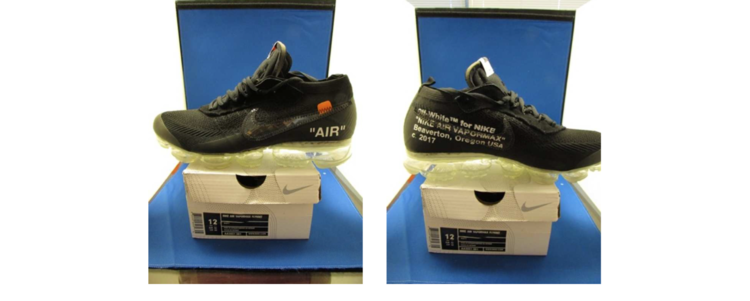
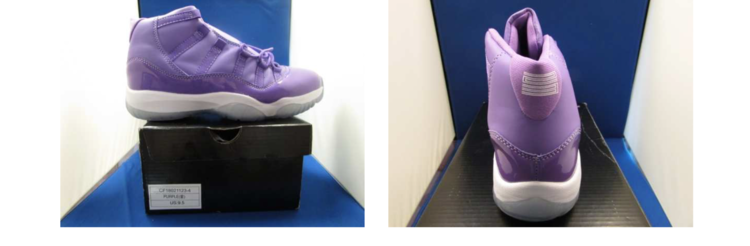
Among the sneakers seized by Customs were ones from Virgil Abloh’s coveted collaboration with the brand to similarly in-demand Air Max 98 models, complete with Nike’s name and similarly-protected swoosh logo. Also in the mix were exact replicas of Nike’s Jordan 11 sneakers, albeit without any explicit Nike branding at all. The company asserts in its suit that this is a common – and particiarly telling – move, as “counterfeiters often import footwear that copies [its] Jordan 11 trade dress without any identifying trademarks, and then after those products clear U.S. Customs, they attach counterfeit trademarks.”
“The commingling of counterfeit Nike sneakers bearing the Nike trademarks with those bearing the Jordan 11 trade dress but no identifying marks shows that the defendants were determined to continue their counterfeiting operations within the U.S.,” Nike argues. In other words, the scheme is far from over once the sneakers pass through Customs. It continues on once the products are in the U.S., with other individuals working in conjunction with the defendants further down the line.
After linking the defendants to at least three shipments that predated the one that was seized in November 2019, Nike filed a lengthy and strongly-worded suit, one that mirrors some of the cases it has filed against customs brokers in the past. In the 200 page-plus filing, Nike sets forth a handful of counterfeiting and trademark infringement and dilution claims, as well as a claiming violations of a trademark statute that legally outlaws “the importation of goods bearing infringing marks or names forbidden,” against all of the defendants, arguing, among other things that are “responsible for the importation of the counterfeit Nike sneakers because they filed, or assisted in the filing of, the entry documentation for the four shipments.”
More than that, Nike claims that the defendants each “willfully disregarded their duties as a customs broker, overseas transportation intermediary, and/or non-vessel operating common carrier in facilitating the transportation and importation of the four shipments, which consisted of the counterfeit Nike sneakers.”
With the foregoing in mind, Nike is seeking injunctive relief to permanently bar the defendants and “all those in active concert or participation with them” from importing or assisting in the importation counterfeit or otherwise infringing Nike products. The sportswear titan also claims that it is entitled to “damages for all of the defendants’ profits derived from their past unlawful conduct, trebled,” plus “reasonable attorney fees … given the defendants’ willful and bad faith acts.”
*The case is Nike, Inc. v. B&H Customs Services, Inc. et al, 1:20-cv-01214 (SDNY).










