






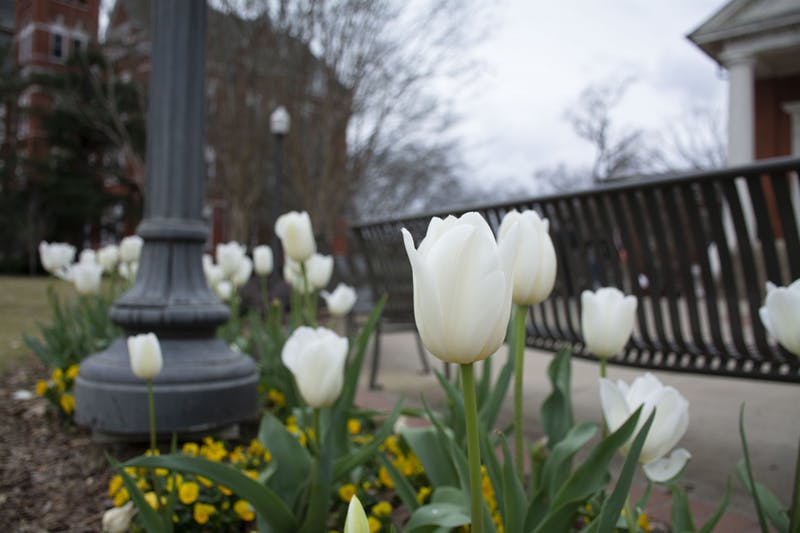
Auburn University’s campus is foremost a place of learning, but it is also a thriving community of 1,785 acres — an area that takes a number of hands and offices to make the “Loveliest Village on the Plains” live up to its nickname.
Justin Sutton, director of landscape services, said there are about 50 landscapers at Auburn. For daily maintenance, they have six zones, each with a supervisor and five to six employees.
“Those are mostly the people you see out and about every day,” Sutton said. “They maintain their area of responsibility, and that goes everything from mowing grass to trimming shrubs to applying fertilizers.”
Sutton said along with maintenance, landscaping has projects they plan and execute. They also assist with capital projects that are installed by a contractor and once the projects are complete, they keep up the maintenance.
He said the cost of maintenance and materials average around $340,000 a year for landscape services. About half of that cost is for the materials used for projects.
Within that number, pine straw and mulch average about $78,000, fertilizer and pesticides $53,000 and soil $3,600 respectively.
“This [soil] number is low due to a lot of our soil and amendment coming from our compost yard, and the soil that is milled off of Jordan-Hare Stadium,” he said.
Sutton said most of the plants on campus are drought-tolerant. However, their annual colors, like the flowers, rotate frequently, he said.
“We grow most of what we put on campus here at our facilities site and our greenhouse,” he said.
Sutton said he gives credit to the staff who earn each landscaping award the University receives.
“We got a lot of guys who are just dedicated to their job and are proud of what they do,” Sutton said. “They just keep campus going great no matter what time of year it is.”
Morgan Beadles, the director of the Donald E. Davis Arboretum, said the arboretum helps with conservation.
Beadles said the upkeep takes a lot of specialized maintenance and hands-on work with pruning shrubs and fertilizing.
“We have a collection to protect, so we can’t have big machinery out here,” she said. “We can’t have big, heavy equipment moving around because you have to protect the roots in the collection.”
Beadles said the workload is always heavy, but the type of work changes with the seasons.
“There’s a balance between it feeling natural and manicured and not overly manicured, but still safe,” Beadles said.
Between student employees, repairs and materials, Beadles said they spend about $40,000 a year on maintenance.
She said they get a semi-truck load of pine straw, and this year, they got about 1,568 bales of pine straw.
Through this effort, Beadles said they have won the AU Spirit of Sustainability Award, the Eagle Award from the Auburn Chamber of Commerce and have been the American Public Garden Association’s featured garden of the week twice.
Maintaining scenery isn’t only about keeping campus visually appealing, but also about providing a learning space for certain majors to gain practical experience.
Some schools make use of Parkerson Mill Creek as a teaching tool for students, but because it runs through campus, it also requires annual cleanup.
“All the trash that’s on the streets that goes into the gutters ultimately ends up into the creek, and so we try to promote initiatives that keep the campus clean,” said Tom McCauley, environmental program manager of Risk Management Services. “We try to bring awareness to the fact that the creek is a resource. It’s an attribute to campus, and we should try to preserve that as best we can.”
Unlike other environmental affairs, the yearly creek cleanup is entirely a student and faculty effort. McCauley said it’s not financial funding but an investment of time and energy from the Auburn Family that allows the program to exist.
“All of our efforts are volunteer efforts,” McCauley said. “We try to involve faculty and students as best as we can, [and] we try to partner with the City because we have a mutual interest.”
Not only has the cleanup benefited major programs like hydrology, aquatic behaviors and ecosystems and engineering, it has additionally helped the University receive a designation for its sustainable water system.
“The University was designated as a watershed of excellence, which means we’ve got the means to promote watershed conservation,” McCauley said. “There’s no better way to show it by example than creating a watershed here on campus that’s a preserved specimen.”
McCauley said cleanups usually occur in cooler months during late winter and early spring when volunteers might be more amenable to collect trash.
“Several times a year we’ll try to gather some momentum, get some involvement through some campus organizations,” McCauley said.
Its latest events were on Feb. 23, in a partnership with Omega Phi Alpha, and on March 1, in association with Alternative Student Breaks. It has one other cleanup planned for the semester on April 4, with the Office of Sustainability in advance of Earth Week.
Waste Reduction and Recycling is the department that sees the rest of campus land and litter maintained each year. This is a significant responsibility for an institution of 30,000 students, and the office receives strong financial backing by the University to uphold its mission: to “strive to make recycling accessible and convenient,” said Joan Hicken, WRR’s manager.
“[Our] yearly budget is about $500,000, and the solid waste and recycling collection contract is about $600,000 annually,” Hicken said. “We want to encourage students, staff, faculty and visitors to incorporate recycling into their daily routine on campus.”
A sizable portion of this funding goes into upkeep for WRR’s containers and machinery. These include over 400 hand-pick trash bins, 130 front-end loaders for solid waste and 200 95-gallon recycling bins, among other utilities.
Altogether in 2019, the University recycled 371 tons of cardboard, 219 tons of paper, 50 tons of scrap metal, 41 tons of plastic, aluminum and steel and 3.5 tons of printer ink cartridges and toner.
Most notably, WRR collected 2,041 tons of construction and demolition debris from on-campus projects in the past year that included sidewalks and sheds that were destroyed. The removal of Allison Laboratory, while not factored into this count, also brought the department a lot of recycled and reclaimed material.
“3,161 tons of concrete, 196 tons of asphalt, 129 tons of metal and 85 tons of wood were removed and recycled,” Hicken said. “In addition, 45,265 linear feet of lumber was reclaimed for future design use by the University.”
All concrete, metal and wood that made up Allison Laboratory was fully recycled by the department, she said.
Football season is perhaps WRR’s most important time of year; a plethora of people visiting campus for games means a wave of waste follows and is a high cost for the department.
They started the Gameday Recycling program to bring hundreds of recycling bins in and around Jordan-Hare Stadium to ensure fans put their trash in the proper receptacles.
“Gameday Recycling is an opportunity for the University to demonstrate to the campus community that recycling and waste reduction activities are not limited to the home,” Hicken said. “To provide waste and recycling services for each home football game is on average $15,000 per game. Each home football game generates, on average, 52 tons of waste and recycling.”
Hicken said WRR performs its functions in tandem with other offices such as Housing and Residence Life, Tiger Dining, Risk Management Services and Auburn Athletics to achieve the University’s land-grant mission of improving the lives of Alabamians and people beyond.
“The entire campus community plays a role in our progress to becoming a more sustainable campus,” Hicken said. “There is not an aspect of campus life that is not touched by waste and recycling.”
Keeping campus beautiful isn’t just a job for a single group. At Auburn, it takes a team of departments and organizations to maintain the campus landscape and promote a loveliness the University seeks to preserve.