






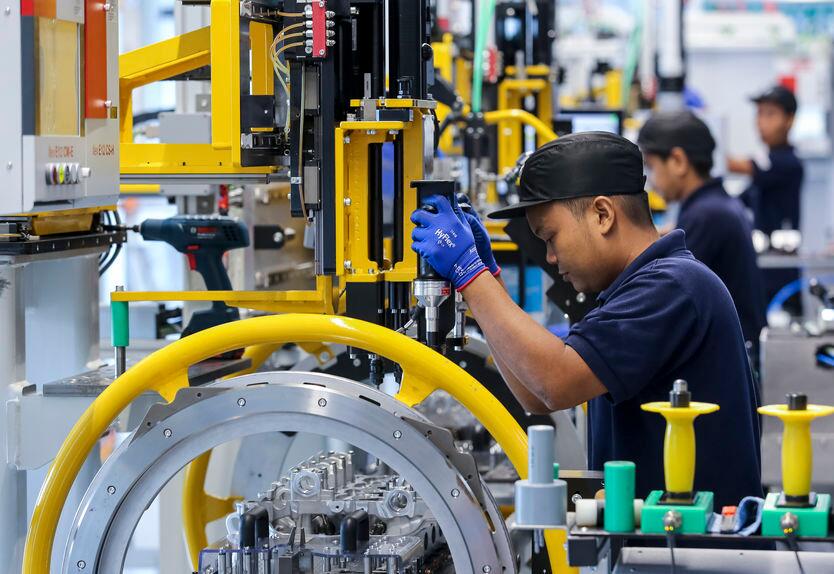
The global manufacturing supply chain faced a challenging year in 2019 due to the ongoing trade war between the United States and China. The uncertainty surrounding the trade tension has brought many companies in Asia to readjust their investments and shift their manufacturing focus to avoid tariffs placed by the US on China-made products.
Supply chains were disrupted. Many companies in China that export to the United States have relocated to Southeast Asian countries to circumvent tariffs. Vietnam has received the majority of the relocation in labor-intensive to high-tech industries, according to Thailand Development Research Institute (TDRI) Economic Intelligence Service. Some companies that have moved to Vietnam include Nintendo, Kyocera, TCL, GoPro, and Goertek, to name a few. Daikin Industries, Casio Computer, Ricoh, and Delta Electronics, meanwhile, are among those who went to Thailand; while Wistron Infocomm is eyeing the Philippines. Catcher Technology, a supplier to Wistron, is likewise mulling investing in the Philippines.
The impact of these relocations is expected to be more evident this year and to be among the main drivers of the region’s economy. That is, until something unexpected happened—just when everyone has been looking forward to a recovery in 2020. The arrival of the novel coronavirus, or COVID-19.
As of March 12, 2020, the COVID-19 outbreak has infected 125,610 individuals worldwide and killed 4,623 since it was first reported in Wuhan, China, on December 31, 2019. While almost all the cases have occurred in China, the virus has spread to more than 100 other countries.
COVID-19 has effectively put a dent in global supply chains. One of the industries mainly affected is the automotive manufacturing sector. As China has become a major automotive and parts manufacturer, plant shutdowns all over the country have sent ripples across the global automotive manufacturing supply chain. Nissan, Honda Motor and PSA Peugeot Citroen have suspended operations in China to keep their workers at home in order to minimize spread of the virus. Tesla postponed the production of its Model 3 at its new factory in Shanghai which it has shut down, while Volkswagen postponed production at all of its Chinese plants run in partnership with SAIC. Hyundai halted one of its assembly lines in South Korea due to the lack of auto parts from China as a result of the outbreak, while Nissan announced it would suspend its production in Japan.
In the electronics manufacturing sector, manufacturers anticipate product shipments to be delayed by more than at least five weeks, according to a survey by IPC, a global trade group representing contract manufacturers, OEMs, and electronics parts suppliers.
There are several reasons why electronics manufacturers and their suppliers might expect delays to be longer than what they are being told by their suppliers. IPC explains: Manufacturing capacity and utilization are two factors that work in tandem. When suppliers have low manufacturing utilization rates, there is significant short-term pain even though they generally have the potential—over time—to boost production and shorten shipment times.
Because of COVID-19, however, utilization rates have dropped significantly because of factory closures. Travel bans, which kept workers from returning to work after the Lunar New Year, have added to this dilemma, such that even though some factories have resumed production, utilization rates are still below previous figures due to labor shortages.
I have a friend working for a company that manufactures certain parts for the fruit company. Based in Shenzhen, he went back to the Philippines around late January because of the Lunar New Year. However, because of COVID-19, the Philippine government announced a travel ban to China, Hong Kong and Macau—thus, keeping him from returning to his work. He’s still here because the government has yet to lift the travel restrictions.
He noted that their group had experienced labor disruptions because of the quarantine required for workers returning from their holidays to Shenzhen.
Another friend, meanwhile, works for one of the biggest power management solutions providers worldwide. Her division manufactures magnetic components, mostly inductors and transformers used in servers and headlights. They had to shut down their line in the Philippines for almost a week last month because of the lack of raw materials—their only two sources, main and alternate, are both based in China because they are the cheapest. Plant shutdowns in China, and even the quarantine process required for parts—yes, parts!—being shipped out of China have significantly impacted their manufacturing line. All because of COVID-19.
And then I’ve another friend who works for one of the biggest manufacturers of circuit protection technologies globally. She mentioned that because of COVID-19, they had to shut down operations in two plants, one in China and another in Singapore, due to precautionary measures. The Singapore facility was shut down recently because it is in the same industrial park where a company had confirmed cases of coronavirus infection.
There are definitely more stories like the above, as COVID-19 make its impact on more than 100 countries. What everyone in the manufacturing industry seemed to be expecting as a year of recovery from the economic downturn of last year might just not materialize as yet—not until the outbreak has been fully contained.
Be that as it may, from a manufacturing perspective, it is events such as this that usually put the spotlight on a company’s supply chain resilience. It is important to have strategies that would ensure continuity in your supply chain if one or more sourcing centers have shut down or have been incapacitated. Just like the case of my friend, who depend on two suppliers from China for their raw materials.
Of course, challenges such as this offer opportunities. We are many weeks away from possible containment of the virus, but as manufacturers rethink their strategies and look outside of China to find alternative supply chain sources, manufacturers in the ASEAN region are on a sweet spot. Despite the gloom being felt right now, the onus is on them to gear up their capabilities so as to hit the ground running, so to speak, when the time for recovery starts.










