



 A woman wearing a mask stands outside a closed fashion store in Naples, Italy.
Source: AP Photo
China is slowly resuming manufacturing activities after weeks of factory shutdowns and logistical restrictions, but the impact on global apparel companies is likely to continue for the foreseeable future as the new coronavirus spreads globally.
Although clothing companies have a large exposure to China, they have so far managed to limit the impact, industry observers say. Even before COVID-19 struck China, many businesses were shifting manufacturing to Vietnam, Cambodia and Bangladesh due to rising labor costs and uncertainty around the U.S.-China trade war. COVID-19 is the disease caused by the new coronavirus.
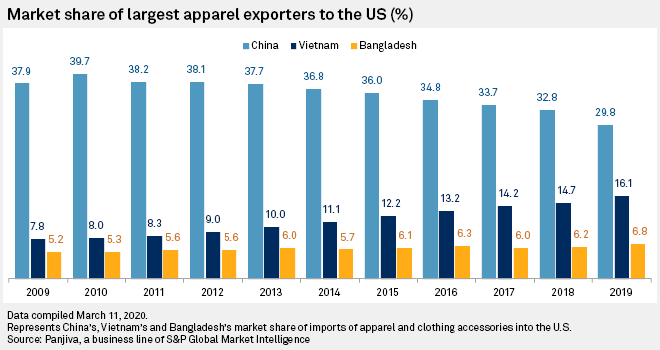
In the fourth quarter of 2019, U.S. imports of apparel and textiles fell 25.4% year over year from China while rising 14.3% from Cambodia, 8.6% from Bangladesh and 6.0% from Vietnam, according to data from Panjiva. The pattern continued in January with Cambodian exports to the U.S. rising by 23.8% compared to a 31.7% slump in shipments from China, the data shows.
However, these countries continue to rely heavily on China for “intermediate inputs” such as raw materials and unfinished goods and services. Once the additional stock imported from China in anticipation of factory shutdowns during the Lunar New Year holidays is depleted, the global textile and apparel industry is expected to face the brunt of the supply disruption.
China is intricately woven into the global consumer supply chain fabric, not just as a manufacturer and a retailer but also as a supplier of intermediate inputs. As of March 4, about 20% of global trade in manufacturing intermediate products originated in China, according to the United Nations Conference on Trade and Development.
The UNCTAD data shows that the European Union and Vietnam are expected to be the worst hit by the disruption in inputs for textile and apparel products.
While Vietnam has managed to contain the outbreak, it imports about 55% to 60% of raw materials in the garment industry from China, according to the Vietnam Textile and Apparel Association.
Hong Kong-listed Lever Style Corp., which manufactures for brands including Paul Smith and Hugo Boss, has set up a major production base in Vietnam. Executive Chairman Stanley Szeto said in an interview that although their factories have yet to experience any meaningful delays, it is not easy to find supply alternatives beyond China for factories that are based in Southeast Asia.
“There may be a gradual shift in the supply chain. That gradual is going to be very gradual,” said Szeto, adding that while raw materials from China are not necessarily more price competitive, the country’s scale, capacity and fast turnover is unmatched by any alternatives.
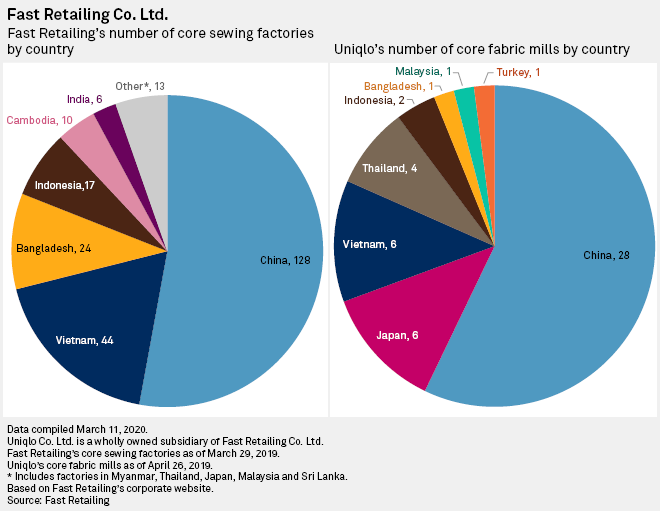
Uniqlo-owner Fast Retailing Co. Ltd. is particularly exposed to the outbreak, with more than half its sewing factories and fabric mills located in China and a quarter in Southeast Asia. Manufacturers in Vietnam warned that many sewing factories in the country would face a serious shortfall of raw materials starting April if shipments do not resume in March.
Fast-fashion retailers, which rely on releasing new lines every few weeks and holding as little stock as possible, would be particularly vulnerable to supplier disruptions.
Spread your bets
The situation has brought to light the challenges manufacturers face in diversifying their supply chains.
“For true risk mitigation, you have to think about the entire global supply chain, and not [just] the parties you deal with immediately … who they deal with and the knock-on effect on my supply chain,” said Edwin Keh, CEO of Hong Kong Research Institute of Textile and Apparel.
“Moving the final place of manufacturing doesn’t mean you mitigate the total production risk in the supply chain,” Keh said, emphasizing the need for manufacturers to have transparency and traceability in the supply chain.
Unlike their Southeast Asian counterparts, South Asian countries such as India and Bangladesh have the entire value chain of textile products within their country.
India was the third-largest textile exporter in 2018 after China and the EU, and its textile and apparel exports totaled $21.7 billion between April and November 2019. Bangladesh has emerged as the third-largest exporter to the U.S. after China and Vietnam.
In the near term, apparel manufacturers may look at these countries to make up for the shortfall in supply, but China may still remain the top supplier once it recovers from the outbreak, said Bin Shen, associate professor in electronic commerce and logistics at Donghua University.
Shen, however, noted that trade policies would be factored into manufacturers’ thought processes when considering whether to diversify their source countries.
For instance, China has a free trade agreement with the ASEAN, an intergovernmental body representing the Southeast Asian countries. Indian textile manufacturers, meanwhile, are worried that the country’s existing free trade deals with Indonesia and Vietnam have disadvantaged local mills. The country also lacks free trade deals with the European Union, Canada and Australia.
“Vietnam has a long-standing relationship with China in imports related to the apparel industry, through a complicated process via middleman companies. Since they are bound by contracts, it is not possible to switch supply on a whim as the fashion retailers would still have to carry out on-site visits and evaluation on the suppliers in a process that could take up to three months,” said Shen.
East meets west
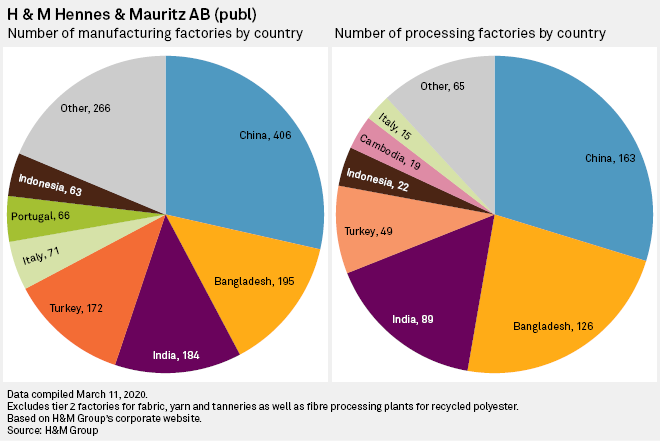
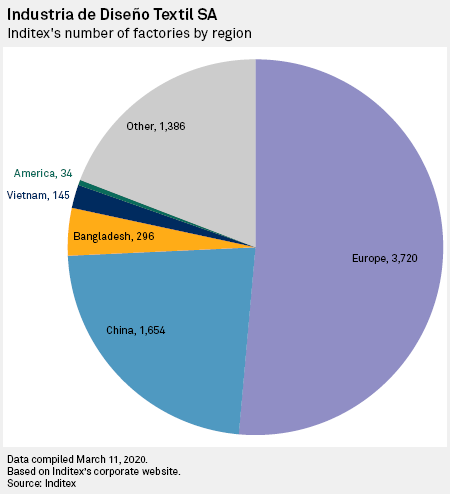
The spread of the contagion to Europe and other parts of the world will increase the threat to bigger players such as Industria de Diseño Textil SA and H & M Hennes & Mauritz AB (publ) that have fairly diverse supply chains. The two companies have had relatively little exposure to manufacturing shutdowns in China, with less than a third of their manufacturing facilities located in the country.
In an emailed statement, an H&M representative said it is constantly monitoring developments and does not anticipate the coronavirus impact to cause significant delays to its supplies. The Swedish company has temporarily closed 41 of its more than 500 stores in China.
“We are in close contact with our suppliers and evaluating the situation together with them,” the representative said.
|
|
Inditex did not respond to requests for comment.
Salmon Lee, head of polyester at commodity consultancy Wood Mackenzie, said the simple lesson that can be drawn is that manufacturers should not put all their eggs in one basket.
“I don’t think anybody was able to imagine what has happened in the past one-and-a-half months. Suddenly one major source just disappears into thin air,” said Lee.
“The pragmatic will say, ‘You can’t forget about China, but you can lessen [the impact] and protect yourself if you do not only buy from China.'”
Panjiva is a business line of S&P Global Market Intelligence, a division of S&P Global Inc.