






Forward Thinking
By Philip J. Palin | March 16, 2020
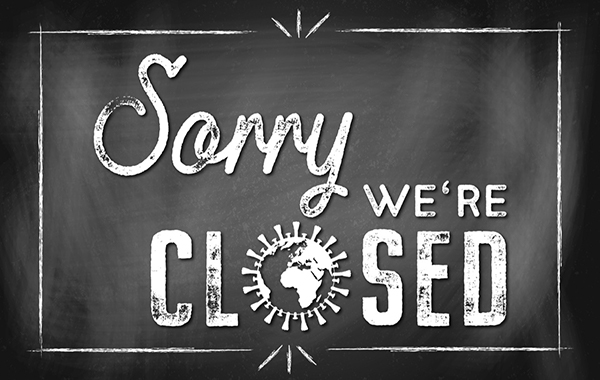
Wide-area mandatory closures of schools and workplaces in response to coronavirus concerns could have a negative effect on supply chain resiliency.
Author’s Note: The thoughts below are my personal opinion and do not reflect the policy or guidance of any organization with which I am affiliated or have been affiliated with in the past.
As the number of confirmed cases of the novel coronavirus (or COVID-19) increase in the United States, many organizations have canceled large events, local and state governments have announced mandatory school closures, and workplace, travel, and other restrictions are being considered. What effect could these closures have on supply chains and the nation’s recovery from the outbreak?
The following are likely outcomes based on work that I have done since 2008 to advance supply chain resilience.
Event cancellations
In my judgment, prohibiting large public and private events should have no systemic impact on demand and supply networks.
Such actions obviously will have economic effects that will accumulate over time, and these effects will—over time—be reflected in marginally reduced consumer demand. But given what we are seeing out of China, implementation of this restriction could reduce virus transmission over the next few critical weeks while presenting almost no risk to the integrity and velocity of supply chains. If our experience—and especially event calendar—is similar to China’s, demand and supply networks will barely notice the absence of large events. But virus transmission will be impeded.
Mandatory workplace and school shutdowns
I take a more nuanced view, however, of mandatory shutdowns of workplaces and schools. In these cases, I perceive supply chain effects will depend on the size of the “containment zone” and whether or not schools are involved. Here are three angles of engagement:
- When possible, government mandated shutdowns should be “precision targeted.” If mandatory shutdowns are implemented in a precision-targeted way—involving areas of less than 9 square miles, for example—then demand and supply networks can adapt. While the containment zone might experience confusion, delay, and other complications in regard to getting needed goods and services, the overall network will not be systemically impacted. The network can probably adapt to several such precision-targeted containment zones. But at some difficult-to-predict point, if network fragmentation continues, it will impede so many nodes and links in the supply chain that the flow of goods and services will stop.
- Government-mandated, wide-area, simultaneous workplace shutdowns will threaten every aspect of continued supply chain operations. The more expansive the geographic scope of simultaneous shutdowns, the more threatening they will be to continued network flow. Mandatory workplace closures—even those that try to explicitly exclude healthcare and grocery supply chains—will quickly and seriously undermine the capacity of all supply chains, many workers in essential sectors will choose not to work or find it not possible to work (see below). Consumers will respond to this threat signal by increasing their already unsustainable pull on many products and services. Where consumer demand is highest, the effects will be worst.
- Wide-area, simultaneous closure of schools will substantially reduce supply chain capacity, generate widespread shortages of many products, and seriously complicate and delay recovery. Given workforce characteristics in the United States—especially in the food and healthcare sectors—school closures amplify all the problems involved in workplace closures.
If schools close, parents will need to stay home with school-age children and will be unable to come into work. Meanwhile workers without children will feel increasingly at-risk. Workplace absences will increase across crucial supply chains including health care and grocery. This in turn will dramatically curtail flow capacity. I have already heard from trucking companies saying they are not confident that truckers will deliver into areas where schools are closed. Even getting drivers to deliver to the edge of such areas may require confidence-building measures.
The circulation of this particular virus among school-age children and most individuals under age 60 seems to be much less consequential than for other demographic groups. This has potentially important implications for the risk-assessment behind school closures. It is true that prior pandemics have generated persuasive evidence that early school closures saved lives. In these prior pandemics, however, children were both vectors and, especially, victims of the disease.
For reasons not yet understood, in this pandemic morbidity and mortality rates among those under 10-years-old is scant and even up to age 40 there is little evidence of deadly risk to populations-at-large. In the most in-depth study so-far undertaken, 0.9% of patients presenting for hospital care were younger than 15 years of age. In another more wide-ranging study, of 12,000 confirmed cases involving patients under age 40, 26 died. The World Health Organization reports: “As this is a new virus, we are still learning about how it affects children. We know it is possible for people of any age to be infected with the virus, but so far there are relatively few cases of COVID-19 reported among children.”
Indeed, guidance from the World Health Organization, UNICEF, and others recommends: “Instead of keeping children out of school, teach them good hand and respiratory hygiene practices for school and elsewhere, like frequent handwashing… covering a cough or sneeze with a flexed elbow or tissue, then throwing away the tissue into a closed bin, and not touching their eyes, mouths or noses if they haven’t properly washed their hands.”
The government of the United Kingdom has, as a matter of explicit policy, decided to keep schools open. Expert guidance and support are being made available for this purpose. On March 12, Prime Minister Boris Johnson said, “We are not—repeat not—closing schools now. The scientific advice is it will do more harm than good at this time, but of course we’re keeping an open view and may change this as the disease spreads. Schools should only close if they are specifically told to do so.” It is unclear if scientific advice can survive—much less assuage—public anxieties.
React, but don’t overreact
I am not recommending that we ignore calls for social distancing and other public health good practices. Social distancing will save lives. Reducing human interaction over the next two to three weeks in particular will save lives. When we are face-to-face, we should maintain a distance of at least six feet. We should not shake hands. We should wash our hands often. We should avoid behavior that can transfer the virus to our nose and mouth. This is a serious disease, especially for those over 60 years old. For people over age 60 (like me), the risk rapidly increases then spikes, especially for those with pre-existing conditions. There are good reasons to limit human interactions.
That said, as we consider moving beyond enhanced population hygiene, voluntary workplace closures, and banning large events, we must realize that mandatory shutdowns will have secondary and tertiary impacts that will constrain delivery of essential services to the population. Indiscriminate, inflexible, simultaneous, wide-area shutdowns will also have impacts on human health. As usual, the most vulnerable are likely to be those most hurt.
It is my judgment that implementation of simultaneous, wide-area shutdowns across China were necessary in Wuhan city, Hubei Province, and perhaps parts of three other provinces. In these places, the transmission rate had exploded before anyone was seriously looking. The demand and supply networks needed to be taken down, so that COVID-19 could not exploit them.
By contrast, in Shanghai (which has a population of 27 million people), there have been 344 confirmed cases and three deaths. There the network’s shutdown caused more human morbidity and mortality than the virus itself. Then, of course, there are economic consequences. There is evidence that the network disruption and fear caused by simultaneous, wide-area, shutdowns across China has seriously exacerbated and delayed recovery.
This is a profoundly uncertain situation. We are facing—and will face—recurring shocks and sustained stress for the next six to eight weeks, potentially longer depending on what we do in response to these unfolding shocks and stress.
In January, I began raising concerns and then alarms. We were too slow to seriously engage the emerging problem. Now I am convinced fear and overreaction are making a difficult situation worse. We are seeking certainty where there is no certainty. This is distracting us from realities that should be well-known.
We know how people are fed today and can be fed tomorrow. We ought not bite the hand that feeds us (especially in these uncertain times). We know how water is delivered. We ought not dam the channels. We know much more. We should avoid undoing the systems that serve us so well.
We do not understand COVID-19. But evidence suggests reasonable human hygiene, social distancing, and traditional epidemiological practice can be effective in slowing transmission. We should absolutely anticipate a surge in healthcare demand and do everything we can to mitigate and support that surge. Especially for those of us over 60, avoid crowds and follow good practice guidelines. If you are over 80 and/or have a preexisting condition, please self-isolate now. But along the way, let’s avoid killing the networks on which all of us depend.
Philip J. Palin has served as the principal investigator for Supply Chain Resilience with the Institute for Public Research of the not-for-profit CNA Corporation and with the Resilient America Roundtable of the National Academies of Sciences, Engineering, and Medicine.
Join the Discussion
After you comment, click Post. If you’re not already logged in, you will be asked to log in or register.

Want more articles like this? Sign up for a free subscription to Supply Chain Executive Insight, a monthly e-newsletter that provides insights and commentary on supply chain trends and developments. Click here to subscribe.
We Want to Hear From You! We invite you to share your thoughts and opinions about this article by sending an e-mail to
?Subject=Letter to the Editor: Quarter : Commentary: Coronavirus-related cancellations and closures—How they could affect the supply chain”>
. We will publish selected readers’ comments in future issues of CSCMP’s Supply Chain Quarterly. Correspondence may be edited for clarity or for length.
Want more articles like this? Subscribe to CSCMP’s Supply Chain Quarterly.