







The global e-commerce market is booming, and it’s growing faster than the more-saturated U.S. market. Global e-commerce sales increased 20.7 percent last year, surpassing the 14.9 percent growth in the U.S.
With such incredible growth numbers, perhaps it’s time to assess how domestic merchants can expand further and tap into international customers. In the past, I’ve discussed how merchants can make free shipping profitable domestically. This time we’re shifting our focus to winning the global e-commerce game. (Here are parts one, two, three, four, and five in this multipart series.)
1. Localization and Full-Service Cross-Border Solutions
Localization helps customers relate to your website, which can increase speed to trust. There are three things to note during localization: language, accurate final costs, and payment methods.
In countries where English is less dominant, navigating your English-only site can be a daunting task for consumers. In countries like China, Colombia, and Brazil, less than 25 percent of the population is proficient in English. It doesn’t stop at merely having your content translated. Once you’ve garnered enough following, further consider tailoring your promotions and content to relate better with customers.
The next part is having an accurate final cost for customers during checkout, which includes duties and tariffs. Without this clarity upfront, customers end up having to deal with imports and customs fees themselves. For example, a customer in Indonesia orders a board game from a U.S. merchant for $125 plus shipping. However, per Indonesian customs rule, any shipment valued over $3 is charged a 7.5 percent duty. If the retailer didn’t include such information upfront, the customer would see a surprise bill. Such an experience would deter that customer from making future purchases from this site.
Additionally, having familiar local currency and payment options at checkout further reduces hesitancy.
Merchants don’t have to figure out localization alone. Cross-border solutions such as Pitney Bowes’ BorderFree and International Checkout assist merchants with localization. They provide a comprehensive solution for selling to international customers. An end-to-end solution offering typically includes:
- Localization of your product content and checkout pages in locale-specific language, user interface, and currency.
- Automatic calculation of taxes, duties and fees during checkout.
- Integration and processing of local payment options for your website.
- International order fulfillment using freight forwarders and other service providers.

Credit: Cahoot
The following checkout page of an online store that uses Borderfree shows personalization to a Chinese customer buying from a seller located in Australia.

Credit: Cahoot
Pros:
- Sellers can increase their market reach to include international customers without having to deal with all the operational complexities.
- Sellers save on additional costs for website development that include local payments and locale-specific content and customer service for international customers.
Cons:
- Limited control over customer experience for international customers due to complete dependence on a third-party service provider.
- The program may not be profitable, at least in the beginning, if your products don’t have sufficient demand in the overseas market.
2. Drop-Shipping With ePacket Service
Merchants conduct market tests to see if there’s enough demand for their products in a new country. They often employ less asset-intense strategies to minimize potential losses if the new market doesn’t work. If your products are manufactured in China, consider talking to your supplier to support a drop-ship model by leveraging the low-cost ePacket service. Merchants can also use drop-shipping to introduce new SKUs before committing to stocking them as inventory.
The ePacket program enables merchants to ship products that weigh less than 4.4 pounds to 35 countries for a low rate. However, it’s a slower service that might take a long time to reach your customers. The latest pricing can be found here. Marketplaces like Wish & Aliexpress have been leveraging ePacket rates to offer Chinese goods on the cheap by sacrificing speed.
Wish.com bases its entire business model on Chinese sellers using ePacket to deliver their products at extremely low prices. As a seller, you too can take advantage of this. Start with establishing a trusted supplier of quality items in China.
It’s important to note that this program may not last much longer. The Trump administration successfully negotiated with the Universal Postal Union to set its own terminal rates by July 2020, and other countries receiving 75,000 tonnes of mail or more will follow suit in 2021.
Pros:
- No warehouse needed to start selling using a drop-ship partner in China
- Its low price draws the price-conscious shopper
- Useful market testing tool for new products
Cons:
- The deliveries can take up to 20 days
- ePacket only works for items weighing less than 4.4 pounds
- Managing and reselling returns can become a complex operation
3. International Freight Forwarding
To fulfill international orders, you can choose to partner with a 3PL in a foreign country or even use Amazon FBA and send your inventory in bulk via freight. It’s most cost effective to ship when merchants have enough inventory to fill less-than-container load (LCL) shipments or even a full container. Navigating border controls and customs can, however, be a headache for inexperienced merchants.
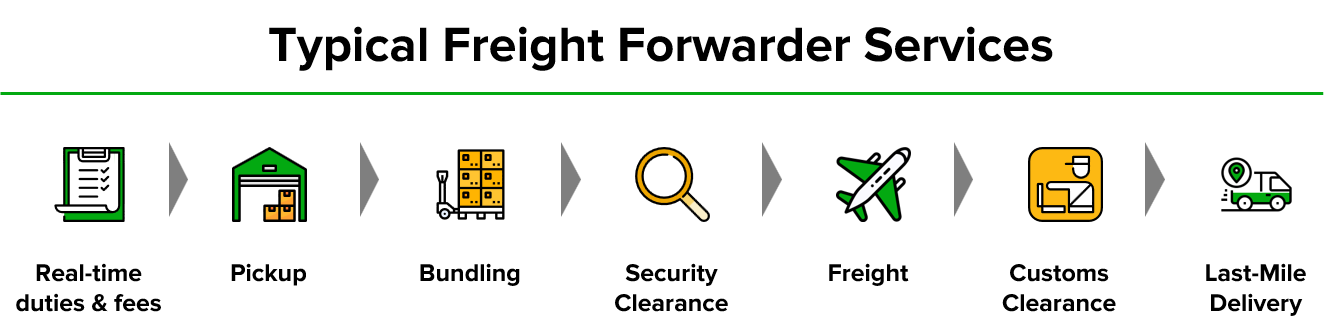
International Freight Forwarding services carry out the logistics operations on behalf of a merchant, including customs. They can handle the inbound receipt of goods to help merchants with e-commerce order fulfillment locally and regionally.
In a nutshell, forwarders provide freight services for merchants, which is cheaper than standard international parcel shipping. They move pallets and containers to the destination country via freight (air, ocean, or ground). At the destination, they will deliver your inventory to warehouses or distributors. Another benefit of forwarders is the simplicity of having another party deal with export-import regulation compliance, forms, and problems that arise during cross-border transport.
Credit: Cahoot
Some freight forwarders have evolved to offer e-commerce-focused services and offer air shipments at low rates. DHL eCommerce is an example of a freight forwarder that has evolved from servicing cross-border e-commerce merchants all the way to final delivery to individual customers.

Credit: DHL
Pros:
- Forwarders have expertise in destination country regulations and can ensure compliance and seamless customs clearance.
- Forwarders can advise merchants on duty rates for different SKU categories, which helps merchants refine their international sales strategy.
- Merchants enjoy lower rates via consolidated freight.
- Some forwarders can ship goods to both warehouses and direct to consumers.
Cons:
- Forwarders are not responsible for shipping delays. Many steps, checks and parties are involved in cross-border delivery, which makes it more unpredictable (e.g., bad weather, breakdown, route changes).
- Not all forwarders have advanced tracking tools. Some only offer an ETA and tracking number.
4. Peer-to-Peer Fulfillment From Cross Border
Shipping to a U.K. address from New York would take about seven days to 10 days to arrive, compared to one or two days locally from the U.K. Traditionally merchants expanding to new countries work with 3PLs or operate their own warehouse. However, it comes with a high barrier to entry. The merchant needs to do substantial due diligence to find the 3PL they want to work with, negotiate, and ensure their reliability. Operating one’s own warehouse would require strong and consistent demand for products in that market, finding and securing the location, as well as hiring staff and managing operations day-to-day.
The peer-to-peer order fulfillment model from part five also applies to cross-border e-commerce. The basic premise is simple: put your inventory into a warehouse from a trusted network partner and enable fast shipping for the destination country. With peer-to-peer, you can outsource your fulfillment in the destination country like working with a 3PL, and quickly find trusted partners through the network. But it has lower costs by design. The barter model cuts down storage and fulfillment costs because merchants fulfill for each other.
There may be complexities of customs, freight and taxation involved in cross border e-commerce, which may need to be reviewed with such an arrangement.

Credit: Cahoot
Pros:
- Minimal up-front costs and lower shipping costs using local and regional carriers
- Offer dramatically faster shipping to customers in target countries
- Storage and fulfillment services and expertise from a local partner
- Lower storage and fulfillment fees than 3PLs due to barter system
Cons:
- Capacity and availability may be limited in some geographies
- Complexities regarding customs, duties, compliance and local taxes may require expert legal advice and guidance
- Expensive to return goods back to the home country if the inventory doesn’t sell out quickly
Manish Chowdhary is the founder and CEO of Cahoot, a peer-to-peer network where merchants collaborate to increase their sales and margins by offering profitable one-day and two-day free shipping to customers nationwide without spending a penny more than the economical ground shipping.










