






Jeenah Moon / Reuters
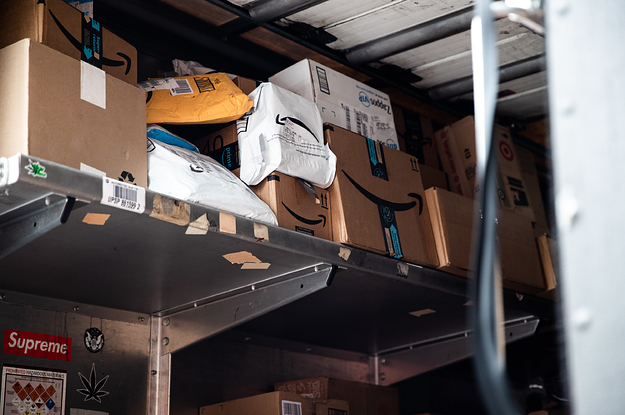
Amazon packages are seen on a delivery truck in New York City, New York, U.S., March 17, 2020. REUTERS/Jeenah Moon
The journalists at BuzzFeed News are proud to bring you trustworthy and relevant reporting about the coronavirus. To help keep this news free, become a member and sign up for our newsletter, Outbreak Today.
Amazon has stopped requiring some of its warehouse employees to gather in closely-packed groups for “stand up” meetings before every shift and is reconfiguring break rooms to promote social distancing and prevent spread of the coronavirus.
The shift in policy, which workers learned of Wednesday morning, comes in the face of growing protests from hourly workers who have complained to managers and signed petitions demanding that the meetings cease, and also that employees be allowed to keep a safe distance away from their colleagues during the outbreak. Workers have increasingly expressed fears of getting infected at work, and some warehouse employees in Europe have already tested positive for the virus.
Amazon orders have soared as people in self-quarantine buy essential goods online rather than go to physical stores. The company has struggled to keep its warehouses fully staffed after it offered hourly workers the opportunity to take unpaid time off if they felt sick — some employees report that attendance has been down as much as half in some locations.
On Monday, Amazon announced plans to hire an additional 100,000 hourly employees and to temporarily increase pay for new hires and existing employees by $2 an hour. Most warehouse workers make $15 an hour, but will receive $17 an hour until April 30 at least. Last week, Amazon also began instituting mandatory overtime, requiring warehouse workers to come in for one extra shift per week.
“This is the most people I have seen in this building since Christmas.”
In a memo to employees confirming the temporary raise, Amazon said the company was “helping people around the world in a way that very few can. Delivering items directly to someone’s door has never been more of an essential service, and your work makes it possible.”
Amazon did not immediately respond to a request for comment and it could not be determined whether the changes apply to all of its facilities in the US and the rest of the world. Amazon employs nearly 800,000 people worldwide, and has warehouses and other facilities in at least 16 countries.
Five Amazon workers at facilities in Italy and Spain have been diagnosed with COVID-19, prompting employees at a facility outside Milan to temporarily go on strike over concerns that the online retailer hasn’t been doing enough to help prevent spread of the disease. Amazon said on Tuesday that it would not be shutting down its European facilities in response to the virus.
Although two salaried employees at Amazon’s Seattle headquarters have tested positive for the virus, to date there have been no confirmed reports of any hourly workers — which make up the vast majority of the company’s labor force — coming down with the disease in the US to date.
Do you have questions you want answered? You can always get in touch. And if you’re someone who is seeing the impact of this firsthand, we’d also love to hear from you (you can reach out to us via one of our tip line channels).
Amazon has been providing workers at its fulfillment centers, sortation centers, and delivery stations with disinfecting wipes and hand sanitizer, but many have complained those are in short supply and that they had been obliged to huddle together for the daily stand up meetings as well as take their lunch in crowded break rooms.
In one facility, Amazon reduced the number of chairs in the break room to create more space, although employees could still sit facing each other across the table; it also reduced the number of microwaves from seven to three to create a foot of space between them. Signs at one facility on the East Coast said that furniture had been moved “to maintain a minimum of 3 feet of distance from one another” in order to practice social distancing.
Despite the new changes, one employee at an Amazon facility in the midwest said she still has concerns about health standards at Amazon.
“There [are] no stand ups but most containers are out of hand sanitizer and wipes are hard to find,” this employee, who requested anonymity out of concern she could lose her job, told BuzzFeed News. “I walked out the front door today and there was a manager vaping right in front the door who blew smoke on me as I was walking out. She added that the warehouse was crowded with workers because of the surging demand. “This is the most people I have seen in this building since Christmas,” she said.
Another Amazon employee from a facility in New York who lives with their 74 year old parent is worried about being exposed to the virus “inside Amazon’s petri dish.”
“They are putting our health and health of customers at risk for profit.”
She said they had seen on an internal on-line message board that workers were raising concerns about a lack of hand sanitizer and wipes. She said a manager answered: “we can’t keep up with demand and we are running out of supplies’. ”z The Amazon worker, who requested anonymity, said she she found this unacceptable. “They are putting our health and health of customers at risk for profit.”
Amazon has taken some steps to provide financial help to its massive workforce. Last week it said it was establishing a $25 million fund to assist employees and third-party contractors impacted by the pandemic; those people can apply for grants for as much as $5,000. But concerned employees say further measures are necessary.
Late on Monday, employee activist groups within Amazon announced that more than 1,500 employees worldwide had signed a petition demanding time-and-a-half hazard pay, paid sick leave and child care, as well as improved on-site safety precautions such as doing away with productivity based performance metrics.
Workers also complain that they are scared to take time away from their tasks to wash their hands regularly, because they fear falling behind on their strict performance metrics and potentially losing their jobs. Others, who want to be home to take care of kids who are no longer in school, say they fear that taking too much unpaid leave could get them fired, despite company assurances to the contrary.
Amazon has not responded to these employee demands. On Tuesday, it sent notes to third party merchants indicating that it would focus its warehouse stocking efforts on essential goods such as over the counter medication, cleaning supplies, and pet food.
For some high-demand products, such as batteries, the Amazon website now displays a note that “inventory and delivery may be temporarily unavailable due to increased demand.”
Ted Miin, an employee at an Amazon delivery station in Chicago, said it’s proving difficult for warehouse workers to do their jobs while keeping distance from one another despite the measures Amazon has instituted, like marking out six feet of space with tape on the floor.
“What they claim to be trying to do is create distance between workers, but this system does not accomplish that in any way,” he said. “You’re going to be coming in close contact anyway hundreds of times a day anyway while doing your job.”
Workers say Amazon has not communicated to its employees what other measures are being taken to ensure their safety. For example, there has been no internal messaging about whether it’s safe to handle packages that could potentially carry the virus on their surface. Employees have been wiping down their own scanners with disinfectant but worry it’s not enough.
“We’re the ones who are going to get hurt and get sick, and it’s only going to get worse,” said Miin. “Amazon is just trying to make as much money as they can while our health is sacrificed.”










