






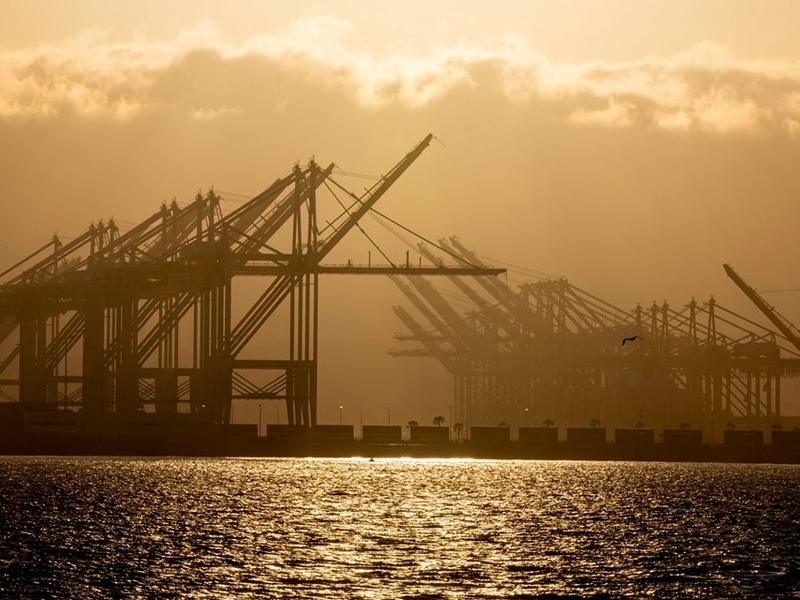
The coronavirus outbreak has ground the economy to a halt as people hunker down, resulting in a major disruption for the global manufacturing supply chain.
COVID-19 highlights the need for supply chain diversification and data from “human intelligence,” not just relying on Industry 4.0 or government statistics, according to a March 10 panel discussion at MODEX 2020 in Atlanta, one of the last trade shows held before the coronavirus set off a cascade of event cancelations.
“There’s a lot of fear. There’s a lot of uncertainty. There’s a lot of anxiety. In cases like this, data is critical. Good data that can be trusted is critical,” said David Shillingford, chairman of Resilience360, a cloud-based platform that tracks shipments.
Even as Chinese workers return to the job and ports there begin to reopen, Shillingford said, “the supply chain disruption is significant and will continue to be significant for a period of time.”
Demand for goods will be volatile, while some regions recover and others lag. The global economy will go through a ripple effect. For example, he said, if fabric plants in China go back online, are there truck drivers and dock crews available to ship it to clothing factories in Bangladesh?
During the MODEX panel, Shillingford said there are two main categories of supply chain data during a major disruption: A summary report of the data about this outbreak, and what is happening right now around the world. “Is this port open? Is this warehouse open? And that is tough to get ahold of. You really have to have boots on the ground, or at least partners on the ground who are willing to share data,” he said.
“Having a network like that and business partners that are prepared to share data is a much more effective way of getting real time ground-data than relying on government sources.”
Shillingford said it’s physical presence, not just Internet of Things.
“You hear more and more about IOT data. It’s very good for certain use cases, but you’ve always got to have the human element who is there to say ‘this is what’s happening on the ground.’ Or to interpret the data that’s coming from sensor-signals and things like that,” he said. “You’ve got to have both to understand what’s happening in a situation like this.”
MODEX is organized by MHI, a trade association covering material handling, logistics and supply chain management.
Before he became MHI’s chief operating officer, John Paxton ran Demag Cranes & Components Corp. in Solon, Ohio, a multinational company with a supply chain in Europe. His advice for manufacturers: Get complete visibility of the supply chain, and access suppliers in several countries in case of problems.
“If you don’t have full visibility now, you probably should hurry up and find out what you can do. Where are your parts? Where are your access points? How can you move around if you get a disruption in any part of the chain?” Paxton said. Where are the materials located? The component parts? How can you access them? “And you can start that process without a whole lot of systems. You can start by asking what happens if?” he said.
The coronavirus is a major global event. But Philip Palin, a supply chain resilience author and researcher who has focused on natural disasters, said it’s wrong to call it a unique “Black Swan” event. Throughout human history, pandemics have hit. “This has been talked about. This has been researched. This has been the object of Hollywood movies,” Palin said. “It’s not a Black Swan. We’re selling ourselves short and we’re not realizing that this was anticipated.”
Palin said he began seriously watching China in late January, and by early February, his contacts on the ground in the supply chain of pharmaceuticals, medical and grocery packaged goods took notice and had procurement reports. “What has been amazing to me is they said they were having a hard time talking to their C-suites,” he said, referring to the top senior executives.
“The last week, CMOS and CEOs that I hadn’t talked to for 20 years were on the phone,” Palin said. He said he thinks the disconnect is one reason the stock market crashed suddenly. “The C-suite wasn’t paying attention,” he said.
Palin said China faced an unusual situation because of massive travel for the Lunar New Year. Facing the coronavirus, the government extended the holiday and did a draconian lockdown of tens of millions of people.
Palin said the United States seems to be ahead of that curve, and even if we’re not, we don’t have 300 million workers separated hundreds of miles from their places of work.
But the pandemic makes it clear that manufacturers need to be prepared for the worse, said Shillingford, of Resilience360. He described a Tier 1 automotive supplier that set up operational strategies a year ago, communicated with suppliers and adjusted its just-in-time model. Officials could gauge the level of a disruption and balance between JIT and the flexibility of the supply chain.
That agility means they could switch from one supplier or production location, to another, he said.
Shllingford said companies that understand the risks on a daily basis are better prepared for a major event. They gain an advantage over competitors that don’t prepare.
“So whether or not the pandemic couldn’t been predicted, this is a company that was ready for it because they were preparing for this. They were ready for a typhoon, whatever it was. So the advice isn’t to worry about whether or not you can predict the pandemic. The advice is, assume something bad is going to happen, and plan for that,” he said.
Palin agreed: “Don’t wait until the gun is pointed at your head. Start thinking about it, mapping it out, analyzing it well ahead of time.”
A message of COVID-19 is, don’t put all your eggs in one basket, said Paxton of MHI. “This too will pass over the next months. But we should take the learning from this, and we shouldn’t find ourselves back in this position when the next epidemic or whatever the predictable event happens,” he said.










