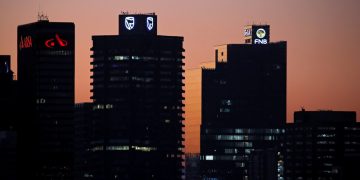








Your money — that you deposit in a bank or in an investment fund — may be being used to support industries that create global warming and the consequences of climate change.
The , issued on Monday by the Centre for Environmental Rights, says just 10 companies are responsible for 61% of South Africa’s greenhouse gas emissions, “more than 164 countries each emit in a year — including Spain, Qatar and Bangladesh”.
Sasol’s Secunda plant alone emits more greenhouse gases than every car, truck, bus, train, and plane in South Africa combined, the report says.
Also released yesterday was data from the Centre for Research on Energy and Clean Air, the Institute for Energy Economics and Financial Analysis and the United Kingdom’s climate think-tank Sandbag, which shows that the world’s use of coal-fired electricity is on track this year for its biggest annual fall after more than four decades of near-uninterrupted growth that has stoked the global climate crisis.
The Guardian reported that coal-fired electricity is expected to drop by 3% in 2019 (more than the combined coal generation in Germany, Spain and the United Kingdom last year) and could help stall the world’s rising carbon emissions this year.
The Full Disclosure 5 report considers the role of banks in financing high greenhouse gas emitting industries and the corresponding risk of instability in financial markets.
Referencing the United Nations Conference on Trade and Development’s 2019 report, the Full Disclosure 5 report warns of the potential for a rapid system-wide adjustment to climate change that threatens financial stability if banks fail to take into account the transitional and physical risks facing borrowers.
It notes that best practice disclosure as set out by the G20’s Task Force on Climate-related Financial Disclosures (TCFD) can help customers and investors “make an informed decision over whether companies and banks have a strategy in place to reduce the harm caused to our communities and environment and to mitigate the risks to investments and deposits”.
“The TCFD recommendations include guidance for companies to ensure they adequately and consistently disclose their climate-related risks and opportunities, and set out the strategies they have put in place to reduce their emissions and mitigate climate-related risks.”
The country’s largest emitters — Eskom (39% of total emissions), Sasol (13.5%), ArcelorMittal (2.8%), South32 (2.7%), Anglo American (1.4%), PPC (0.8%), Sappi (0.53%), African Rainbow Minerals (0.4%) Exxaro Resources (0.16%) and Gold Fields (0.1%) — are assessed in the Full Disclosure 5 report in terms of the TCFD criteria.
Global greenhouse gas emissions must peak in 2020 and then decline rapidly to keep global warming within 1.5°C above pre-industrial levels, according to the UN Environmental Programme.
The Full Disclosure 5 report says: “To avoid overshooting 1.5°C, emissions must decline by 45% from 2010 levels and reach net-zero around 2050, according to the IPCC.
Despite this, only two of the 10 emitters assessed use a 2°C or lower scenario to inform their strategy for mitigating climate impacts and set absolute long- and short-term targets to reduce their greenhouse gas emissions.
Only South32 has a target of net-zero emissions by 2050.”
Eskom does not fare well in the Full Disclosure 5 report. “Eskom has no reported governance over its climate-related risks and opportunities and no reported targets to reduce greenhouse gas emissions. This is despite emitting 39% of South Africa’s greenhouse gases,” it says.
“As an energy utility, 99% of its greenhouse gas emissions are a result of coal combustion at the company’s coal-fired power stations. The heavy reliance on coal poses exceptional transitional risks to Eskom’s operations (compared with other emitters assessed).”
Eskom provides some disclosure of how climate risks or opportunities are incorporated into its strategy, but with limited detail on efforts such as mitigation, adaptation, resource efficiency, pollution reduction and transition plans.
The report adds: “High debt at the power utility, which makes it difficult to implement a strategy, could be a possible cause of the lack of disclosure. Eskom provides no scenario analysis based on the Paris Agreement commitment to keeping global warming below two degrees above pre-industrial levels, placing South Africa at risk of failing to meet its international commitments.”
The report says Sasol has improved its TCFD disclosures with the release of its 2019 Climate Change Report, particularly in the area of metrics and targets, but its long-term reduction target of 10% may be inadequate given that Sasol is the second-highest emitter of greenhouse gases.
“Sasol does not adequately disclose the scenarios used to inform its resilience strategy, nor whether the scenarios relied on are consistent with a 2°C or lower temperature targets of the Paris Agreement.” the report says. “It also does not adequately set out the risks and opportunities it faces as a result of climate change, despite the heightened risks it faces given the high concentration of emissions at its ageing Secunda plant.”
The report says companies that emit high amounts of greenhouse gases face physical and transitional risks. These are passed on to the bank: if emitters are unable to repay their debts to the bank, the emitters could default on their loans, placing banks’ corporate and wholesale loan portfolios at risk.
The five South African banks assessed — Absa, Firstrand, Standard, Investec and Nedbank — have a combined asset value of more than R6.8-billion. “Bank assets are funded by our deposits and investments, and some of those assets may be at risk if they are invested in highly exposed sectors,” the report notes. “Without disclosure of the concentration of assets in carbon related sectors, we are not aware of the extent of their risks.
“Banks need to assess the extent of their exposure to climate-related risk and implement mitigation strategies to ensure the long-term stability of the financial services sector. Despite the need to strengthen governance and risk-management practices following the 2008 financial crisis, only Nedbank reports on the concentration of carbon assets in its portfolio of the five banks.”
If Nedbank comes out tops of the five banks, Absa fares the worst. “Absa does not identify climate change as a material business risk, nor does it disclose its direct or indirect risks from climate change with sufficient detail in its mainstream reports,” the report says.
Absa does not disclose any strategy to mitigate climate change risks in its mainstream reports, with the bank reporting that it has “embarked on a group-wide sustainability programme to consider the potential implications on the group’s operating model, products and services, our customers’ businesses and society at large”.
In its annual report, Absa mentions physical climate events that may have “credit and insurance implications” but does not report on the more pressing transitional risks nor, more generally, the risks in its lending and other financial intermediary business activities.
The report says: “Absa does not disclose the concentration of carbon-related assets in its portfolio, making it difficult for investors to assess their risk exposure in the absence of risk identification. The bank does not have a policy in place to reduce exposure to high greenhouse gas emitting industries.”
The report finds that, while 10 out of the 15 companies and banks assessed identified climate change as posing a material business risk, only three set out the short-, medium-, and long-term effects to their businesses, strategy, and financial planning.
Only two companies report on the scenarios used to inform their strategy, and seven have a target to reduce their emissions. Just one bank discloses its concentrations of credit exposure to carbon-related assets while two have a policy in place on funding coal mining and coal-fired power.
A lack of information places banks at risk, the report says. “Banks need to assess the extent of their exposure to climate-related risks in their corporate and wholesale loan portfolios. A catastrophic climate-related event (physical risk) or unexpectedly rapid decline in commodity prices (transitional risk) that affects borrowers’ ability to repay the bank could potentially lead to bank failure depending on the extent of the bank’s exposure to affected sectors.”
Of the 15 companies, ArcelorMittal and Absa do not disclose a strategy for mitigating climate related risks, despite identifying climate change risks for their businesses (albeit to a limited extent). “Only Anglo American and South32 sufficiently describe the scenarios used to inform their strategy,” the report finds.
“At Sappi and Exxaro, there is no evidence that climate-related risks form part of company-wide risk management programme or specific climate-related risk management process.”
The TCFD recommends that remuneration policies should be designed to encourage long-term corporate behaviours, but just four of the 15 companies are incorporating climate-related performance metrics into remuneration policies.










