

• Latest
  • Trending
  • All
The Coronavirus Pandemic May Be Loosening Links In The Supply Chain : NPR

The Coronavirus Pandemic May Be Loosening Links In The Supply Chain : NPR

March 27, 2020
Last Mile Delivery Market Worth Observing Growth | UPS, FedEx, SF Express

Last Mile Delivery Market Worth Observing Growth | UPS, FedEx, SF Express

April 23, 2024
Top 5 Spend Analysis Software ranked in 2024

Top 5 Spend Analysis Software ranked in 2024

March 1, 2024
How Tesla And BMW Are Leading A Supply Chain Renaissance With Blockchain

How Tesla And BMW Are Leading A Supply Chain Renaissance With Blockchain

January 19, 2024
LATAM Cargo strengthens European cargo links

LATAM Cargo strengthens European cargo links

April 14, 2020
Ford making reusable hospital gowns from airbag materials as efforts against coronavirus expand

Ford making reusable hospital gowns from airbag materials as efforts against coronavirus expand

April 14, 2020
Don’t Sweat NBC’s Decision to Cut Back on Television Ad Inventory

Don’t Sweat NBC’s Decision to Cut Back on Television Ad Inventory

April 14, 2020
Software firms sharpen focus on AI, big data as IT spending drops

Software firms sharpen focus on AI, big data as IT spending drops

April 14, 2020
Navigating turbulent times in your supply chain (TL:DR version)

Navigating turbulent times in your supply chain (TL:DR version)

April 14, 2020
Last Mile Delivery by Drones Market is Booming Worldwide

Last Mile Delivery by Drones Market is Booming Worldwide

April 14, 2020
AIR CARGO MARKET SIZE, SHARE, DEMAND, TREND, LATEST INNOVATIONS & APPLICATION ANALYSIS AND INDUSTRY GROWTH FORECAST 2027 – Science In Me

AIR CARGO MARKET SIZE, SHARE, DEMAND, TREND, LATEST INNOVATIONS & APPLICATION ANALYSIS AND INDUSTRY GROWTH FORECAST 2027 – Science In Me

April 14, 2020
Wheat procurement in Patiala: 6,500 coupons issued to farmers – cities

Wheat procurement in Patiala: 6,500 coupons issued to farmers – cities

April 14, 2020
Pandemic, Plastics And The Continuing Quest For Sustainability

Pandemic, Plastics And The Continuing Quest For Sustainability

April 14, 2020
  • Supply Chain
  • Logistics
  • Warehousing
  • Procurement
  • Shipping
  • More
    • Strategic Sourcing
    • Spend Analysis
    • Inventory
    • Contact Us
No Result
View All Result
United States International Supply Chain Commission
Home Supply Chain

The Coronavirus Pandemic May Be Loosening Links In The Supply Chain : NPR

by usiscc
March 27, 2020
in Supply Chain
0
The Coronavirus Pandemic May Be Loosening Links In The Supply Chain : NPR
494
SHARES
1.4k
VIEWS
Share on FacebookShare on Twitter

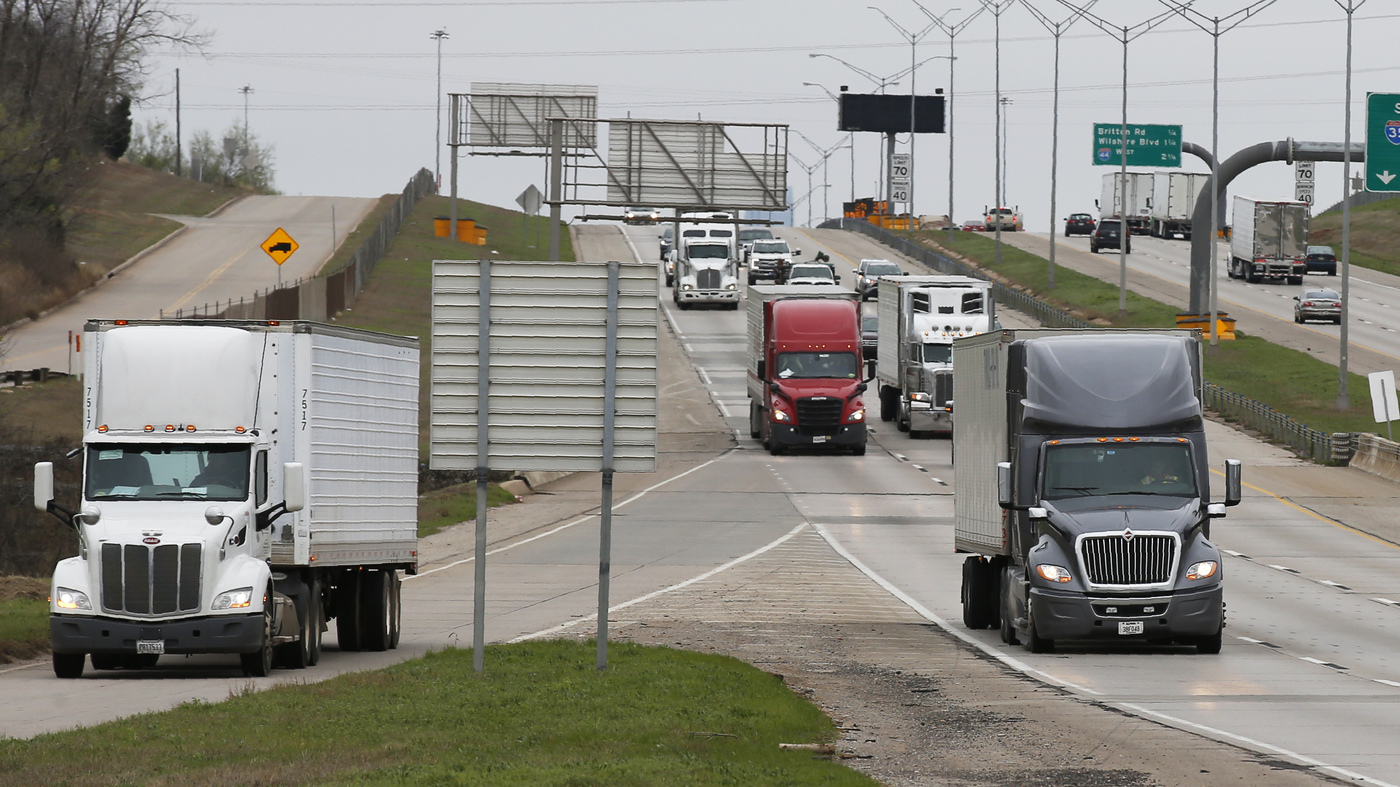
A truck leaves the highway at the Hefner Road exit of I-35 in Oklahoma City on March 20. Truckers say that the impact from the coronavirus is twofold: Some have more loads now because of shortages, while others say that their customers are not ordering and have cut their runs down.

Sue Ogrocki/AP


hide caption

toggle caption

Sue Ogrocki/AP

A truck leaves the highway at the Hefner Road exit of I-35 in Oklahoma City on March 20. Truckers say that the impact from the coronavirus is twofold: Some have more loads now because of shortages, while others say that their customers are not ordering and have cut their runs down.

Sue Ogrocki/AP

Fast-moving viruses come with a cruel twist.

They tend to hammer hardest at people on the front lines of defense, making the rest of us that much more vulnerable.

Truckers, warehouse workers and cargo handlers, all in a vast network, find themselves one endless day after the next getting food, medicine and, yes, toilet paper to customers.

The complex supply logistics of our 21st-century world face a gathering storm even as reliance on those supply chains becomes more critical in the worst public health crisis in generations.

“We’re still trying to figure out the new normal right now,” said Kathy Fulton, executive director of the American Logistics Aid Network. “We’ve not yet gotten to a place of stability.”

Worried customers have been buying up household basics at two to three times the normal rate. That has meant truckers and warehouse crews have been pounding energy drinks and ibuprofen to move products so we can stay home and flatten the curve.

But, Fulton said, social distancing regulations can throw roadblocks in the way of deliveries. She has worked with states to reopen rest areas. After all, federal rules demand that truckers barrel down the highway only so long before taking a breather — and, hopefully, a nap.

Coronavirus Daily

Michael Belzer, an economist at Wayne State University, said few professions’ workers fight chronic stress and fatigue like truckers in normal times. Now, that population of big-rig drivers finds itself especially vulnerable to COVID-19.

“It’s older,” Belzer said. “It’s got high blood pressure, has cardiovascular disease, has asthma.”

And if you think it’s tough getting tested for COVID-19 where you are, imagine how it would be if you were working on the road, constantly tethered to an 80-foot, 70,000-pound vehicle.

On the plus side, truckers sit isolated behind the wheel for hours on end — away from other people.

The federal government has greenlighted waivers letting truckers drive even longer hours — although some rules remain in place. States have waived some truck-weight restrictions.

And traffic is light. Normal highway chokepoints are flowing freely. That’s also speeding up home deliveries.

Air freight has been severely stretched. Commercial airlines ship goods in their baggage holds. But with dramatically fewer passenger airliners in the air, that has wiped out significant shipping capacity.

Major seaports are functioning more or less normally. But they have fewer ships to unload because Asia hasn’t fully ramped up exports in the wake of coronavirus shutdowns there.

Freight trains are rolling, but they’re carrying about 9% less stuff than they were a year ago.

Of course, shippers can’t deliver what they don’t have — like face masks or ventilators.

But food remains plentiful.

Ananth Iyer, a supply chain management professor at Purdue University, figures there’s 80 to 120 days’ worth of basic household goods in factories, warehouses and trucks chugging toward retailers right now.
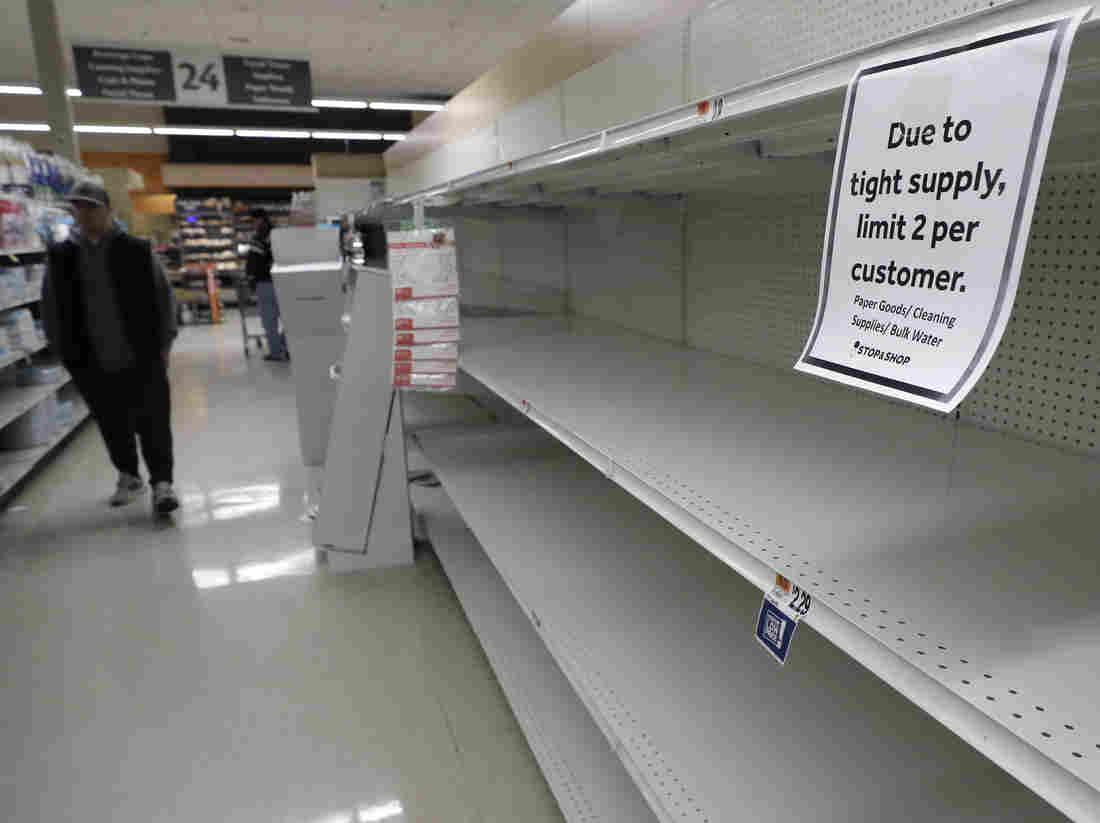
At a grocery store in Quincy, Mass., on March 26, a passerby walks down an aisle with empty shelves where paper towels are normally stocked. Paper towels and toilet paper have sold briskly as people take measures to cope with the coronavirus.

Steven Senne/AP


hide caption

toggle caption

Steven Senne/AP

At a grocery store in Quincy, Mass., on March 26, a passerby walks down an aisle with empty shelves where paper towels are normally stocked. Paper towels and toilet paper have sold briskly as people take measures to cope with the coronavirus.

Steven Senne/AP

“The product is going to be there,” Iyer said. “And the reason there’s going to be there is everybody wants to sell product to customers.”

Iyer said a lot of food that would normally be in the supply chain now is already stuffed into home pantries.

That makes some sense. With more scores of counties and a handful of entire states under one stay-at-home order or another, and with most dine-in restaurants shuttered, Americans now have to cook more for themselves.

But David Ross, a logistics analyst at Stifel Financial Corp., said that after weeks of consumers stuffing so many groceries into pantries and freezers, the logistics industry might soon have to slam on the brakes.

“At some point, folks will have all of the ground beef they need until July, all of the toilet paper they will need until November,” he said. “And over the coming weeks, the demand for that should drop off significantly.”

Then, truckers who have been busting their humps for weeks trying to fill orders could see demand evaporate.

Ross and others predicted a rough year for the trucking and railroad industries this year even before the coronavirus upended the world. Now their prognosis is worse.

On Monday, Beaver Express Services, an Oklahoma-based trucking firm that had survived 77 years in the logistics business, called it quits. Its owner, Mike Stone, said the coronavirus helped whip up a “perfect storm” that crushed the company. Ross expects more stories like this in the deep recession that the pandemic is expected to trigger.

“Any time consumer confidence is cracked and people stop buying stuff, you’re not going to be moving a lot of goods,” Ross said.


Share198Tweet124
usiscc

usiscc

  • Trending
  • Comments
  • Latest
Escape From Tarkov – How to Rotate Items

Escape From Tarkov – How to Rotate Items

February 5, 2020
Supply chain examination: Planning for vulnerabilities you can’t control

Supply chain examination: Planning for vulnerabilities you can’t control

December 7, 2019
Procurement Project Manager job with Camden London Borough Council

Procurement Project Manager job with Camden London Borough Council

February 17, 2020
Art Battle Wichita Falls III at The Warehouse, 1401 Lamar.

Art Battle Wichita Falls III at The Warehouse, 1401 Lamar.

0
Global Industry Analysis, Size, Share, Growth, Trends, and Forecasts 2016–2024 – ZMR News Reports

Global Industry Analysis, Size, Share, Growth, Trends, and Forecasts 2016–2024 – ZMR News Reports

0
PHOTOS: Ottawa firefighters respond to warehouse fire

PHOTOS: Ottawa firefighters respond to warehouse fire

0
Last Mile Delivery Market Worth Observing Growth | UPS, FedEx, SF Express

Last Mile Delivery Market Worth Observing Growth | UPS, FedEx, SF Express

April 23, 2024
Top 5 Spend Analysis Software ranked in 2024

Top 5 Spend Analysis Software ranked in 2024

March 1, 2024
How Tesla And BMW Are Leading A Supply Chain Renaissance With Blockchain

How Tesla And BMW Are Leading A Supply Chain Renaissance With Blockchain

January 19, 2024
  • Privacy Policy
  • Terms of Use
  • Disclaimer
  • DMCA
  • Contact Us

Copyright © 2024 United States International Supply Chain Commission (usiscc.org)

This website uses cookies to improve your experience. We'll assume you're ok with this, but you can opt-out if you wish. Cookie settingsACCEPT
Privacy & Cookies Policy

Privacy Overview

This website uses cookies to improve your experience while you navigate through the website. Out of these cookies, the cookies that are categorized as necessary are stored on your browser as they are essential for the working of basic functionalities of the website. We also use third-party cookies that help us analyze and understand how you use this website. These cookies will be stored in your browser only with your consent. You also have the option to opt-out of these cookies. But opting out of some of these cookies may have an effect on your browsing experience.
Necessary
Always Enabled

Necessary cookies are absolutely essential for the website to function properly. This category only includes cookies that ensures basic functionalities and security features of the website. These cookies do not store any personal information.

Non-necessary

Any cookies that may not be particularly necessary for the website to function and is used specifically to collect user personal data via analytics, ads, other embedded contents are termed as non-necessary cookies. It is mandatory to procure user consent prior to running these cookies on your website.

SAVE & ACCEPT
No Result
View All Result
  • Supply Chain
  • Logistics
  • Warehousing
  • Procurement
  • Shipping
  • More
    • Strategic Sourcing
    • Spend Analysis
    • Inventory
    • Contact Us

Copyright © 2024 United States International Supply Chain Commission (usiscc.org)






