








The Federal Emergency Management Agency (FEMA) is working with the largest carriers in the country to ensure the U.S. supply chain can keep up with a patchwork of COVID-19 responses.
To find and deliver personal protective equipment (PPE), ventilators and other critical resources requested by states, tribes and U.S. territories, FEMA and the Department of Health & Human Services (HHS) formed the Supply Chain Stabilization Task Force. This is one of eight COVID-19 focused groups under FEMA’s National Response Coordination Center (NRCC), which is following the White House Coronavirus Task Force’s push to use the private sector to help fill health care needs during the pandemic.
The supply chain task force is working to meet the medical demands as COVID-19 “hot spots” arise across the country. Currently, those “hot spots” are in New York City, Detroit and New Orleans — but health officials said this week to expect new hot spots to pop up as the novel coronavirus spreads. The White House, on Tuesday, said U.S. deaths from the virus could range from 100,000 to 240,000 people even if current social distancing policies remain in effect until May.
The death toll could vary depending on the health care system’s ability to care for those stricken with the respiratory virus. A lot of that care is dependent on a strong supply chain. FEMA said this week that its strategy is a four-pronged approach: preservation, acceleration, allocation and expansion to accelerate and expand the pipeline of medical supplies and equipment.
UPS, the largest for-hire carrier in the U.S., is coordinating with the President’s Coronavirus Taskforce, FEMA and state health agencies. UPS Healthcare and UPS operations all over the world are working with other private companies and government agencies, the carrier said.
“UPS’s dedicated people, global network and public-private partnerships are creating a powerful combination for rapid deployment of protective equipment and test kits throughout the U.S. and around the world,” said David Abney, UPS chairman and CEO, on March 30. “UPS Healthcare has the expertise and experience to move vital, life-saving medicines, medical devices, diagnostic specimens and supplies everywhere they are needed.”
UPS is working with FEMA to provide supply chain services for the agency’s distribution of PPE and other necessary health care materials throughout the U.S. This includes respirators, N95 masks and gloves and COVID-19 test kits. As part of the collaboration, FEMA will use UPS’s Worldport facilities in Louisville, Ky., for the temporary staging of critical shipments from overseas.
Rival FedEx has the largest express shipping service in the U.S. The Memphis, Tenn.-based company started a special operation for the task force last week to quickly move COVID-19 test specimens from more than 50 remote drive-thru testing centers at major retailers across 12 states.
“We have a great responsibility in these unprecedented times to do what we do best — mobilize our network quickly to help the communities where we live and work,” said Raj Subramaniam, president and COO of FedEx Corp. “As the world’s largest cargo airline, we have the ability to flex our operations in some of the most challenging of circumstances. By swiftly taking action to stand up this special operation, we are playing an important role in advancing the speed of delivery for these critical test samples.”
FedEx Express dedicated 28 flight legs — as well as specialized pickup and delivery operations — to help FEMA quickly process COVID-19 test specimens, which could help prevent the spread of the virus as health officials get a better picture of current and potential hot spots.
FedEx is using its SenseAware technology and monitoring to help safely transport the test specimens to 10 labs operated by Quest Diagnostics and other commercial labs. HHS aided in collecting, packaging and sealing test sample boxes with the SenseAware devices before they were shipped via FedEx Express First Overnight with Priority Alert monitoring for delivery by 8 a.m. the next day.
Subramaniam said FedEx Express will continue to provide support seven days a week as more remote testing centers come available across the country.
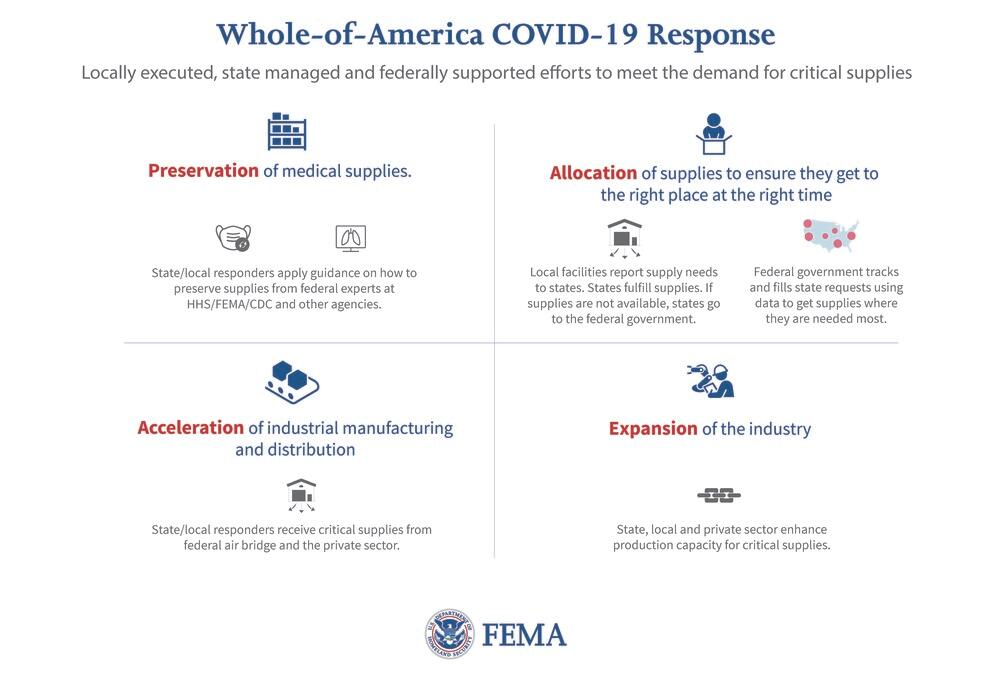 FEMA is using a four-pronged approach to keep the U.S. supply chain moving critical medical supplies during the COVID-19 pandemic.Chart: FEMA
FEMA’s supply chain strategy
FEMA’s supply chain task force detailed this week what it calls a “critical whole-of-America effort” to keep the supply chain connected.
The first part of that effort is preserving current supplies. The reuse of PPE, according to the government, can quickly expand the capacity to meet needs. For example, an Ohio medical technology was given FDA approval this week to start sterilizing 160,000 surgical masks per day.
The second part of the task force’s plan is to accelerate industrial manufacturing to meet the urgent demand. Manufacturers are ramping up production of critical resources and have extended operating hours to increase production above their standard levels, according to FEMA. The joint FEMA-HHS contracting team has been working to evaluate and act on solicitations. FEMA is also expediting the movement of critical supplies from the global market to medical distributors in the U.S.
Over the weekend, FEMA coordinated an air bridge for flights from Asia that delivered 80 tons of PPE supplies to New York, New Jersey and Connecticut, which is the largest “hot spot” of COVID-19 in the U.S. A second flight landed in Chicago on Monday. FEMA is scheduling daily flights of PPE in varying quantities. But the government said it does not know how much PPE is coming from overseas until the flights are loaded.
FEMA is using the supply chain task force to coordinate the PPE distribution in areas of greatest need. After those needs are met, it plans to spread the remaining PPE into the broader U.S. supply chain. Prioritization will be given to hospitals, health care facilities, and nursing homes around the country. Additionally, in some cases, the federal government may purchase some of the supplies to be used to replenish the Strategic National Stockpile or provide to states with unmet needs.
The third part of FEMA’s supply chain approach is expanding manufacturing. Manufacturers are enhancing production capacity with additional machinery or re-tooling assembly lines to produce new products needed in the fight against the virus. The task force is engaging manufacturers, distributors and health care networks to build the next phase of supply chain stabilization.
The final prong of the task force’s approach is allocating critical resources to ensure the right quantities of supplies get to the right place, at the right time. This is being done with a data-driven distribution that considers demand and supply to ensure resources go where needed. FEMA is focusing allocation of critical resources to areas experiencing the greatest increase in COVID-19 cases with the largest forecast capacity shortfalls. This approach also considers the at-risk population distribution across the nation.
To make effective decisions about resources, a National Resource Prioritization Cell was established to unify government and private industry prioritization recommendations. These recommendations will further inform federal, state and private sector operations.
“The global UPS Healthcare team has mobilized in extraordinary ways around the world to bring all of our expertise and highly specialized capabilities to serve the urgent needs of our health care and life science customers,” said Wes Wheeler, UPS Healthcare president. “Our strength is our ability to be nimble in times of emergencies, whether natural disasters or pandemics, so we will continue to do our part to help us all through this challenge.”
Public-private partnership
As part of this public-private partnership, UPS is working with an array of government agencies and companies to support swift transportation of test kits, PPE, supplies and medical devices. The company this week highlighted some of these deals:
- State health agencies: Helping U.S state health agencies, including California, Georgia and Kentucky, secure and set up testing sites at select locations. UPS is also offering support to other states, including Colorado, Connecticut, Delaware, Florida, Hawaii, Illinois, Indiana, Kansas, Louisiana, Massachusetts, Michigan, Missouri, North Carolina, New Jersey, New York, Ohio, Pennsylvania, Rhode Island, Texas, Washington, and Wisconsin.
- Medical supply companies such as Henry Schein, McKesson, DuPont, Pharmatech and others are using UPS to distribute PPE to medical professionals and supplies to testing facilities.
- UPS will provide distribution services for 50,000 test kits a day from LetsGetChecked, which is releasing a two-part test in the U.S. that offers an immediate indication, followed by a full Clinical Laboratory Improvement Amendments (CLIA)-certified laboratory test.
- Everlywell is using UPS logistics expertise to assist its distribution of test kits to hospitals, community clinics, nursing homes, and organizations with health care workers on the front lines. Test samples will be overnighted to CLIA-certified laboratories and digital results will be available in 48 hours.
- AmerisourceBergen is utilizing UPS to support the distribution of critical, life-saving medications to physician offices, health systems and veterinary clinics so that patients can continue to receive the products – including chemotherapies, blood pressure medications and heart disease treatments – they depend on.










