

• Latest
  • Trending
  • All
Why empty shelves don’t mean we’re out of food: How Canada’s supply chain works

Why empty shelves don’t mean we’re out of food: How Canada’s supply chain works

April 2, 2020
Last Mile Delivery Market Worth Observing Growth | UPS, FedEx, SF Express

Last Mile Delivery Market Worth Observing Growth | UPS, FedEx, SF Express

April 23, 2024
Top 5 Spend Analysis Software ranked in 2024

Top 5 Spend Analysis Software ranked in 2024

March 1, 2024
How Tesla And BMW Are Leading A Supply Chain Renaissance With Blockchain

How Tesla And BMW Are Leading A Supply Chain Renaissance With Blockchain

January 19, 2024
LATAM Cargo strengthens European cargo links

LATAM Cargo strengthens European cargo links

April 14, 2020
Ford making reusable hospital gowns from airbag materials as efforts against coronavirus expand

Ford making reusable hospital gowns from airbag materials as efforts against coronavirus expand

April 14, 2020
Don’t Sweat NBC’s Decision to Cut Back on Television Ad Inventory

Don’t Sweat NBC’s Decision to Cut Back on Television Ad Inventory

April 14, 2020
Software firms sharpen focus on AI, big data as IT spending drops

Software firms sharpen focus on AI, big data as IT spending drops

April 14, 2020
Navigating turbulent times in your supply chain (TL:DR version)

Navigating turbulent times in your supply chain (TL:DR version)

April 14, 2020
Last Mile Delivery by Drones Market is Booming Worldwide

Last Mile Delivery by Drones Market is Booming Worldwide

April 14, 2020
AIR CARGO MARKET SIZE, SHARE, DEMAND, TREND, LATEST INNOVATIONS & APPLICATION ANALYSIS AND INDUSTRY GROWTH FORECAST 2027 – Science In Me

AIR CARGO MARKET SIZE, SHARE, DEMAND, TREND, LATEST INNOVATIONS & APPLICATION ANALYSIS AND INDUSTRY GROWTH FORECAST 2027 – Science In Me

April 14, 2020
Wheat procurement in Patiala: 6,500 coupons issued to farmers – cities

Wheat procurement in Patiala: 6,500 coupons issued to farmers – cities

April 14, 2020
Pandemic, Plastics And The Continuing Quest For Sustainability

Pandemic, Plastics And The Continuing Quest For Sustainability

April 14, 2020
  • Supply Chain
  • Logistics
  • Warehousing
  • Procurement
  • Shipping
  • More
    • Strategic Sourcing
    • Spend Analysis
    • Inventory
    • Contact Us
No Result
View All Result
United States International Supply Chain Commission
Home Supply Chain

Why empty shelves don’t mean we’re out of food: How Canada’s supply chain works

by usiscc
April 2, 2020
in Supply Chain
0
Why empty shelves don’t mean we’re out of food: How Canada’s supply chain works
494
SHARES
1.4k
VIEWS
Share on FacebookShare on Twitter

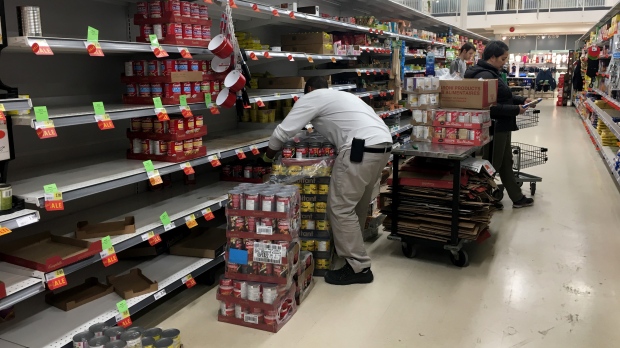
Shoppers are facing empty shelves at some stores due to unprecedented demand for food and other goods even as grocers assure Canadians coping with the COVID-19 outbreak that plenty of new items are on the way and manufacturers say they have the raw materials they need.

Temporary shortages are to be expected in spite of a supply chain working in overdrive, experts say, because the system isn’t built to predict extreme, large-scale changes in buyer behaviour.

Shoppers stockpile for a number of reasons, said Mike von Massow, an associate professor at The University of Guelph. Some fear stores may close amid the pandemic. Others buy in bulk with the goal of shopping less frequently to avoid unnecessary exposure.

That means right now, “we are seeing demand-based shortages, not supply-based shortages,” he said.

Shelves keep getting restocked with goods still flowing to the stores. Limited hours have been introduced in part to allow time to unpack and display replacement products.

Canada tends to operate with what’s knows as a “just-in-time food system,” von Massow said. That means grocers and other stores tend to receive food products just before they are ready to put them in the store.

It’s more cost effective for companies than keeping a large surplus that takes up unnecessary space. Some food, like fresh fruits and vegetables, can spoil. Rotten food that can’t be sold brings up the cost of the product for customers.

For non-perishable items, like toilet paper or canned black beans, too much so-called buffer inventory ties up money otherwise available for other things and requires storage space, he said.

“By minimizing inventory, we keep prices lower in the store.”

Companies determine the exact amount of inventory to order and keep through “a bit of a science and also a bit of an art,” said von Massow, who worked for about two decades in the industry during which time he helped with forecasting.

Data helps companies make predictions. They’ll look at historical and recent sales, special events (the Superbowl, for example, may boost demand for avocado as football fans make guacamole for the big game), what influencers are saying about the product and more, said von Massow.

Increasingly, computers crunch the data and make suggestions. A human then looks at these figures and determines if they need to be adjusted up or down.

“The numbers can help you make a decision. They can’t make the decision for you,” von Massow said he teaches his students during a class about forecasting.

Both manufacturers and grocers will forecast demand, and the level of collaboration and information they share can help make their guesses much more accurate.

This model doesn’t work as well during an unexpected and widespread change in shopper behaviour. As the COVID-19 crisis took hold, Canadians purchased toilet paper, cleaning products and other items in droves. Photos of empty store shelves circulated online, further feeding the buying frenzy.

Canada’s major grocers have worked to reassure customers there’s no food shortage on the horizon as they work with suppliers to keep delivering essentials into their stores and catch up to the demand.

About three-quarters of members of Food & Consumer Products of Canada, a national association for manufacturers, say they’re confident in raw materials supply for two to five months or more, if current trends continue, according to a recent survey of the association’s members.

A fifth projected no issues at any time, even with current trends, while just five per cent foresaw possible supply issues within one month.

This data supports evidence of a demand-based shortage.

If it were a supply-based shortage, von Massow said, shelves would remain empty because manufacturers can’t produce the products or farmers can’t grow or raise the food.

For example, if a disease wiped out 90 per cent of the country’s chicken population, it would be next to impossible to find fresh eggs.

The lag in seeing some products reappear on shelves — such as flour or antibacterial wipes — in this case comes from the supply chain catching up to the spike in demand.

The level of collaboration and integration across a supply chain is another important factor, said Giovani Caetano da Silveira, a professor of operations and supply chain management at the University of Calgary’s Haskayne School of Business.

A classical, textbook example of a supply chain includes at least four players, he said — not only the manufacturer and store where the product is sold, but also distributors and wholesalers.

They could share all kinds of information, such as inventory levels, promotional plans and what markets they may want to serve in the future, he said. Major players may manage multiple parts of the supply chain and be more integrated.

Companies with well-integrated supply chains “can react more quickly … to sudden changes in demand,” he said.

But extreme changes in demand, such as what companies experienced recently with COVID-19 panic buying, are nearly impossible to anticipate, he said.

He noted Canada’s grocery chains seem to have responded well despite the unpredictable spike. That may be explained by the number of companies with collaborative, integrated supply chains that were able to respond to the unanticipated demand quickly, as well as a strong, capable logistics network to move the product from the manufacturer to the stores.

“There appears to be quite a good logistics capability here in Canada, in this case,” he said, particularly for grocery stores and consumer products.

“So that also might be an explanation.”

This report by The Canadian Press was first published April 2, 2020.

Share198Tweet124
usiscc

usiscc

  • Trending
  • Comments
  • Latest
Escape From Tarkov – How to Rotate Items

Escape From Tarkov – How to Rotate Items

February 5, 2020
Supply chain examination: Planning for vulnerabilities you can’t control

Supply chain examination: Planning for vulnerabilities you can’t control

December 7, 2019
Procurement Project Manager job with Camden London Borough Council

Procurement Project Manager job with Camden London Borough Council

February 17, 2020
Art Battle Wichita Falls III at The Warehouse, 1401 Lamar.

Art Battle Wichita Falls III at The Warehouse, 1401 Lamar.

0
Global Industry Analysis, Size, Share, Growth, Trends, and Forecasts 2016–2024 – ZMR News Reports

Global Industry Analysis, Size, Share, Growth, Trends, and Forecasts 2016–2024 – ZMR News Reports

0
PHOTOS: Ottawa firefighters respond to warehouse fire

PHOTOS: Ottawa firefighters respond to warehouse fire

0
Last Mile Delivery Market Worth Observing Growth | UPS, FedEx, SF Express

Last Mile Delivery Market Worth Observing Growth | UPS, FedEx, SF Express

April 23, 2024
Top 5 Spend Analysis Software ranked in 2024

Top 5 Spend Analysis Software ranked in 2024

March 1, 2024
How Tesla And BMW Are Leading A Supply Chain Renaissance With Blockchain

How Tesla And BMW Are Leading A Supply Chain Renaissance With Blockchain

January 19, 2024
  • Privacy Policy
  • Terms of Use
  • Disclaimer
  • DMCA
  • Contact Us

Copyright © 2024 United States International Supply Chain Commission (usiscc.org)

This website uses cookies to improve your experience. We'll assume you're ok with this, but you can opt-out if you wish. Cookie settingsACCEPT
Privacy & Cookies Policy

Privacy Overview

This website uses cookies to improve your experience while you navigate through the website. Out of these cookies, the cookies that are categorized as necessary are stored on your browser as they are essential for the working of basic functionalities of the website. We also use third-party cookies that help us analyze and understand how you use this website. These cookies will be stored in your browser only with your consent. You also have the option to opt-out of these cookies. But opting out of some of these cookies may have an effect on your browsing experience.
Necessary
Always Enabled

Necessary cookies are absolutely essential for the website to function properly. This category only includes cookies that ensures basic functionalities and security features of the website. These cookies do not store any personal information.

Non-necessary

Any cookies that may not be particularly necessary for the website to function and is used specifically to collect user personal data via analytics, ads, other embedded contents are termed as non-necessary cookies. It is mandatory to procure user consent prior to running these cookies on your website.

SAVE & ACCEPT
No Result
View All Result
  • Supply Chain
  • Logistics
  • Warehousing
  • Procurement
  • Shipping
  • More
    • Strategic Sourcing
    • Spend Analysis
    • Inventory
    • Contact Us

Copyright © 2024 United States International Supply Chain Commission (usiscc.org)







