






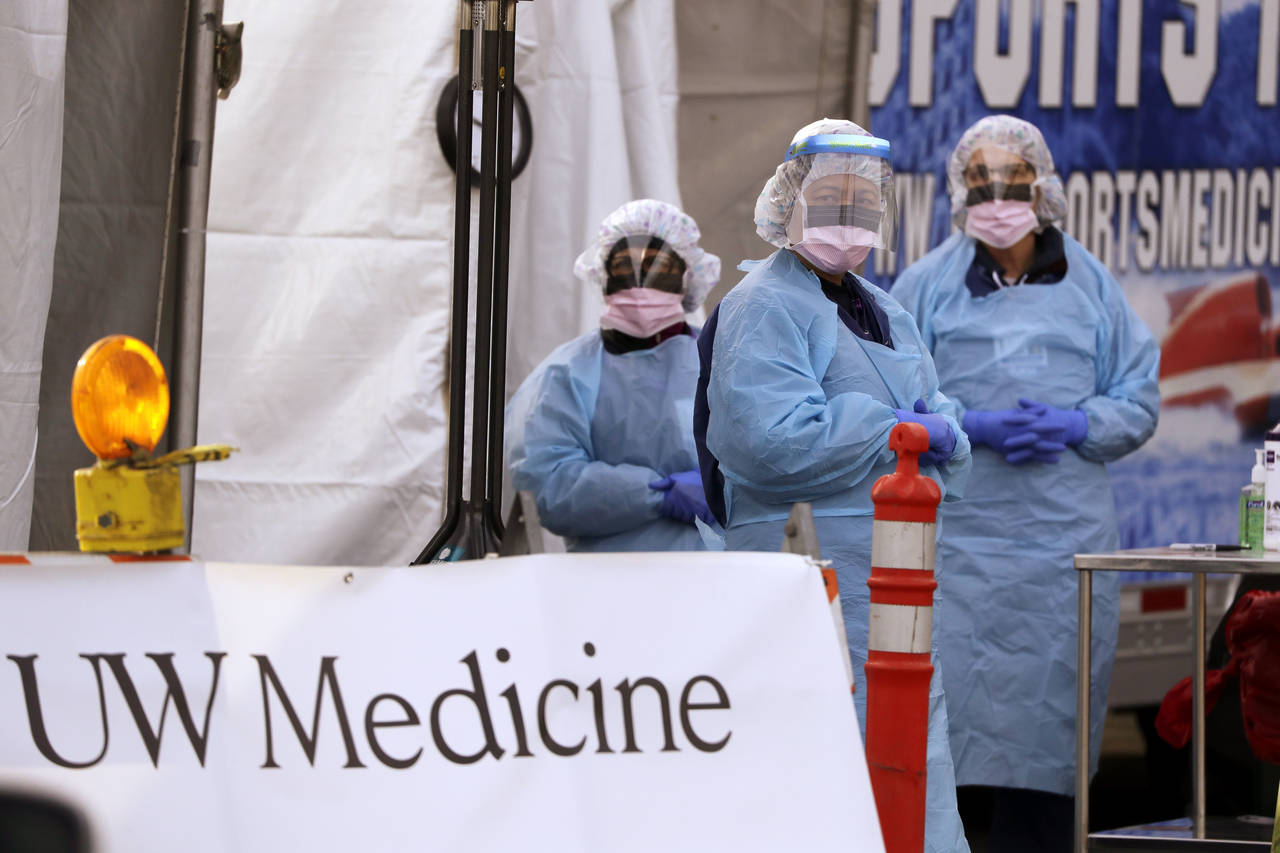
FILE – In this March 17, 2020, file photo, medical personnel wait for a driver to pull up at a drive-thru COVID-19 testing station for University of Washington Medicine patients in Seattle. Experts and health officials who are trying to plan a response to the coronavirus outbreak are missing a critical piece of information – the number of health care workers who have tested positive for the disease. (AP Photo/Elaine Thompson, File)
SEATTLE (AP) — Experts and health officials who are trying to plan a response to the coronavirus outbreak are missing a critical piece of information — the number of health care workers who have tested positive for the disease.
Washington state faced the first major outbreak of COVID-19 in the nation, but health officials have not kept track of how many doctors and nurses have the disease. New York, the epicenter of the coronavirus outbreak, also lacks infection figures for medical staff, according to Jill Montag, spokeswoman with the New York State Department of Health.
That information can help save lives, said Dr. Grete Porteous, an anesthesiologist in Seattle who has worked on health care emergency preparedness and crisis management. It previously helped reduce risks to medical personnel during the much smaller SARS outbreak of 2003-04, she said.
With the medical profession facing shortages of basic protective gear, “the question should be asked: are there ways that we can improve what we do to make care safer for everyone?” Porteous said. “Without regional and national public health data on COVID-19 infections in health care personnel, it is difficult to envision how to start answering this question.”
During the SARS outbreak, Porteous said, data about “an alarmingly high rate of infection and death” in medical staff led to improved rules around infection protocol and use of personal protective equipment.
Ruth Schubert, spokeswoman for the Washington Nurses Association, said that same data are needed for COVID-19.
“We are urging the (Department of Health) and the emergency operations team at the state level to begin collecting and reporting this information,” she said.
Experts who create models for how the coronavirus will impact the country’s health care system say they also want the data to better determine how severely hospitals will be impacted.
While health officials count ICU beds and calculate hospital capacity to plan for a surge in cases, Christopher Murray, director of the Institute for Health Metrics and Evaluation at the University of Washington, has created a model for predicting COVID-19 deaths. It also predicts the number of hospital beds, ICU beds and ventilators each state will need.
Murray is also trying to include things like how many workers are needed to care for patients. But without access to the number of infected health care workers, he’s unable to make that determination.
Murray hopes that will change.
“That’s a really important piece of information to know,” he said. “I’ll add that to the data that we’ll ask for from governments.”
As of Saturday, Washington state had more than 7,500 cases and New York had counted more than 110,000. Neither state knows how many of those cases are health care workers.
Ohio, on the other hand, reported at least 16% of its cases involved health care workers, while in Minnesota, it was 28% on Wednesday.
Other countries are reporting COVID-19’s impact on their health care community. Spain has said at least 12,298 health care workers have tested positive for the disease – 14.4% of the total reported cases. More than 60 doctors have died in Italy.
Johns Hopkins University’s online map tracking the spread of the virus doesn’t include a subset of data on how many health care workers have become sick. The platform wasn’t built to collect data on workers, said university spokesman Douglas Donovan. CDC charts also don’t break it out.
The Johns Hopkins Center for Health Security has recommended hospitals keep a log of staff with COVID-19. Those who have recovered could work on units devoted to COVID-19. But data on infected staff may not be available because hospitals want to protect that information, fearing it may appear they have unsafe conditions, said Dr. Angela Gardner, an emergency physician and professor at the University of Texas Southwestern Medical Center.
Having data on how many health care workers are sick would help with planning, she said.
Hospitals also need better parameters for how long a worker should stay away from patients if exposed to COVID-19, she said. CDC recommendations say a doctor or nurse can return three days after they are asymptomatic. But if a worker was exposed and didn’t have symptoms or even tested negative, they’re required to be quarantined 14 days.
Although the Washington state health department isn’t collecting the data, some counties are. At least 88 health care workers in Snohomish County have tested positive for the coronavirus, out of 1,300 total cases. In Yakima County, it’s more like 30%.
However, officials in King County, home to the highest concentration of cases, don’t know how many health care workers have the disease.
University of Washington Medicine began testing employees with symptoms on March 5, said spokeswoman Susan Gregg.
“Since that time, we have tested approximately 1,304 UW Medicine health care workers in our drive-through clinics,” she said. About 95.6% tested negative and 4.4 percent tested positive, she said. Many have already recovered.
Colorado health officials also want to find out who’s infected by implementing a testing program for all health care workers, said Micki Trost, a spokesperson for the Colorado Division of Homeland Security and Emergency Management.
“This testing strategy helps strengthen our medical capacity,” she said.
Copyright © The Associated Press. All rights reserved. This material may not be published, broadcast, rewritten or redistributed.










