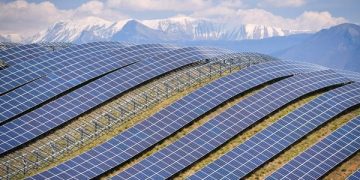








The solar economy continues its dramatic growth, with over a half-terawatt already installed around the world generating clean electricity. But what happens to photovoltaic (PV) modules at the end of their useful life? With lifespans measured in decades, PV-waste disposal may seem to be an issue for the distant future. Yet, the industry ships millions of tons every year, and that number will continue to rise as the industry grows. Total e-waste—including computers, televisions, and mobile phones—is around 45 million metric tons annually.
By comparison, PV-waste in 2050 will be twice that figure. Motivated by concerns about exposure to toxic materials, increased disposal costs and overcapacity at landfills managed by underfunded local governments, researchers are exploring global solar waste management solutions based on concepts like the circular economy.
At the same time, demand for everything from sand to rare and precious metals continues to rise. While supplying only about 1 percent of global electricity, photovoltaics already relies on 40 percent of the global tellurium supply, 15 percent of the silver supply, a large portion of semiconductor quality quartz supply, and smaller but important segments of the indium, zinc, tin, and gallium supplies. Closing the loop on these metals and embracing circular economy concepts will be critical to the industry’s future.
Europe is leading the way
The leading policy with a proven record of successful end-of-life product management is extended producer responsibility (EPR). A decade ago, European PV manufacturers began participating in a voluntary EPR system called “PV Cycle.” In 2014, when the industry came under the Waste Electronics and Electrical (WEEE) Directive, all manufacturers were required to participate in an EPR program. Since 2009, the EPR program run by PV Cycle has recycled over 30,000 metric tons of PV, and with the establishment of collection centers, has driven a market in second-life PV modules.
In the U.S., there is no federal e-waste regulation to motivate PV-waste collection and recycling. Federal law only requires special management for PV modules that are characterized as hazardous waste under the Resource Conservation and Recovery Act. Some PV modules are considered hazardous waste because of lead or cadmium, others are not considered hazardous waste at all. Since it is not possible to tell whether a PV module is hazardous from visual inspection, many argue it is simpler to collect all PV modules.
States in the U.S. are taking the lead. In 2020, manufacturers wishing to sell into New York or Washington markets, will be required to participate in a take-back and collection or EPR program. Several California agencies, a state with more than half of the nations’ installed PV capacity, recently convened a task force to evaluate options, including EPR, for recycling both PVs and lithium-ion batteries.
Without clear incentives, recycling markets are struggling struggle
The primary challenge to recycling PV today is finding value in the recovered materials compared to the costs of collection and recovery. The International Renewable Energy Agency reported that recovered materials could exceed $15 billion dollars (U.S.) by 2050. But a cost-effective PV-waste collection and recovery system capable of high-value material recovery remains elusive. Most of the value in PV-waste is in the aluminum frame and the silver in the metallization paste. Getting higher-value PV recycling will require expertise in managing glass. 80–90 percent of a module by weight is made from glass.
Recycled glass can be returned to its highest value form many times over, if free of contamination. The challenge today is that recyclers are not able make to high-quality glass from from PV-waste because of contamination by antimony (added forclarity), and plastics debris from the backsheet and encapsulant. Decision-making about glass materials is an area in need of both innovation in recycling technologies, but also better communications between product designers and waste handlers.
Market signals are essential to attracting investment in recycling infrastructure. SolarWorld in 2008 experimented with recycling technologies when polysilicon spot prices spiked in the 2000s. The recycled silicon became a hedge on the price for their supply. They demonstrated that recycled silicon resulted in 50 percent reduction in energy needed to make an entire PV module just by using 100 percent recycled silicon feedstock. But this pilot facility never scaled to the automated PV recycling facility they planned and was closed early as the company struggled to compete with emerging PV manufacturers.
Innovation and public policy are key
Recycling PV-waste will require innovations in material processing and reverse logistics. Many types of recovery processes have been explored, including recycling all types of PV-waste in bulk, versus specific methods for particular PV technologies. The optimal mechanism to take-back PV is also unclear at this time. How to best collect distributed PV-waste with minimal driving. The best pathways forward have yet to be identified.
Voluntary measures may work, but probably will not go far enough. EPR is most effectively when it is mandatory because it helps avoid free riders, companies that benefit from recycling but do not pay into it. There are many solar power advocates that view mandatory EPR negatively, arguing that it adds costs to the industry as it competes against natural gas. Some manufacturers have asked for recycling laws to level the playing field.
The National Standards International/American National Standards Institute has a sustainability leadership standard that rewards companies participating in take-back and collection schemes that are not funded by customers. First Solar has recycling facilities capable of recovering 95 percent of the semiconductor materials and nearly all of its tellurium. This helps them meet regulatory requirements around cadmium content and guarantees to keep it out of landfill, while acting as a hedge to investors against tellurium supplies and price volatility.
All of these trends point to a need for greener product design and supply chain responsibility to ensure sustainability. Solar energy is critical to addressing both climate change and energy poverty. Embracing a circular economy approach to PV-waste and materials recovery is urgently needed to support those roles.










