







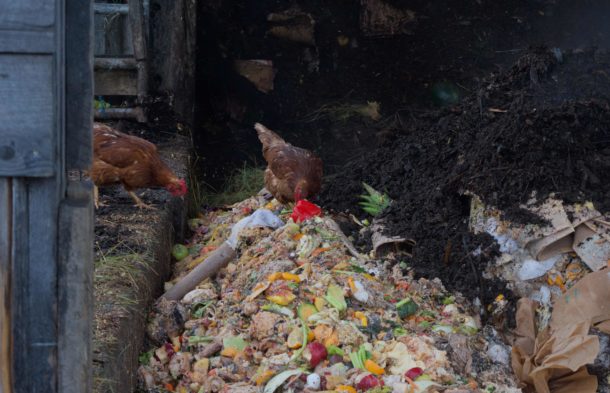

Chicken farmers who also run compost operations say a change in how they are regulated will put them out of business.
Until last year, this small group involved in both composting and farming were viewed as farms and overseen by the Agency of Agriculture. By next November, they will have to receive solid waste permits from the Department of Environmental Conservation, a change the on-farm composters say will be costly and complicated.
The compost and chicken farmers hope to have lawmakers keep their status as farms next session and be allowed to continue feeding chickens food scraps. And they hope the state will do more to promote in-state food waste recycling.
“It’s had a huge economic impact on us,” said Tom Gilbert, owner of Black Dirt Farm in Greensboro Bend. “The piece about not being a farm, it would basically be impossible for us to be open.”

The state Agency of Agriculture and Agency of Natural Resources have tangled for decades over who should be regulating the environmental and public health impacts of farms. Vermont is one of the only states to divvy up farm water quality regulation between its environmental and agricultural agencies.
Vermont has a handful of farms that collect food scraps from local businesses and residents that they blend into a compost mix to feed hens. The leftovers are then processed into compost that they sell. Feeding the hens food scraps allows these farmers to make the economics work for smaller scale egg operations, where most of the costs come from feed.
This is not the first time this question of whether these businesses are farms or solid waste facilities. But Gilbert and Kurt Ericksen, general manager of Montpelier-based Vermont Compost Company, had thought the matter was settled over a decade ago.
In 2006, the Department of Environmental Conservation received a complaint about alleged stream pollution by Vermont Compost Company. Though no evidence of a violation was found, the complaint brought up a lingering question about which agency should investigate. Cathy Jamieson, solid waste program manager with DEC, clarified in a 2007 memo that her department does not regulate food waste brought to farms to feed chickens.
Vermont Compost Company’s “use of food wastes for chicken feed is a resourceful operation, where waste that might normally end up in a landfill is eaten by chickens, which lay eggs that get sold locally,” she wrote.
VTDigger is underwritten by:
The Agency of Agriculture, through the Attorney General’s Office, submitted a memo around the same time saying that the agency considered “the operation of an egg farm and the preparation of compost by (the Vermont Compost Company)” to be farming.
A law passed in 2012, the Universal Recycling Law, set off a wave of waste management changes in the state. Among other requirements, the law contained a phased-in ban on food waste going to landfills, with a complete ban next year.

As more composting businesses started in response to that law, the Agency of Agriculture started receiving odor and bird complaints about the on-farm compost facilities, said Cary Giguere, director of public health and agricultural resource management for the agency. The ag agency did not have the authority to regulate odors and other nuisance complaints on those operations. That power fell to the DEC environmental regulators.
The agriculture agency could have entered into an agreement with DEC similar to its agreement to divvy up water quality regulation but “didn’t actually have any staff or expertise to deal with some of the issues that were coming up,” said Giguere.
“While we’re supportive of feeding chickens food scraps, it’s outside of our bandwidth to regulate that activity,” he said.
That led Diane Bothfeld, director of administrative services for the Agency of Agriculture, to send a memo in 2018 to Jamieson, of DEC, saying that the agriculture agency was no longer going to regulate on-farm composting operations. She wrote that “it is important to note that importing ‘food residuals’” is not considered farming.

Bothfeld also wrote that the agency “has concerns” that farmers feeding chickens food plate scraps could transmit infectious diseases and farmers to comply with the updated federal food safety law.
Giguere said in an email that the agency is neither condoning nor condemning farmers who feed chickens food scraps. “While post-consumer plate waste can’t be distributed as a commercial feed these is no current state law or policy preventing composters from allowing chickens to forage on compost piles,” he wrote.
The agriculture agency’s memo says it will work with the seven unpermitted on-farm composting businesses to apply for a composting facility permit by next November. Jamieson said composting regulations “ensure that it is done in a way that protects public health and the environment.”
“Because this is food waste, it can attract rodents, skunks, birds, flies and whatnot,” she said. “It needs to be managed appropriately. If it’s not done correctly it can cause odors, dust and be a real nuisance to neighbors.”
When the change was announced, compost farmers complained that the agency had undermined a public process that began when the Agency of Agriculture met with them a couple years prior to discuss best management practices for their businesses. They were surprised when this resulted in what they feel is an about-face in how they are regulated.
“Right now, with the policies as they’re proposed, someone from the Agency of Ag could come on-site to look … at the compost forage that we produce, which is we raise our flock on, and they would say … we do not look at this as an agricultural practice anymore,” said Ericksen of Vermont Compost Company.
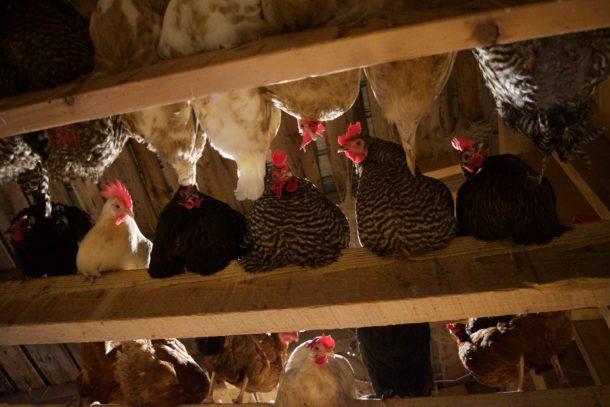
Both Gilbert and Ericksen see raising chickens as integral to the composting process on their farms, with the food waste, spent grain and pasture that the hens forage on mimicking their natural feeding habits. Black Dirt Farm even received a grant from the USDA to study the best way to safely and economically scale up this practice.
The change from being regulated as a farm to a composting facility does not just entail applying for a single solid waste permit. Gilbert estimates that he would now need six additional permits beyond what he had as a farm. And he is afraid he will lose his exemptions from local zoning laws and Act 250 regulations.
VTDigger is underwritten by:
Gilbert wrote in testimony to lawmakers last February that poultry farmers with hens foraging on compost “are facing a unique level of regulation and scrutiny compared to other farmers.”
“My friends that are dairy farmers, they’re just so insulted looking on at what we have to do because when the Agency (of Agriculture) shows up there, it’s like they’re filling out paperwork for you to help with everything,” he said.
Additionally, Gilbert says the way the state Agency of Natural Resources is interpreting food waste management parts of the universal recycling law is further hurting his business.
Vermont has a food recovery hierarchy in law that prioritizes how the state will manage otherwise tossed food, with reducing food waste at the top. Feeding animals is third on the list, followed by composting and anaerobic digestion at number four. (Second is donating eligible food for human consumption.)
Black Dirt Farm had been contracted by Maine-based Agri-Cycle to collect food waste from Hannaford’s. Gilbert said there was an understanding between the two businesses that even if Agri-Cycle, which converts food waste into electricity, wanted to process the food scraps in their anaerobic digesters, they couldn’t because of how the law was written.
Last November, Gilbert received a letter from the company saying that they were no longer contracting with Black Dirt to pick up Hannaford’s food waste because they could more cheaply send it to an out-of-state methane digester.
“In six months we lost 30% of our business,” he said.
Jamieson contends that the state cannot enforce the food regulation hierarchy; for example, there would be no way to require increased food waste reduction. She added that food rescue, which is when otherwise wasted food is sent to food shelves, in Vermont has almost tripled from 2014-2017.
Gilbert also questions whether the state should be giving the green light to food “depackaging” systems, which mechanically separate plastic packaging from food materials. Vermont does not currently have any in-state food depackagers but Casella Waste Systems has received a draft permit for one at its Williston transfer station.
“The problem is that fundamentally you cannot smash plastics and organic material … without getting microplastics in that material,” said Gilbert.
Jamieson, of DEC, said depackaging systems could significantly increase food recovery, particularly from larger businesses where it may be impractical to manually separate out spoiled products from their packaging. She pointed out that a waste report last year showed that 38% of food that was thrown away in Vermont was in packaging.
But as state law requires “source separation” of food waste from other disposed items, DEC is still reviewing whether to allow non-packaged food waste to be mixed with packaged foods and sent through depackagers, Jamieson added.
After an unsuccessful effort to reverse the Agency of Agriculture’s decision last session, compost and poultry farmers worked with DEC to delay the date they would need to apply for compost facility certification to next November.
They have been working with advocacy group Rural Vermont on policy proposals for next session. Ericksen said their main goals are to keep their businesses defined as farms and to have their compost defined as “principally produced” on-farm.
If these hoped-for changes don’t happen, Vermont Compost Company and others with similar operations have indicated they will be “stepping away from food scraps,” he said.
Don’t miss a thing. Sign up here to get VTDigger’s weekly email on the energy industry and the environment.