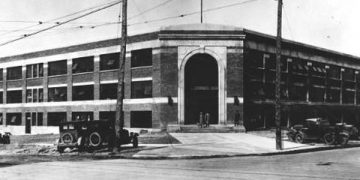








Kettering University Academic building when it was known as General Motors Institute in 1927
In recent decades, Flint, Mich. has been known better as a symbol of urban decay and lead-poisoned water than for high technology. However, situated in the heart of this troubled city is a relatively small educational institution that has had an outsized influence on American industry for the past century. In 2019, Kettering University celebrated its centennial and as an alumnus I’ve recently been back to visit and see what has changed and got to spend some time with university president Dr. Robert McMahon.
A private school with a bit more than 3,000 full-time students, Kettering is dwarfed in size by the likes of the University of Michigan and Michigan State University. But unlike those large public institutions, Kettering’s undergraduate programs are limited to engineering, science, math and management.

CAMBRIDGE, MA – JULY 17: Robert McMahan of Kettering University, Ryan Keenan of Udacity and David … [+]
The name Kettering is a relatively recent change. It reflects both the school’s heritage as the former General Motors Institute and it’s expanding base of corporate partners over the last several decades. The school opened in 1919 as the Flint School of Automotive Trades and four years later became the General Motors Institute when it was acquired by the automaker. In 1982, it was spun off as the GMI Engineering and Management Institute and got its current name in 1998. Charles Kettering was the co-founder of the Dayton Engineering Labs Company (later Delco) and served as head of research at GM from 1920 to 1947.
The Kettering campus sits on Chevrolet Avenue in Flint, just down the block from the home of the old Chevrolet factory which was the site of the famous 1936-37 sit-down strike that gave birth to the UAW. Today, that factory is long gone, having been replaced by the Mobility Research Center (MRC) test track operated by the school.

Kettering University Mobility Research Center
What has always made Kettering unique and special was its co-operative educational model. From the beginning, students have alternated school terms with work terms at sponsor companies. In the beginning, all of the students worked at GM, but by the time I attended in the late-1980s, dozens of companies were sponsoring GMI co-op students a number that has grown to hundreds in the 29 years since I graduated.
As of 2019, only about 4% of the students at Kettering spend their work terms at GM facilities. As the range of degree programs has expanded into computer science and bio-medical engineering, so too have the types of companies sponsoring students and only about 60% of the students today work in automotive related companies.
The co-op program is enormously valuable in multiple ways. It gives students an opportunity to gain valuable experience in their chosen field as they go through school as well as earn money to pay the not inconsiderable tuition (this is after all a private post-secondary school). Students get the opportunity to apply their education and find out if this is really what they want to do or whether they want to choose a different track.
During my time in Flint, many of the classmates I started school with either didn’t leave with a GMI engineering degree or switched majors. In those days, the school mainly offered degrees in mechanical, electrical, chemical or industrial engineering along with business administration. Today, that scope has expanded significantly with applied math, biology, physics, computer engineering, biochemistry and even pre-med.
Compared to larger comprehensive schools the University of Michigan, MIT or Stanford, Kettering’s graduation rate of about 65% may seem rather low. But there is a crucial difference. A student at U-M that decides engineering isn’t the right path for them has many other options available to them if want to change majors and they don’t necessarily have to leave the school. While new degree fields do provide more flexibility to students than they had 30 years ago, many end up transferring elsewhere.
The commitment to the co-op undergraduate system means that Kettering will always remain relatively small because of the challenges in finding companies willing to commit to taking on students for most if not all of the five year program. However, Kettering has expanded its scope with the addition of online masters degree programs in areas such as lean manufacturing, management and even an MBA which includes several thousand more students every year.
Managing the supply chain
One of the big topics of my discussion with Dr. McMahon was diversity. During my time in Flint, the student body was something like 90% male and predominantly white. As we’ve come to see in many areas of business, but especially technology, having a monochromatic and largely single gendered workforce has led to many issues with the type of products that get produced. Even in software, where algorithms are supposedly neutral, lake of broad-based input can and does lead to biases in the way that data is treated.
In the past decade or two, there have been many efforts to get more female students and students of color involved in STEM related programs. According to McMahon, many of these programs have failed to make an impact because they come too late, often focusing on the high school years. By that time, many girls and students from lower income communities have long since opted out of STEM paths.
McMahon feels it is crucial to nurture the development of these students at a much younger age, starting even before middle school. It turns out that students are opting out of technical tracks as soon as sixth and seventh grade. McMahon feels that educators from the college level need to reach down and get involved with those younger students to help them stay interested.
Kettering has been involved in a broad range of efforts to support students that may have an interest in pursuing science, technology, engineering and math careers as they grow up. The situation has improved since my time in Flint, but with only about 20% women in the student body, there is still a long way to go to achieve the kind of diversity that the engineering field needs. The situation is slightly better on the faculty side with about 25-30% of the staff being women now.
As with graduation rates though, the picture is more nuanced than a simple top level number implies. The more a discipline touches on humanity, the more women are inclined to follow that path. For example, mechanical and electrical engineering have the lowest percentage of women students, something that hasn’t changed since I got my mechanical engineering degree. However, 50% of the students in the bio-medical engineering program are women.
Given the challenges of ensuring that automated vehicles are safe and can interact smoothly with other vehicles and vulnerable road users including pedestrians and cyclists, it would seem like this is an area where women could play an important role. Companies and educational institutions need to focus more on these aspects of developing the mobility ecosystem and hopefully more women will become involved.
FIRST
One of Kettering’s biggest efforts to extend diversity in the STEM field is its support for FIRST robotics, a program that Kettering has been supporting for 20 years. Since the beginning, Kettering faculty and students have been active as mentors and guides for FIRST robotics teams from Flint and the surrounding communities.

Kettering University FIRST Robotics Center hosts teams from eight Flint region schools
When a new recreation center was built on the campus in the early 2000s, the former gym in the academic building was converted into a home for FIRST robotics. Eight local robotics teams are hosted in the Kettering robot facility. Each team gets its own space for building and testing its machines, storing tools and other equipment. There is even a practice field that teams can use for testing and development before going to competitions.
The teams get access to the computer labs with all of the same software that Kettering students use every day including computer aided design, programming and project management tools. Faculty and student advisors work with the FIRST teams to provide guidance and training. Adjacent to the main facility in the old gym is a fabrication center with all of the equipment the teams may need including 3D printers.

Kettering University FIRST Robotics Center includes a complete fabrication lab and computer center … [+]
Kettering staff provides safety training on all of the equipment similar to the processes that workers in a factory would get and supervises operations. For the kids participating in FIRST, they get to interact with college students that bring their co-op experience to the program from the academic and work side. This is the kind of exposure that is hard to get anywhere else and can really help the younger kids get an idea of what they’d like to do later on. All of this is provided at no cost to the teams hosted at Kettering.
Unlike sports, “the robotics team is the only one at a typical school where every member has the opportunity to go pro,” says McMahon.

Kettering University FIRST Robotics Center includes a practice field for the student teams
Kettering also offers a program called Academically Interested Minds (AIM) which provides a five week residential program for high-school students from underserved communities in the summer. Students live in the dorm and attend classes and other programs at Kettering.
Science is all about understanding how and why the world around us works. Engineering is about taking the scientific concepts and applying them to solve real world problems.
“One of the failures of technical education is that math is taught as an abstraction,” adds McMahon. “But calculus was invented to solve the problem of dealing with nature.”
The close proximity of academics and the work environment in a co-op education system lets students break through that abstraction layer to see what all of these concepts really mean and how they can be leveraged to solve those problems. For McMahon reaching downstream to younger students is an extension of the whole co-op philosophy that develops future generations of scientists and engineers.
At any level from elementary school to post-graduate, developing interest across domains and beyond technical subjects is also crucially important. According to McMahon, real innovation occurs across those domains when you see ways to connect dots in disparate areas to find new solutions to problems. That’s why even though Kettering is primarily an engineer and science school, the students do also take many courses in humanities areas.
McMahon describes it as trying to develop “T-shaped individuals.” Traditional engineering involves developing a deep knowledge in a narrow space. While that is ultimately important, it’s also imperative to have a broad range of knowledge across many topics. No technology exists in isolation and it’s important to have a view of how what you develop affects other areas, and how externalities affect what you are doing.
That T-shaped knowledge is where you start to see the connections that should influence your work. As we’ve seen in many areas including social media and transportation in the past decade, disruption can have both a positive and a negative impact on society. Staying in a silo or swim lane, can often prevent engineers from seeing all sides of what might happen.
Part of this is developing a sense of ethics among the students that will form future generations of technologists. Many of the products created by engineers can have life or death consequences if they fail and professional ethics has long been considered an important aspect of the job.
Silicon Valley has attracted countless young engineers in recent decades with the promise of vast riches if they create a breakout product. Many of those ideas were spawned while their creators were still in school. Bill Gates, Steve Jobs, Mark Zuckerberg and many others left school before earning a degree and finishing their formal education.
In some cases we’ve seen a lot of questionable business practises and unintended consequences. From the ways that Facebook and Twitter have been used to manipulate public attitudes to Uber’s mad rush to get autonomous vehicles to market, a lack of humanities and ethics education clearly has played a role.
In addition to having students volunteer for programs like FIRST robotics, Kettering strongly encourages them to participate in other community and volunteer programs. In school professors are encouraged to discuss choices and implications with the students and when those students return to their sponsoring companies they are expected to do the right thing.
Educating young adults is a tough challenge no matter what the chosen field. For 100 years Kettering/GMI/General Motors Institute/Flint School of Automotive Trades has pursued a unique path that has spawned many leaders in industry across the U.S. and beyond. As this comparatively small school starts its second century with leaders like Robert McMahon, it hopes to develop and even better crop of graduates that will have a positive influence on the world.










