

• Latest
  • Trending
  • All
‘Sneaky’ underwater robot spent 18 days recording sea creatures — and noisy humans, too

‘Sneaky’ underwater robot spent 18 days recording sea creatures — and noisy humans, too

December 8, 2019
Last Mile Delivery Market Worth Observing Growth | UPS, FedEx, SF Express

Last Mile Delivery Market Worth Observing Growth | UPS, FedEx, SF Express

April 23, 2024
Top 5 Spend Analysis Software ranked in 2024

Top 5 Spend Analysis Software ranked in 2024

March 1, 2024
How Tesla And BMW Are Leading A Supply Chain Renaissance With Blockchain

How Tesla And BMW Are Leading A Supply Chain Renaissance With Blockchain

January 19, 2024
LATAM Cargo strengthens European cargo links

LATAM Cargo strengthens European cargo links

April 14, 2020
Ford making reusable hospital gowns from airbag materials as efforts against coronavirus expand

Ford making reusable hospital gowns from airbag materials as efforts against coronavirus expand

April 14, 2020
Don’t Sweat NBC’s Decision to Cut Back on Television Ad Inventory

Don’t Sweat NBC’s Decision to Cut Back on Television Ad Inventory

April 14, 2020
Software firms sharpen focus on AI, big data as IT spending drops

Software firms sharpen focus on AI, big data as IT spending drops

April 14, 2020
Navigating turbulent times in your supply chain (TL:DR version)

Navigating turbulent times in your supply chain (TL:DR version)

April 14, 2020
Last Mile Delivery by Drones Market is Booming Worldwide

Last Mile Delivery by Drones Market is Booming Worldwide

April 14, 2020
AIR CARGO MARKET SIZE, SHARE, DEMAND, TREND, LATEST INNOVATIONS & APPLICATION ANALYSIS AND INDUSTRY GROWTH FORECAST 2027 – Science In Me

AIR CARGO MARKET SIZE, SHARE, DEMAND, TREND, LATEST INNOVATIONS & APPLICATION ANALYSIS AND INDUSTRY GROWTH FORECAST 2027 – Science In Me

April 14, 2020
Wheat procurement in Patiala: 6,500 coupons issued to farmers – cities

Wheat procurement in Patiala: 6,500 coupons issued to farmers – cities

April 14, 2020
Pandemic, Plastics And The Continuing Quest For Sustainability

Pandemic, Plastics And The Continuing Quest For Sustainability

April 14, 2020
  • Supply Chain
  • Logistics
  • Warehousing
  • Procurement
  • Shipping
  • More
    • Strategic Sourcing
    • Spend Analysis
    • Inventory
    • Contact Us
No Result
View All Result
United States International Supply Chain Commission
Home Logistics

‘Sneaky’ underwater robot spent 18 days recording sea creatures — and noisy humans, too

by usiscc
December 8, 2019
in Logistics
0
‘Sneaky’ underwater robot spent 18 days recording sea creatures — and noisy humans, too
493
SHARES
1.4k
VIEWS
Share on FacebookShare on Twitter

For 18 days, an underwater robot dived and surfaced and dived and surfaced — some 402 times in all — listening to the ocean’s depths as it traveled hundreds of miles along the continental shelf off the Washington and Oregon coastline.

The torpedo-shaped robot, called a glider, captured the percussive roar of a research ship’s air gun, which reverberated like a muffled bass drum. It listened to what sounded like the churn of a wobbly washing machine, which indicated the presence of a ship passing nearby. The 120-pound robot even caught the delightful, baritone whining of humpback whales.

For years, scientists have been working to untangle the mysteries of ocean sound. Noise travels much farther underwater than it does in air.

“Sound is to marine animals what light is to people on land,” said Joe Haxel, an assistant professor at Oregon State University in marine resources studies. It is the medium through which these creatures hear, locate themselves and communicate.

Just how noisy is the sea? Are humans — with freight ships and ocean drilling and sonar testing — making it louder?

“We know so little about the overall noise in the ocean and how that affects things — the critters that live there,” said Chris Meinig, the director of engineering for the National Oceanic and Atmospheric Administration’s Pacific Marine Environmental Laboratory in Seattle.

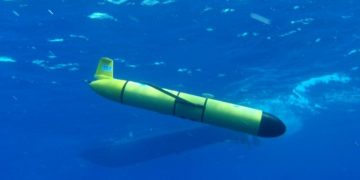
A glider dives past a vessel during testing in Kona, Hawaii. Most gliders do not have propellers or propulsion systems, relying on buoyancy engines, wings and rudders to propel them. (courtesy of Oregon State University)

A glider dives past a vessel during testing in Kona, Hawaii. Most gliders do not have propellers or propulsion systems, relying on buoyancy engines, wings and rudders to propel them. (courtesy of Oregon State University)

A new research paper, authored by both Haxel and Meinig and published last month in the peer-reviewed science journal PLOS ONE, chronicles the glider’s travels and explains how this technology allows scientists to listen to the sea and explore its murky depths.

“This is a new way to make measurements that inform us about what’s going on out there,” Haxel said.

Most ocean gliders operate without propellers or any propulsion system at all.

Instead, they carve through the water because of their wings, which angle against the saltwater as the robot adjusts its buoyancy.

“We use the wings to adjust the attitude and the flight path,” Meinig said.

Mechanical rudders are often equipped to help keep the machine on course. Batteries inside the tubular machine can move and adjust its ballast.

When gliders surface, they can communicate with satellites, share data and get instructions from their handlers. Then, they dip back down to a programmed depth, before beginning to climb through the water again.

Scientists use gliders to gather ocean temperatures, information about salinity and myriad other measures.

Seagliders were invented at the University of Washington. These robots have been searching the ocean for clues to science’s mysteries for about 15 years, Meinig said. But the technology continues to develop.

Oregon State University acoustic engineer Haru Matsumoto dives behind a glider being tested in Kona, Hawaii. After testing, scientists sent the glider on an 18-day trip along the Washington and Oregon coast, in part, to listen to ocean noise and record what it heard. (Courtesy of Oregon State University)

Oregon State University acoustic engineer Haru Matsumoto dives behind a glider being tested in Kona, Hawaii. After testing, scientists sent the glider on an 18-day trip along the Washington and Oregon coast, in part, to listen to ocean noise and record what it heard. (Courtesy of Oregon State University)

Because gliders do not have propellers, the quiet machines rarely disrupt normally skittish animals, Haxel said.

“They’re kind of sneaky,” he said.

Hydrophones, which are essentially underwater microphones, have allowed scientists to gather acoustic data from gliders for many years.

But studies of ambient ocean noise have typically relied on fixed moorings, which can only sample at individual locations and depths.

Gliders with hydrophones have not been used for extensive noise monitoring before, largely because the vehicles’ rudders often interrupt recordings. Haxel and other scientists managed to filter rudder noise from their audio using computer algorithms.

“I have not seen anybody do an ambient noise study with gliders like this before,” said Elizabeth Küsel, a senior scientist with JASCO Applied Sciences, who has worked with gliders for about a decade and was not involved in this research. “Their work is very valuable.”

Research scientists launched the glider on July 20, 2012, off Grays Harbor. It arrived two and a half weeks later near Brookings, Oregon, some 285 miles away.

The robot traveled, on average, less than 1 mph. Its median dive depth was more than 2,050 feet below the ocean’s surface.

Scientists recorded throughout its journey, capturing audio of at least 11 encounters with Pacific white-sided dolphins, three brushes with humpback whales and several other creatures scientists could not identify.

The robot also captured passing vessels and the powerful air gun of a National Science Foundation ship conducting seismic research off the coast.

“It’s basically an explosion,” Haxel said of the air gun’s blasts. “Every 20 or 30 seconds you’re getting a large rumble in the water column.”

Oil and gas companies also use seismic air guns to research possible deposits. Their use is controversial because these blasts can harm nearby animals.

At times, the research air gun was loud enough to register “above the sensitivity threshold we could measure,” Haxel said, though the scientists were using a particularly sensitive hydrophone.

Still, on the whole, the scientists found that ocean noise off the coast had remained similar to measurements from the 1990s taken from fixed moorings.

Large vessels did not have as significant an impact on overall noise levels as Haxel had expected. The scientists compared tracking data from ships and found little correlation between overall noise and ship presence.

“That was an eye-opener for me. I used to think ships are so loud,” Haxel said. But along the continental shelf, which features an uneven sea floor, an energetic, wavy ocean surface and unique physical properties in the water column, sound emanating from ships seemed to get “trapped” and have “limited range,” he said.

These results can’t be extrapolated to other locations.

“Your sound velocity profile is going to look a lot different in Puget Sound,” Haxel said.

Gliders have been used to map the sound of erupting underwater volcanoes, help with National Oceanic and Atmospheric Administration hurricane forecasts and also to listen to deep-diving baleen whales.

They’ve flown through the Blob-like marine heat wave roiling the Pacific Ocean, in the Bering Sea near Alaska and beneath ice at both polar continents, Meinig said.

“There’s probably more simple robots in the ocean than anywhere else,” Meinig said. And with gliders, “We’re doing ever increasing and challenging things.”

Each flight, these robots reach a bit further into the unknown.

Share197Tweet123
usiscc

usiscc

  • Trending
  • Comments
  • Latest
Escape From Tarkov – How to Rotate Items

Escape From Tarkov – How to Rotate Items

February 5, 2020
Supply chain examination: Planning for vulnerabilities you can’t control

Supply chain examination: Planning for vulnerabilities you can’t control

December 7, 2019
Procurement Project Manager job with Camden London Borough Council

Procurement Project Manager job with Camden London Borough Council

February 17, 2020
Art Battle Wichita Falls III at The Warehouse, 1401 Lamar.

Art Battle Wichita Falls III at The Warehouse, 1401 Lamar.

0
Global Industry Analysis, Size, Share, Growth, Trends, and Forecasts 2016–2024 – ZMR News Reports

Global Industry Analysis, Size, Share, Growth, Trends, and Forecasts 2016–2024 – ZMR News Reports

0
PHOTOS: Ottawa firefighters respond to warehouse fire

PHOTOS: Ottawa firefighters respond to warehouse fire

0
Last Mile Delivery Market Worth Observing Growth | UPS, FedEx, SF Express

Last Mile Delivery Market Worth Observing Growth | UPS, FedEx, SF Express

April 23, 2024
Top 5 Spend Analysis Software ranked in 2024

Top 5 Spend Analysis Software ranked in 2024

March 1, 2024
How Tesla And BMW Are Leading A Supply Chain Renaissance With Blockchain

How Tesla And BMW Are Leading A Supply Chain Renaissance With Blockchain

January 19, 2024
  • Privacy Policy
  • Terms of Use
  • Disclaimer
  • DMCA
  • Contact Us

Copyright © 2024 United States International Supply Chain Commission (usiscc.org)

This website uses cookies to improve your experience. We'll assume you're ok with this, but you can opt-out if you wish. Cookie settingsACCEPT
Privacy & Cookies Policy

Privacy Overview

This website uses cookies to improve your experience while you navigate through the website. Out of these cookies, the cookies that are categorized as necessary are stored on your browser as they are essential for the working of basic functionalities of the website. We also use third-party cookies that help us analyze and understand how you use this website. These cookies will be stored in your browser only with your consent. You also have the option to opt-out of these cookies. But opting out of some of these cookies may have an effect on your browsing experience.
Necessary
Always Enabled

Necessary cookies are absolutely essential for the website to function properly. This category only includes cookies that ensures basic functionalities and security features of the website. These cookies do not store any personal information.

Non-necessary

Any cookies that may not be particularly necessary for the website to function and is used specifically to collect user personal data via analytics, ads, other embedded contents are termed as non-necessary cookies. It is mandatory to procure user consent prior to running these cookies on your website.

SAVE & ACCEPT
No Result
View All Result
  • Supply Chain
  • Logistics
  • Warehousing
  • Procurement
  • Shipping
  • More
    • Strategic Sourcing
    • Spend Analysis
    • Inventory
    • Contact Us

Copyright © 2024 United States International Supply Chain Commission (usiscc.org)







