

• Latest
  • Trending
  • All
OPINION: Life (and death) in plastic

OPINION: Life (and death) in plastic

December 9, 2019
Last Mile Delivery Market Worth Observing Growth | UPS, FedEx, SF Express

Last Mile Delivery Market Worth Observing Growth | UPS, FedEx, SF Express

April 23, 2024
Top 5 Spend Analysis Software ranked in 2024

Top 5 Spend Analysis Software ranked in 2024

March 1, 2024
How Tesla And BMW Are Leading A Supply Chain Renaissance With Blockchain

How Tesla And BMW Are Leading A Supply Chain Renaissance With Blockchain

January 19, 2024
LATAM Cargo strengthens European cargo links

LATAM Cargo strengthens European cargo links

April 14, 2020
Ford making reusable hospital gowns from airbag materials as efforts against coronavirus expand

Ford making reusable hospital gowns from airbag materials as efforts against coronavirus expand

April 14, 2020
Don’t Sweat NBC’s Decision to Cut Back on Television Ad Inventory

Don’t Sweat NBC’s Decision to Cut Back on Television Ad Inventory

April 14, 2020
Software firms sharpen focus on AI, big data as IT spending drops

Software firms sharpen focus on AI, big data as IT spending drops

April 14, 2020
Navigating turbulent times in your supply chain (TL:DR version)

Navigating turbulent times in your supply chain (TL:DR version)

April 14, 2020
Last Mile Delivery by Drones Market is Booming Worldwide

Last Mile Delivery by Drones Market is Booming Worldwide

April 14, 2020
AIR CARGO MARKET SIZE, SHARE, DEMAND, TREND, LATEST INNOVATIONS & APPLICATION ANALYSIS AND INDUSTRY GROWTH FORECAST 2027 – Science In Me

AIR CARGO MARKET SIZE, SHARE, DEMAND, TREND, LATEST INNOVATIONS & APPLICATION ANALYSIS AND INDUSTRY GROWTH FORECAST 2027 – Science In Me

April 14, 2020
Wheat procurement in Patiala: 6,500 coupons issued to farmers – cities

Wheat procurement in Patiala: 6,500 coupons issued to farmers – cities

April 14, 2020
Pandemic, Plastics And The Continuing Quest For Sustainability

Pandemic, Plastics And The Continuing Quest For Sustainability

April 14, 2020
  • Supply Chain
  • Logistics
  • Warehousing
  • Procurement
  • Shipping
  • More
    • Strategic Sourcing
    • Spend Analysis
    • Inventory
    • Contact Us
No Result
View All Result
United States International Supply Chain Commission
Home Procurement

OPINION: Life (and death) in plastic

by usiscc
December 9, 2019
in Procurement
0
OPINION: Life (and death) in plastic
494
SHARES
1.4k
VIEWS
Share on FacebookShare on Twitter

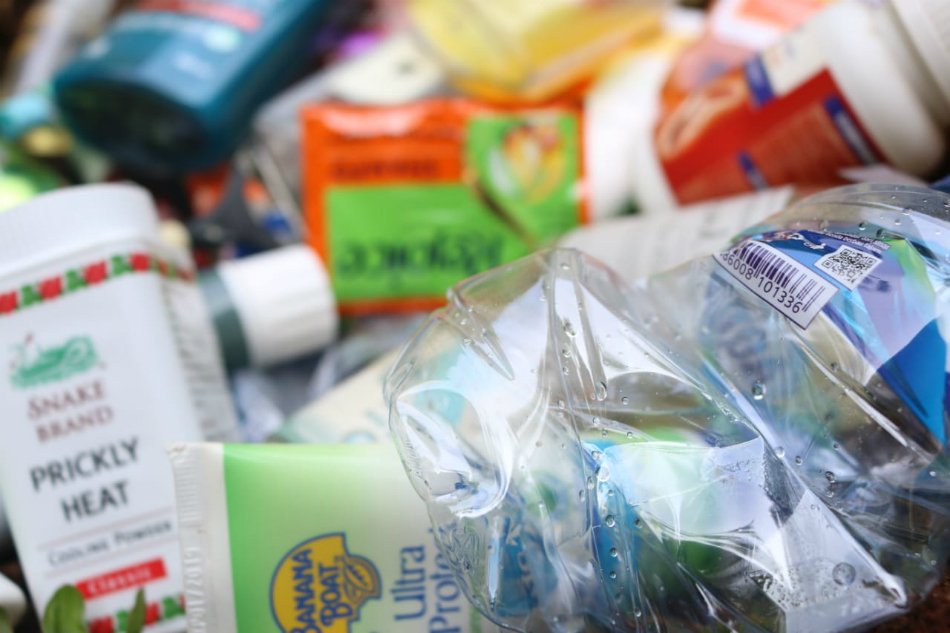
Close shot of the plastic waste from the author’s bathroom shelf. In 2018, the average Malaysian produced 1.17 kilogram of waste according to the Solid Waste Management and Public Cleansing Corporation (SWCorp). Team Ceritalah

The animal is dead. It can be a fish, bird, mammal or reptile. It’s always the same. An autopsy is conducted and inevitably – reams of plastic are discovered in its stomach.

When I wake up every morning, I step into my bathroom and survey the shelves. There are rows of multi-colored plastic containers: toothpaste, hair conditioners, hand soap, creams and eye lotions. Since I’m always traveling, I also have stacks of those cheap, single-usage shampoo sachets.

Nowadays, (and because of the endless amounts of plastic that I seem to be using) I feel as if I’m a perpetrator and the killer of all those animals.

It’s easy to succumb to hopelessness at the scale of it all: of mountains of indestructible trash. But let’s pause and get some perspective for a second.

Plastic – put simply – is any synthetic or semi-synthetic organic polymer and typically produced from petrochemicals. And we’re talking about a lot more than single-use plastics.

According to the Society of the Plastics Industry, the majority of plastic produced and thrown away can be narrowed down to 6 categories.

First: the (notorious) plastic bottle. These are usually made out of Polyethylene Terephthalate (PET), which is a hard but flexible material. Polyesters – the wearable fabric – are a form of PET.

Second: High Density Polyethylene (HPDE) is used to make sturdier objects that require a fixed structure, for example, auto parts, pallets, furniture, packaging detergents, bleach and milk containers.

Three: Polyvinyl Chloride (PVC). This is more ductile and durable. PVC’s resistance to fire and ability to withstand pressure makes it an ideal construction material, used in piping, flooring and cables.

Fourth: Low Density Polyethylene (LDPE) is generally a thin, flexible plastic material used for plastic bags and most of our packaging.

Fifth: Polypropylene (PP) is an extremely flexible and rubber-like type of plastic used in tubes and medical supplies. It is superior in terms of heat resistance, flexibility and transparency.

Sixth: polystyrene (PS) is a type of thermoplastic, which means it can be melted and reformed without going through a permanent chemical change. It is most often used in producing Styrofoam.
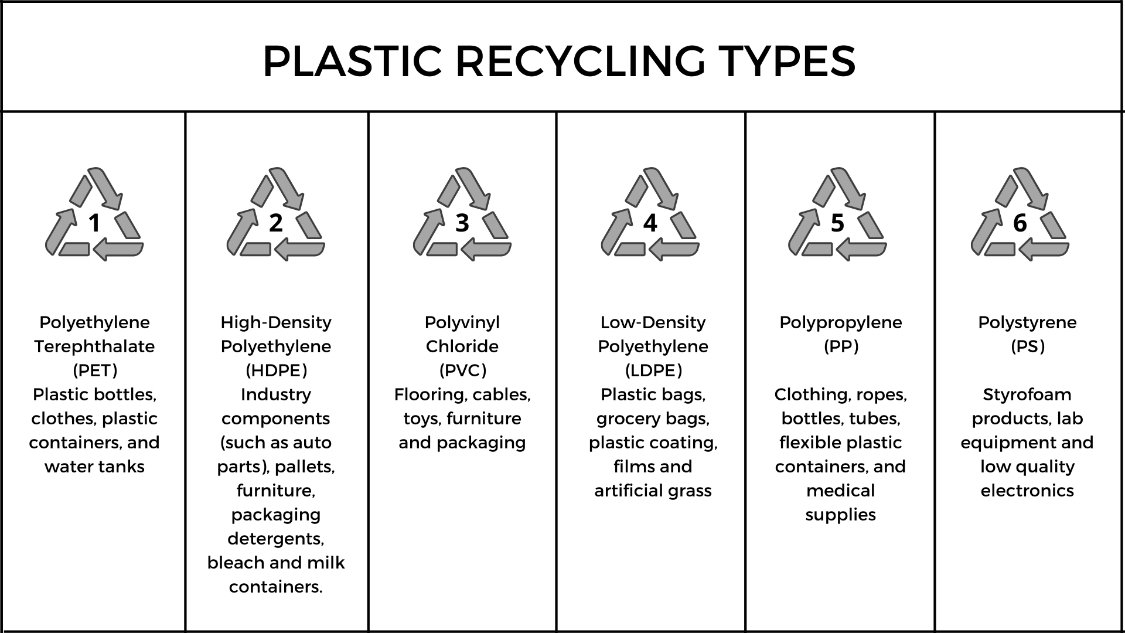
Types of plastics. Team Ceritalah

Surely we can recycle or do anyway with all these categories of plastic?

Not necessarily; and this is where things get complicated.

For instance, out of the 6, only 3 can be recycled in Malaysia: PET, HPDE and PP. In Indonesia, only PET, HPDE and (to a lesser extent) LDPE are recycled.

However, I – and most Southeast Asians – have all 6 categories in our homes.

Indeed, there is a big question mark over whether we can do away with plastic in entirety.

The plastics industry (a key product of petrochemicals) is huge. The combined revenue from the top 50 petrochemical firms in 2018 was $926.8 billion, far exceeding the refining industry’s $400 billion.

Moreover, the petrochemical industry is projected to grow by 10 to 15 percent every year.

In East Asia, there are giants like LG, Toray, Formosa Plastics, SINOPEC, Mitsubishi, PetroChina and LOTTE. Southeast Asia accounts for one-third of the top 50’s revenue, demonstrating strong growth in the region.

And all this plastic sure piles up!

Bantar Gebang is Indonesia and Southeast Asia’s largest dumping side. Every day, around 6,500 – 7,000 tons of waste from the greater Jakarta metropolitan region enters the area.

Plastics constitute a large proportion of the waste. But the painful truth is that we cannot afford to simply stop producing plastic, nor are there feasible alternatives to allow us to easily function in our daily lives without it.

To my mind, the plastic isn’t so much the issue. The real challenge is figuring out and then maintaining an effective and cost-effective waste management system.
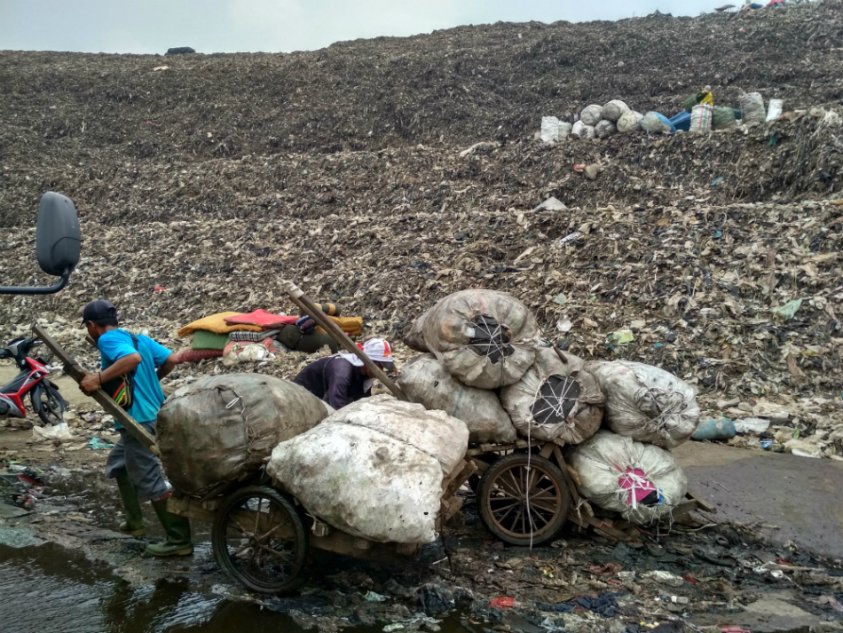
More than 7,000 scavengers lend assistance from rubbish bins in Bantar Gebang. Team Ceritalah

For example: Indonesia – which throws an estimated 1.3 million tons of plastic into the ocean annually, suffers from having inadequate infrastructure and limited official commitment.

Open-dumping sites are not a good long-term solution given plastic’s immense durability.

As a result, sites like Bantar Gebang are already close to being full.

Singapore, South Korea and Japan are potential models: where waste is either incinerated in waste-to-energy power plants or recycled.

These countries also have 3 factors in common.

First, they make it the responsibility of producers to produce easily recyclable packaging.

Second, they have a strong culture of promoting disciplined and responsible individual recycling.

Finally, all 3 have good industrial capability in processing waste and recyclable material.

But this is not to say we should solely depend on waste management. Where possible, we should reduce, reduce, reduce.

Countries can try and cut back on single-use plastic via measures like bans and tariffs. Indonesia’s premier tourism hub, Bali, for instance, has implemented the former since June 23, 2019.

Retail outlets like supermarkets and restaurants can opt to use traditional packaging like banana leaf.

But ultimately, we, the people, need to demand change while also altering our own behaviour.

People form and inform governments, shape markets as well as affect demand.

You and I are not off-the-hook here.

It is either that or we accept responsibility for the death of thousands, if not millions of animals.

Although tragic, the visceral reactions evoked by images of “death by plastic” should serve as a strong impetus for action.

Like it or not, plastic is here to stay.

But there’s no reason why we can’t also be conscientious in disposing of what remains through effective waste management systems.

Disclaimer: The views in this blog are those of the blogger and do not necessarily reflect the views of ABS-CBN Corp.

Blog, blog roll, Karim Raslan, Ceritalah ASEAN, Indonesia, Malaysia, plastic, single-plastic, pollution, animals, death, trash, garbage, recycle, recycling


Share198Tweet124
usiscc

usiscc

  • Trending
  • Comments
  • Latest
Escape From Tarkov – How to Rotate Items

Escape From Tarkov – How to Rotate Items

February 5, 2020
Supply chain examination: Planning for vulnerabilities you can’t control

Supply chain examination: Planning for vulnerabilities you can’t control

December 7, 2019
Procurement Project Manager job with Camden London Borough Council

Procurement Project Manager job with Camden London Borough Council

February 17, 2020
Art Battle Wichita Falls III at The Warehouse, 1401 Lamar.

Art Battle Wichita Falls III at The Warehouse, 1401 Lamar.

0
Global Industry Analysis, Size, Share, Growth, Trends, and Forecasts 2016–2024 – ZMR News Reports

Global Industry Analysis, Size, Share, Growth, Trends, and Forecasts 2016–2024 – ZMR News Reports

0
PHOTOS: Ottawa firefighters respond to warehouse fire

PHOTOS: Ottawa firefighters respond to warehouse fire

0
Last Mile Delivery Market Worth Observing Growth | UPS, FedEx, SF Express

Last Mile Delivery Market Worth Observing Growth | UPS, FedEx, SF Express

April 23, 2024
Top 5 Spend Analysis Software ranked in 2024

Top 5 Spend Analysis Software ranked in 2024

March 1, 2024
How Tesla And BMW Are Leading A Supply Chain Renaissance With Blockchain

How Tesla And BMW Are Leading A Supply Chain Renaissance With Blockchain

January 19, 2024
  • Privacy Policy
  • Terms of Use
  • Disclaimer
  • DMCA
  • Contact Us

Copyright © 2024 United States International Supply Chain Commission (usiscc.org)

This website uses cookies to improve your experience. We'll assume you're ok with this, but you can opt-out if you wish. Cookie settingsACCEPT
Privacy & Cookies Policy

Privacy Overview

This website uses cookies to improve your experience while you navigate through the website. Out of these cookies, the cookies that are categorized as necessary are stored on your browser as they are essential for the working of basic functionalities of the website. We also use third-party cookies that help us analyze and understand how you use this website. These cookies will be stored in your browser only with your consent. You also have the option to opt-out of these cookies. But opting out of some of these cookies may have an effect on your browsing experience.
Necessary
Always Enabled

Necessary cookies are absolutely essential for the website to function properly. This category only includes cookies that ensures basic functionalities and security features of the website. These cookies do not store any personal information.

Non-necessary

Any cookies that may not be particularly necessary for the website to function and is used specifically to collect user personal data via analytics, ads, other embedded contents are termed as non-necessary cookies. It is mandatory to procure user consent prior to running these cookies on your website.

SAVE & ACCEPT
No Result
View All Result
  • Supply Chain
  • Logistics
  • Warehousing
  • Procurement
  • Shipping
  • More
    • Strategic Sourcing
    • Spend Analysis
    • Inventory
    • Contact Us

Copyright © 2024 United States International Supply Chain Commission (usiscc.org)