






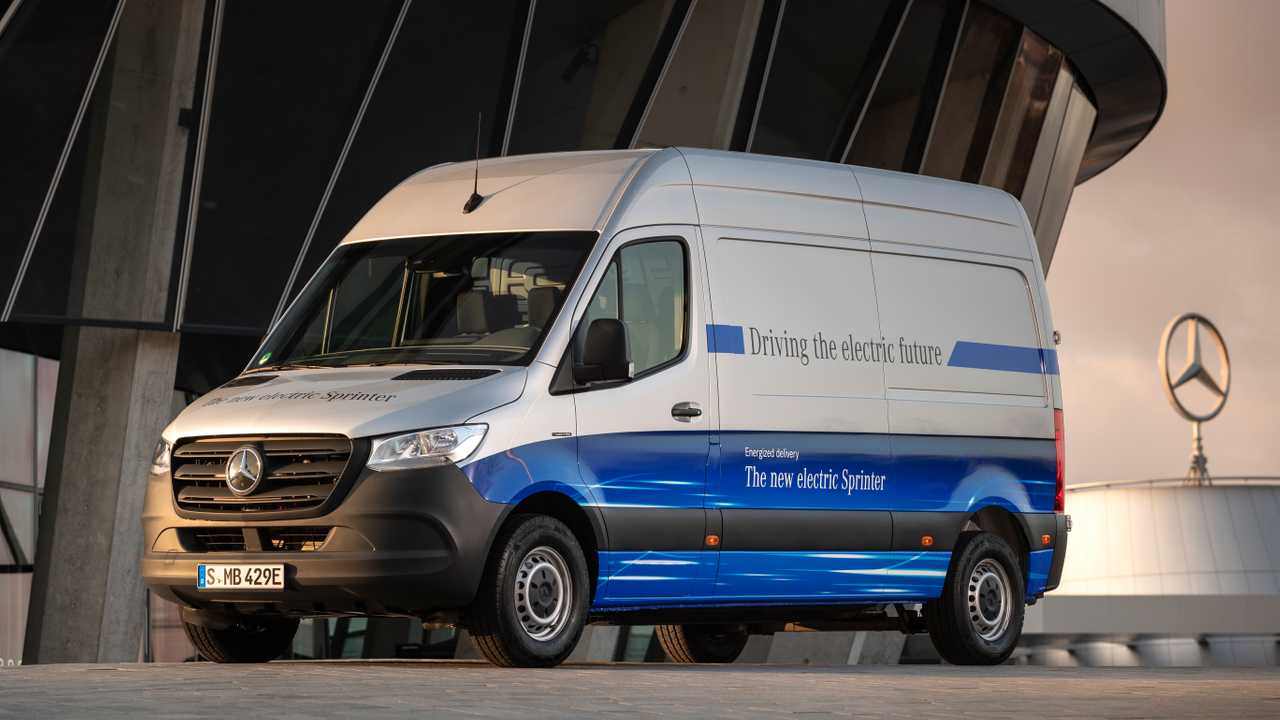
Electrified segment founder: the new Mercedes-Benz eSprinter
Next milestone in the electrification of all commercially used Mercedes-Benz vans
Mercedes-Benz presents locally emission-free mobility for urban use at the press roadshow
Flexible battery and payload concept for various customer profiles
eCharging planner as advice tool for the mobility revolution in vehicle fleets
Low-emission, reliable and flexible: the new Mercedes-Benz eSprinter combines all the attributes by which vehicle fleets measure their vehicles. As the second commercial model after the eVito, it continues the consistent electrification at Mercedes-Benz Vans and, from 9 to 17 December, was presented to the trade press in six large German cities. In short the founder of its segment is therefore also available to commercial customers who deliver goods locally emission-free, drive to the building site or take care of maintenance work. Which aspects of the vehicle fleet have to be taken into account in the conversion to electric drive is answered by the new eCharging Planner, which enhances the eDrive@VANs ecosystem with a comprehensive advisory tool.
Flexibility and adaptability to individual utilisation profiles
The new Mercedes-Benz eSprinter is intended to cover the broadest possible range of use in urban logistics. Accordingly, it is initially being offered as a panel van and a permissible gross mass of 3500 kilograms. Its maximum loading volume is 10.5 m3, the same as for the Sprinter with a combustion engine. As with the entry-level diesel engine, the electric drive in the eSprinter drives the front wheels with an output of 85 kW and a torque figure of up to 295 newton metres. A flexible payload and battery concept moreover allow adaptation to individual needs for practical use. The range with a utilisable battery capacity of 47 kWh (installed: 55 kWh) is 168 kilometres[1], [2] with a maximum load of 891 kilograms. A second battery option takes into account other priorities in the use parameters: the configuration with a utilisable capacity of 35 kWh (installed: 41 kWh) allows a range of 115 kilometres1, 2. In turn, the maximum load rises to 1045 kilograms. The integrated quick-charge function also ensures flexibility, thanks to which around 80 percent of the energy can be recharged within 30 minutes. The maximum speed can be configured to suit the task in hand: Maximum speed can be set at 80 km/h, 100 km/h or even as much as 120 km/h.
Maximum efficiency thanks to drive program and recuperation modes
After all, flexibility is just as much of a clincher in the important discipline of recuperation: various modes regulate the degree of recuperation of the energy generated during braking and can be optimally configured with paddle shifters on the steering wheel. The four recuperation levels of “D-“, “D”, “D+” and “D++” are selected with the steering wheel paddle shifters. In the D- gear the proactive driving is only possible with a pedal. In the D++ gear the eSprinter “glides”.
The three “E+”, “E” and “C” drive programs are selected via the drive program button in the centre console. Depending on the selection the eSprinter drives either particularly efficiently or focuses on higher comfort, in which the climate control is adjusted in favour of a higher range, for example.
During recuperation energy is reclaimed if the vehicle is decelerated. For example, the battery charges when going downhill, instead of losing the energy when braking. The respective setting for the drive program and recuperation level is displayed in the display of the instrument cluster. With this route-based operating-mode strategy the economy of the vans can be further optimised with electric drive in daily operation on the road.
eSprinter data at a glance:
Max. electric motor output (kW)
85
Electric motor rated torque (Nm)
295
Top speed up to (km/h)
80 (100; 120)
Local CO2 emissions (g/km)1
0
Maximum load capacity (m3)
10.5
Perm. gross combination weight (kg)
3500
Payload capacity (kg)
1045/891
Utilisable battery capacity (kWh)
35/47
Installed battery capacity (kWh)
41/55
Electrical consumption (kWh/100 km)1
37.1 – 32.5[3]
Charging capacity (kW)
7.4 (AC) / 20 as standard, optionally 80 (DC)
Electric range (km)
120 – 168 km1
Charging time[4] at a wallbox or at a public charging station (AC charge) (h)
Approx. 6 h (AC 7.4 kW) / approx. 30 Min (10-80 %) (DC 80 kW)
eDrive ecosystem for the individual mobility revolution
It is important to many vehicle fleets and fleet operators to carry out a precise analysis of feasibility, economy and efficiency before switching to electric drives. Typical driving profiles, operating times, ranges as well as charge times are decisive parameters here – and require a holistic consideration. As part of its eDrive@VANs strategy, Mercedes-Benz Vans has met these needs and established an ecosystem for the individual mobility revolution. Significant points of the service include advice on the selection of the vehicle, support with new tools and consideration of the overall running costs.
With its eVan Ready App and the eCost Calculator, Mercedes-Benz Vans already has helpful and successfully established tools, which allow employers and drivers to use recordings of all journeys over a certain time period to find out whether an electric vehicle is suitable for their area of use – and which savings could be found.
In countless customer conversations, however, there were always questions about charging infrastructure – particularly in larger fleets: can all vehicles be charged simultaneously at the depot? Is the current power supply sufficient or are additional installations required? After all, the decision to switch is also about the investment needs that the vehicle fleet will have to deal with – as well as savings that can be made.
The eCharging Planner, developed in customer co-creation by Mercedes-Benz Vans together with customers, is to answer precisely these questions in three steps. Furthermore, the web-based tool carries out an analysis that is tailor-made for the business, dealing with the conversion from conventional to battery-powered electric vehicles.
Three steps to an individual result
In the first step, the conditions relevant to energy management are collected: this includes the necessary size of vehicles and vehicle fleet, the typical operating times, the potential energy consumption as well as the circumstances at the place of business. The eCharging Planner also takes into account electric vehicles made by other manufacturers, as only the total number of battery vehicles in the vehicle fleet allows an informative analysis of the necessary charging infrastructure.
In a second step, the eCharging Planner, depending on the actual application situation, analyses the suitability and the use of peripheral services and products by Mercedes-Benz: the wallbox, Mercedes PRO services as well as intelligent charging management. Step three takes account of local circumstances: this includes necessary construction measures at the depot as well as the electrical parameters of grid installed power, potential load peaks or the installation of power distributors.
Ultimately, the eCharging Planner creates an individual result for each user. Investment and operating costs of the conversion are compared to the possible savings in order to determine the amortisation period.
Charging infrastructure: advice and practical implementation
Alongside analysis and advice, Mercedes-Benz also offers hardware solutions for charging infrastructure: for individual customers, the Mercedes-Benz Wallbox Home, featuring a compact, high-quality design, is available through Parts Sales. It must be installed by a competent electrician – who can be chosen freely by the customer – in accordance with local regulations. Even more comprehensive is the offering for customer with more than two vehicles at one location: with the charging infrastructure offering for fleet customers, Mercedes-Benz Vans supports vehicle fleets – together with a selected partner – from advice and location preparation, installation of the charging hardware, right through to maintenance and support.
For fleet customers in Germany, an optional intelligent charging solution will become available[5] which features networking of the vehicle and a compatible charging station. As a result, load peaks can be avoided or at least reduced and thus costs saved.
Specific Mercedes PRO connect Value Packages for electric vehicle fleets
Right from the start eSprinter customers benefit from the Value Package of Mercedes PRO connect introduced in March 2019, from which fleet operators that want to integrate electrically-powered vehicles into their vehicle fleet particularly benefit. The “Digital eVan Management” Value Package features two alternative services which can be used. Thanks to the “remote charging management” service, customers have the possibility to set the temperature in the vehicle interior before they even start their journey. This means
that the amount of battery charge which would otherwise be required for climate control is reduced and accordingly a greater vehicle range can be achieved. Using the Mercedes PRO connect App[6], drivers can remotely program when they would like to begin their journey and thus specify that the vehicle temperature should be adjusted ahead of this. Besides the driver, the fleet manager also receives all relevant information on the battery charge level and climate control system in the Vehicle Management Tool.
A second specific service offered by Mercedes PRO connect for battery-powered electric vans will be the “intelligent charging management” service[7]. This service will give fleet managers the possibility to charge their electric vehicle fleet in a staggered manner and can thus minimise the power output required for the electrical connection. What’s more, settings for the departure time and pre-entry climate control can be made by the fleet manager using the Vehicle Management Tool and called up by the driver using the Mercedes PRO connect App. The intelligent infrastructure records these data and initiates staggered charging and pre-air conditioning of all the electric vehicles[8].










