






If there’s going to be a global carbon tax on ocean shipping someday, the industry itself wants to devise the “architecture” of how this levy is charged and collected. That proposed framework has just been revealed.
On Dec. 18, associations representing over 90% of the world’s merchant fleet proposed a mandatory global tax of $2 per ton of fuel consumed to fund research and development (R&D) that would help the industry introduce “zero-emission vessels by 2030 and beyond.”
The initial reaction has been to ask: Is this enough R&D funding? Is the timescale too long? Is this a ploy to subvert a future carbon tax? These questions miss the larger importance of what is “between the lines” in the new document. What’s much more important is that the proposal serves as a “Trojan horse” for a blueprint on how the industry wants a future global carbon tax to be implemented — if member states of the International Maritime Organization (IMO) ever agree to do so.
Market effects of R&D proposal
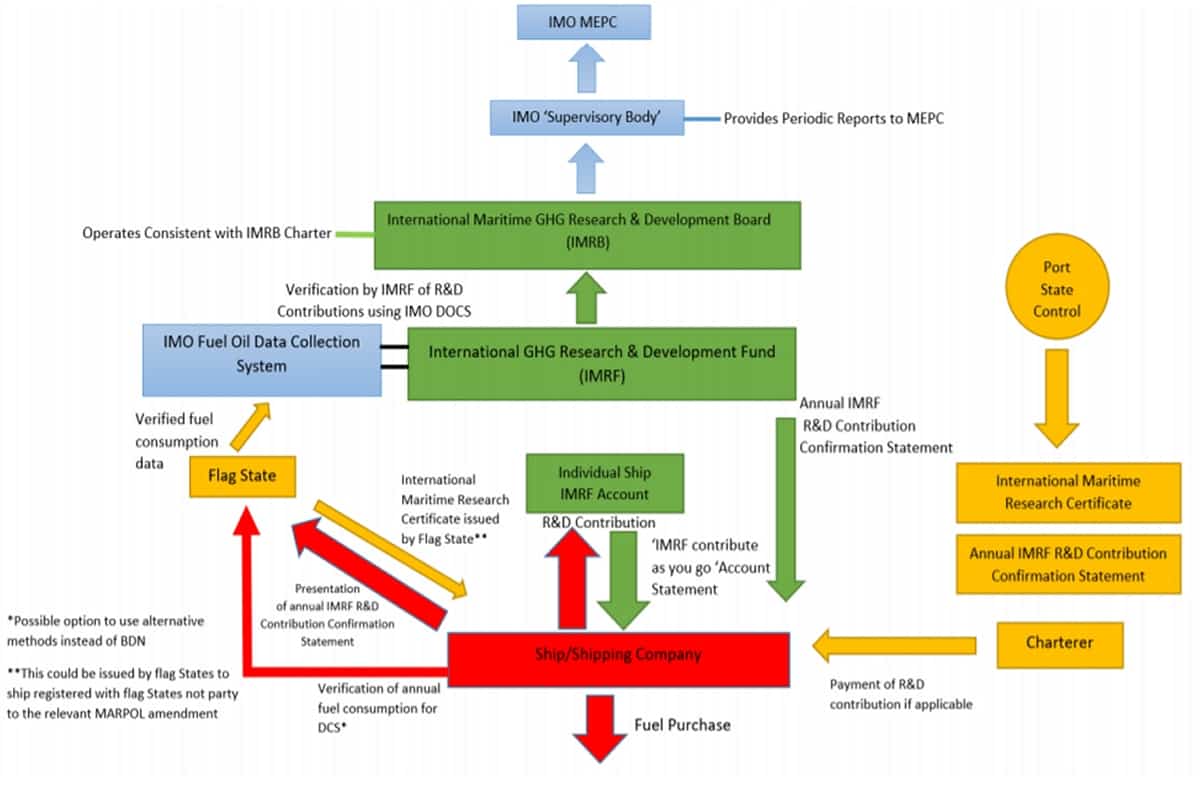
Proceeds from the $2 per ton tax would go to a new entity called the International Maritime Research Fund (IMRF), with R&D spending coordinated by another new body, the International Maritime Research and Development Board (IMRB).
The $2 per ton charge is based on the assumption that the maritime industry burns 250 million tons of fuel oil per year and that the R&D program requires $5 billion in industry funding. The industry’s R&D proposal will be considered at the IMO meeting in March 2020. Assuming the proposal passes and becomes effective around 2022, the R&D program would not be fully funded until 2032.
In practical terms, the effect of the R&D levy on shipping markets would be extremely small. In the case of container lines, the very minimal extra expense could be passed along to cargo shippers as part of existing fuel surcharges. For a large container ship (with a capacity of over 10,000 20-foot-equivalent units or TEU) traveling at 22 knots and burning about 250 tons of fuel per day, the annual R&D tax for that ship would be $125,000 (assuming 250 days at sea), equating to a few cents extra per TEU for cargo shippers.
A Capesize dry bulk ship carrying 180,000 deadweight tons (DWT) of iron ore from Brazil to China that was at sea for 300 days a year burning 50 tons of fuel per day would pay an R&D fee of $30,000 for the year. Assuming an average of 4.2 voyages per year on that route, this equates to less than $0.05 per DWT of cargo carried.
R&D versus broader carbon levy
The industry submission specifically states that it is not meant to substitute for a carbon levy large enough to disincentivize use of high-carbon emitting fuels, i.e., a market-based measure (MBM).
The submission emphasized, “The co-sponsors do not consider the proposed IMRB concept to be an MBM. Neither is this proposal intended to frustrate or delay the development of an MBM should there be consensus for this among member states.”
At the Global Maritime Forum (GMF) meeting held in Singapore in October, industry leaders discussed a carbon tax of $30-$225 per ton of fuel; industry members of the GMF are leading companies within the associations that have just introduced the R&D plan.
The International Monetary Fund (IMF) working paper, “Carbon Taxation for International Maritime Fuels: Assessing the Options,” published in September 2018, discussed an example of a carbon tax of $24 per ton of bunker fuel starting in 2021, rising to $240 per ton by 2030.
For skeptics who contend shipping associations are now trying to preemptively subvert a future carbon tax, the rebuttal would be: If tax advocates believe the price should average $100 per ton or more over time, you might counter with $50, but you’d never counter with $2.
The issue of how to divvy up carbon-tax proceeds, as well as the need to have a tax high enough to incentivize a move away from carbon-generating fuel use, was addressed in the IMF working paper. “If taxes were collected domestically, it would be logical for this revenue to go to national budgets, but with international collection, climate finance might be a more natural use of the revenue, as national governments have a weaker claim on the tax base, which is combusted in international waters,” it said.
The paper continued, “Some funds might be retained by the industry, most obviously for clean-technology research and deployment, though the efficient amount of spending is likely a small fraction of potential carbon tax revenues — put another way, if tax rates were set based on industry spending needs they may fall well short of the levels needed for meaningful mitigation incentives.”
The process of collecting the levy
The most important aspect of the new industry R&D plan is how it proposes collecting a global fuel tax.
The proposal endeavors to create the framework that a future MBM carbon tax could follow, while preserving a slice of the overall revenue for R&D funding. It states that “the IMRB concept … could potentially provide some of the architecture for the possible future development of a levy-based MBM for shipping, in a manner that would reduce the possibility of market distortion.”
The tax would not be collected “at the pump” because not all countries in the world may agree to participate, which would allow non-signatories to develop non-taxed bunker fuel hubs and outcompete rival hubs in signatory nations.
This issue was addressed in the World Bank working paper, “Regional Carbon Pricing for International Transport,” published in January 2018, which pointed out, “Vessels could avoid the tax by refueling in jurisdictions that do not apply the tax.”
The new industry proposal said that collection of the levy by flag states (the nations that ships are registered to) is also unworkable because “it would be too complex and could potentially lead to taxation and hypothecation issues with national administrations.”
Instead, the plan calls for direct per-ship payments via an automated system, either on a “pay as you go” basis or annually, to the IMRF. Ships would hold a certificate from their flag states confirming the R&D payments have been made. Those certificates would be subject to inspection by the port-state control authorities when a ship makes a port call (in the U.S., for example the port-state control authority is the U.S. Coast Guard).
On the container-shipping side, lines could adjust their fuel surcharges to accommodate a new tax. On the commodity shipping side, it’s much more complicated. When a bulker or tanker is on a spot voyage contract, the vessel interest pays for fuel. When the ship is on a time charter, the charterer pays.
The industry proposal to the IMO highlighted that under a time-charter contract, the charterer would be “responsible … for the cost of the contribution to the IMRF. In order for the IMRB concept to be taken forward, the importance of addressing this issue is strongly emphasized.” The proposal also noted that ship owners may prefer the “pay as you go” option over the annual payment option because “this will facilitate reimbursement to the shipping company from third parties such as charterers.”
The R&D levy — and a much larger carbon tax, if it ever came about — would be incorporated into the accounting between the vessel interest and the charterer. The R&D levy is small enough that it would probably be seen as little more than another headache.
In contrast, if a very substantial MBM carbon tax is someday introduced, it could have a significant effect on spot voyages and time charters in commodity markets, as well as on the cost paid by beneficial cargo owners on the container side. And if the just-announced R&D proposal is approved and implemented, there’d be a convenient, ready-to-use automated payment system to handle those carbon-tax collections already in place. More FreightWaves/American Shipper articles by Greg Miller










