







INTRODUCTION
In 2018, the American Club, in partnership with American Bureau of Shipping (ABS) and Lamar University (Lamar), launched a new project aimed at reducing accidents caused by unsafe conditions aboard vessels. The initiative’s long-term objective is to develop recommendations aimed at improving the day-to-day safety of maritime personnel, both afloat and ashore, through sharing the results of data analyses derived from this initiative.
As a snapshot, the American Club has incurred over 8,400 claims from 2013 to 2018. Of these claims, 4,241 (~50%) of them are injuries. The total costs of injury-related claims during this time period is US$ 246.2 million. Between 2013 and 2018, 46% of injuries were the result of slips, trips, falls and lifting incidents. Excluding claims with no American Club costs, falls cost
on average US$ 182,000, slips cost US$ 137,000 and lifting incidents cost US$ 112,000. With the inclusion of all the American Club records into these financial calculations, falls and trips cost on average U.S. $88,000, slips cost US$56,000 and lifting incidents cost US$48,000. Regardless, the urgency to address these types of claims are evident.
The project analyzed the American Club injury records, generating unprecedented insight into the nature and cost of maritime-related accidents. These records were compared to the data from the ABS/Lamar Mariner Safety Research Initiative (MSRI) data set with more than 8,000 injury and 100,000 near miss records from over 31 data sources that were collected with support from other maritime organizations. These data sets were also compared with the data summaries from the European Maritime Safety Agency (EMSA).
This report summarizes the current state of the initiative and efforts forthcoming to address slips, trips, falls and lifting related injuries.
TYPES OF INJURIES
Table I compares the type of injury event in the ABS/Lamar and American Club data sets. Slips, trips and falls were the most common event type in the American Club database and the second most common event type in the ABS/Lamar data set. Being struck by an object was the most common event in the ABS/Lamar data set and the second most common in the American Club data set. Lifting events were the second most common event in the American Club data set and third most common in the ABS/Lamar data set. However, the cost per event shows that burns are the most expensive event and lifting events and slips are the least expensive.
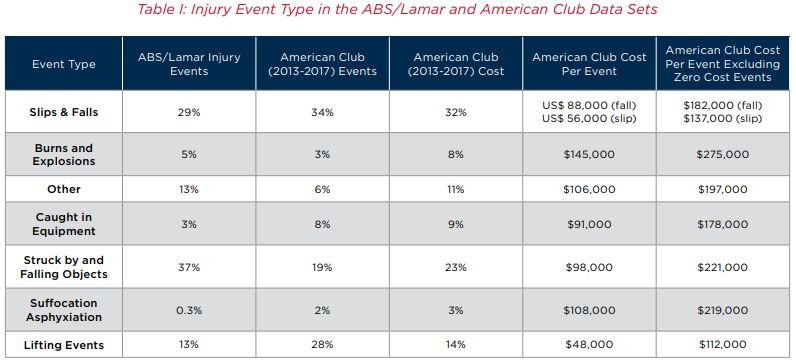
The data sets are surprisingly similar given that each data set has a wide variety of vessel types. The American Club data includes a significant number of fishing vessels injuries that are not represented in the ABS/Lamar data set. The data sets identify key areas of maritime injuries. Even with the differences noted, the similarity of the incidents is striking given the different incident record keeping definitions, taxonomies and motivations between the data sets.
In comparison with the European Maritime Safety Agency’s (EMSA’s) AnnuAl Overview of MArine CASuAlties And Incidents 2018, they report that slips and falls account for 40% of injury incidents. Loss of control of machines and material handling equipment and body movement were the next two more common injury categories for cargo vessels in their report. The EMSA taxonomy is very different than the ABS/Lamar and American Club databases, so a direct comparison beyond
slip, trip and fall percentage was not performed. This is another example where consensus terminology and reporting requirements could yield valuable information to help reduce or eliminate injuries to seafarers.
FOCUS ON SLIPS, TRIPS AND FALLS
Falls represented 22% of the incidents in the American Club data set. Slips accounted for 12% of the American Club injury claims. Fall events were more expensive than slip events in the American Club data set. Falls were also common in
the ABS/Lamar data set accounting for 23% injuries. Slips and trips were also common in injury in the ABS/Lamar data set (6% of records).
Falls were more common than slips and trips in both data sets. This could be due to slip events not resulting in reportable injuries. This is commonly called a near miss or close call. Based on the ABS/Lamar data set, common locations for falls that caused injury are deck (43%), engine room (13%), and stairs (7%). Common locations for slips that caused injury were deck (44%), stairs and ladders (13%) and engine room (11%).
From the ABS/Lamar MSRI data set, injuries involving slips, trips, and falls accounted for 11% of the records, while near misses accounted for over 24% of records. Contributing factors for the injury records included situational awareness, spills, poor housekeeping, and inappropriate lighting. Key contributing factors related to the near misses include situational awareness, housekeeping, asset design, seafarer fatigue, lack of following procedures, and lack of anti-skid material on decks.
FOCUS ON LIFTING
Lifting injuries are clearly a key concern as highlighted in Table I. Of the records that could be classified in the American Club data set, 28% of the injury incidents were lifting related. In contrast, the ABS/Lamar data set found that 13% of injuries were lifting related.
From the ABS/Lamar data set, lifting injuries mostly occurred on the deck (45%), in the engine room (25%), cargo areas (5%), and galley (5%). Back injuries (46%), arm and hand (30%) and leg and foot (13%) were the most common body locations for lifting-related injuries. At the time of the lifting injury, a wide range of activities in the ABS/Lamar data set were being performed including material handling (34%), maintenance (18%), deck activities (16%), and housekeeping (5%).
Lifting injury related lessons learned from industry participants on the ABS/Lamar MSRI initiative include:
• Education on the proper lifting techniques;
• Proper exercise to strengthen back muscles;
• Nutrition and weight control; and
• Removing or properly marking the slippery surfaces to avoid slips, trips and falls that can lead to back injuries.
Lifting near misses were very rare with 0.7% of near miss records being strain sprain in the ABS/Lamar data set. Traditionally, a near miss gets reported when someone observes a hazardous condition or unsafe act, recognizes the act as a near miss, and decides that the event warrants reporting in the system. Therefore, reporting has substantial subjectivity and requires detailed near miss reporting training.
Based on ABS/Lamar analyses and discussions with MSRI industry partners, we identified the following reasons why lifting-related near misses might go under reported:
1. Lifting injuries often have a random component and can occur even when an individual is following safe procedures;
2. Unsafe lifting is difficult for an untrained observer to identify since the weight of an item and the capacity of the individual lifting the item are often unknown to the observer. For an untrained observer, identifying incidents of incorrect lifting technique is difficult;
3. The crew might be hesitant to report a lifting event since the risk is limited to the individual who engages in the reporting of the event. Also, this may unintentionally identify the individual not following procedures;
4. The person was not immediately hurt, so they are assumed to have lifted the item correctly; and
5. The near miss reporting form might not support lifting events as a category.
From a near miss perspective, these type hazards might be under-appreciated or just too difficult to identify.
FOCUS ON NEAR MISSES
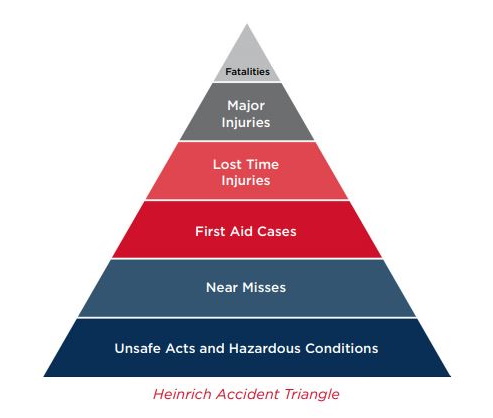
Many safety researchers and safety professionals view a pyramid or iceberg model relationship between near misses and incidents based on Heinrich Accident TRIAngle, increasing from unsafe acts and hazardous conditions, to near misses, to first aid cases, to lost work time, to major injuries, and finally to fatalities. The ratio between reported near misses and unreported near misses is arguably on the order of 5 to 1 or 10 to 1. A similar ratio may be maintained at each level as one goes from near misses to fatalities. While the exact ratio may vary widely, safety researches would anticipate some similar pattern of many near misses and hazardous conditions and few major events.
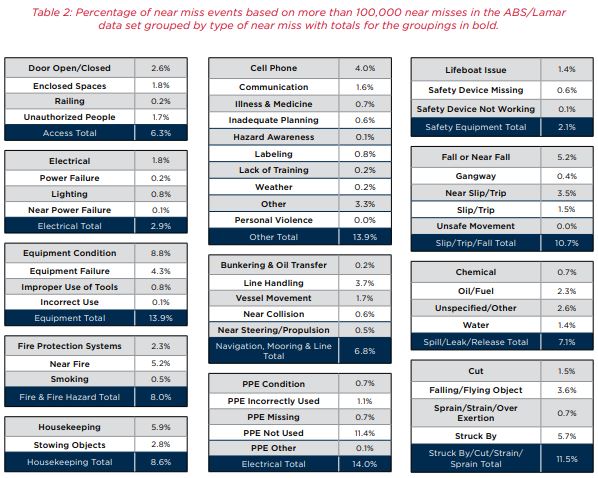
Near misses may represent a warning signal that an incident might occur. Table 2 displays the near miss by event types in the ABS/Lamar data set. Some near miss categories such as spills, housekeeping, conditions of equipment, line handling activities, and personal protective equipment
For events with direct mappings to specific near miss categories, this project found that the pyramid has very different ratios depending on the type of injury and near miss event.
• Slips trips and falls injuries were 29% of all injuries in the ABS/Lamar injury data set and 34% in the American Club data set. Slip, trip and fall near misses accounted for 24% of all near misses.
• Lifting injuries were 13% in the ABS/Lamar data set and 28% in the American Club data set. Lifting near misses accounted for 0.7% of all near misses.
• Struck by injuries were 37% in the ABS/Lamar data set 19% in the American Club data set. Struck by near misses were 12.1% of all ABS/Lamar near misses (5.7% struck by, 2.8% stowing objects, and 3.6% falling objects).
• Caught in machinery or equipment injuries were 3% in the ABS/Lamar data set and 8% in the American Club data set. Equipment related near misses accounted for 13.9% of near misses with incorrect use being 0.9% in the ABS/Lamar data set.
• Fire-related injuries were 5% in the ABS/Lamar data set and 3% in the American Club data set. Fires and fire-related events represented 8.0% of near misses in the categories of fire protection (2.3%), near fire (5.2%) and smoking (0.5%). Most of the open and closed door related near misses (2.6%) were also related to fire risk. Housekeeping and oil and chemical spills also have a fire risk component in most near miss records.
Given the catastrophic potential consequences of fires on board vessels, individuals are trained to identify risk, understand the potential dangers of not fixing the problem, and recognize that the near miss should be reported. As such, fires hazards being highly represented in a near miss data set is not surprising.
• Suffocation and asphyxiation injury events were 0.3% in the ABS/Lamar data set and 2% in the American Club. Ineffective enclosed space procedures were 1.8% of near miss reports in the ABS/Lamar data set.
The near miss pattern suggests that perceived risk drives near miss reporting. When the percentage of near miss in an area significantly diverges from the percentage of injuries in an area, a potential opportunity exists for educational
interventions being useful to reduce injuries. In our study, lifting was the area of greatest divergence between the number of near misses and actual injury events. Almost as many near misses in the ABS/Lamar data set were reported for smoking (0.5%) as all lifting-related near miss events (0.7%).
SLIPS, TRIPS, FALLS & LIFTING: WHERE WE ARE NOW
AMERICAN CLUB
A full summary of the American Club’s loss prevention products and services can be found at our website at https://www.american-club.com/page/loss-prevention.
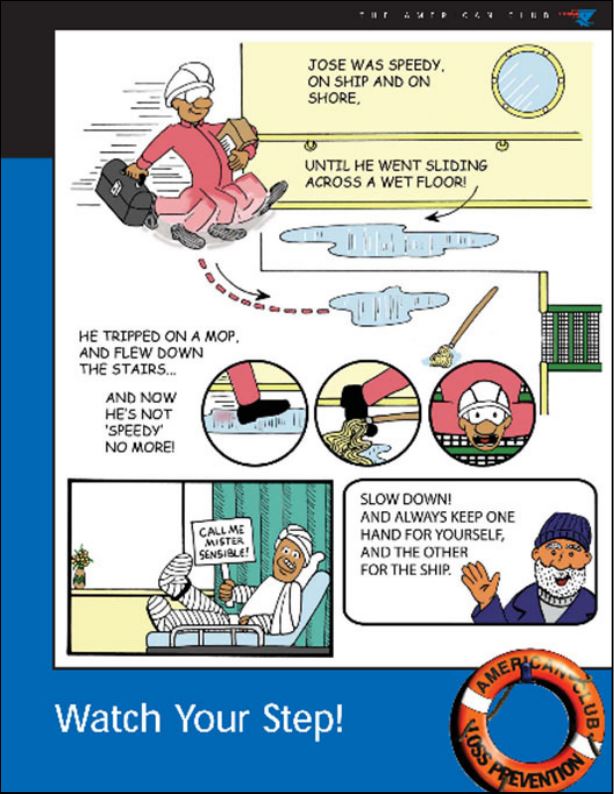
With regards to slips, trips and falls, we maintain a dedicated section at https://www.american-club.com/page/slips-trips-falls that focuses attention upon the risks of slips, trips and falls through case study claims experienced by the American Club. In addition, our comic ShipboArd Safety, Watch Your Step safety poster and Good Housekeeping: A Pocket Guide also brings attention to the risks of slips, trips and falls.
On the subject of lifting, check out our safety poster, Proper Lifting Prevents Back Injuries.
ABS/LAMAR MARINER SAFETY RESEARCH INITIATIVE
ABS/Lamar MSRI: The MSRI is a collaborative effort to create a large international database and online repository of maritime injury and close call (near miss) reports. The information is analyzed to identify and share trends, corrective actions, lessons learned and to develop benchmarking statistics. More information can be found at https://maritime.lamar.edu/.
ABS and Lamar’s efforts support an understanding of the human element in all aspects of the maritime industry. Industry and university involvement with the MSRI allows us to target specific needs that could be addressed to achieve a better understanding of human factors, ergonomics, the contribution of human decisions and behaviors to accidents and incidents, and different means to improve safety. (ABS’ Safety and Human Factors in Design)
Industry partners have used the MSRI analyses to:
• Help direct safety auditing efforts or vessel design change efforts;
• Identify additional shipboard hazards (space specific);
• Assist safety interventions and resource allocation;
• Input to safety (metrics) – benchmarking;
• Augment existing Toolbox Talks and other safety related education for the crew; and
• Support continual improvement of shipboard safety and related safety management systems.
THE WAY FORWARD
This joint initiative has spurred a number of further considerations for the American Club, and the ABS/Lamar MSRI, particularly related to addressing the most critical injury factors related to slips, trips, falls, lifting incidents and near miss and hazardous situation reporting. Guidance exists or forthcoming in due course as follows:
1. Slips, trips and falls.
• Further guidance will be forthcoming in the form of a safe lifting pocket guide for seafarers.
• ABS has existing guidance to help eliminate slips, trip, and falls from a design and administrative prospective.
i. Guidance Notes on the Application of Ergonomics to MArine Systems;
ii. Guidance Notes on Job Safety Analysis for the Marine And Offshore Industries; and
iii. Guidance Notes on the Development of Procedures And Technical Manuals.
2. Lifting. Further guidance will be forthcoming from the American Club in the form of safe lifting pocket guide for seafarers as well as considerations under way in a safe lifting program.
3. Near miss reporting. The scope of issues surrounding near miss reporting are broad. They encompass building a workable and functional taxonomy of terminology that is a balance between user-friendliness and usefulness
for analytical purposes. The American Club is considering a mobile application type of hazardous situation, near miss reporting system for Members in 2020. The product will also be accompanied by a user training program to assist in building a consistent reporting system. Currently, the ABS/Lamar MSRI has an existing public portal (http://maritime.lamar.edu) which has some guidance on near miss reporting.
4. Standardized industry injury and near miss reporting and recording. Initial efforts by ABS and Lamar have been taken to support this call for consensus reporting. Recently, Lamar and ABS supported the US Department of Transportation’s Maritime Administration in the development of two ASTM Guides to support more consistent injury and near miss reporting and recording. These can be used a building blocks for a more comprehensive and consistent international reporting effort. These ASTM Standard Guide are:
• ASTM F3256-17 Standard Guide for Near Miss Reporting and Recording (https://www.astm.org/Standards/F3256.htm)
• ASTM F3284-18 Standard Guide for Injury Reporting and Recording (https://www.astm.org/Standards/F3284.htm)
ACKNOWLEDGMENTS
The American Club, ABS, and Lamar would like to thank Kevin McSweeney, PhD, CPE and Ms. Julie Pray of the American Bureau of Shipping; Brian Craig, PhD, PE, CPE and James Curry, PhD of Lamar University and Weihang Zhu, PhD of the University of Houston; and William Moore, Dr Eng and Ms. Jana Byron from the Shipowners Claims Bureau, Inc. for their dedicated efforts on this joint initiative.
Source: The American Club










