






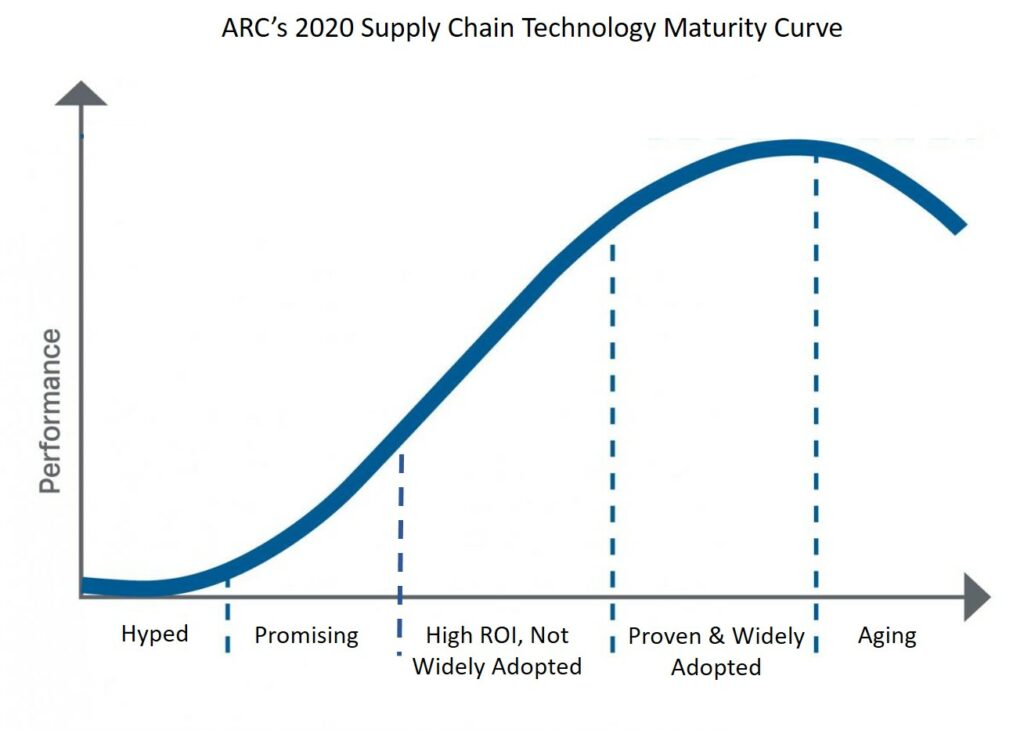
There are some young supply chain technologies that are getting a lot of buzz. But how mature are these technologies? Do they have a proven ROI? Are they worth piloting? Or can we safely ignore them for a few more years?
There are technologies that are proven and widely adopted. In supply chain management, examples would be transportation management, warehouse management, and other well-known supply chain applications.
There are also aging technologies – these technologies have benefits, but newer technologies offer a better ROI, faster time to value, or other benefits. Examples would be some traditional forms of material handling equipment. There can still be a place for these solutions, but newer solutions like robotics are more adaptable, offering a shorter payback period and lower risk profile. These newer robotic solutions are a better fit in a growing number of fulfillment scenarios.
In this article, these more mature and aging technologies will not be discussed.
Hyped Technologies
Hyped technologies are getting a lot of publicity but have little proven value. These seem like technologies in search of a solution.
Blockchain – We continue to see companies pitching their blockchain solutions in the supply chain realm. Often these companies have disappeared within a year or so. Blockchain is said to be a strong solution for traceability or to provide payment to linked supply chain partners after their part of a chain of linked activities has been completed. We have continued to ask blockchain providers for the names of customers that are using their technology on a daily basis as part of their newly entrenched way of doing business. Blockchain providers cannot provide these references. That is a sure sign that the technology is still in the hype stage.
Aside from traceability for the food and beverage industries, blockchain could become a critical component of transporting goods throughout the supply chain. Most pharmaceutical companies have a small window to get products from point A to B without changes in temperature. Blockchain monitors who has access to the temperature data, and whether that changes between modes.
5G – 5G is the fifth generation of wireless technology. With 5G, you’ll see exponentially faster download and upload speeds. Latency, or the time it takes devices to communicate with each other wireless networks, will also drastically decrease. The benefits are clear for consumers that want to download movies on their smart phones and watch them. But what will the benefits for the supply chain be?
Greg Carter, the Chief Technology Officer at GlobalTranz, a large logistics service provider, points out that “as more and more devices throughout the supply chain and manufacturing process become part of the ‘Internet of Things,’ they will produce an incredibly rich data stream that will send signals in real-time to trigger a wide variety of events. For example, using a 5G network, a parts tote could communicate that the tote is 80% depleted for this SKU which would trigger a re-order of the necessary parts. This would be a trigger across the supply chain which would result in warehouse movements, maybe LTL, consolidation, and finally distribution and delivery of re-supplies.”
But we are the hype stage here. We are still in the very early stages of building out 5G wireless networks across the nation – this is requiring a massive, incredibly expensive roll-out of the new wireless infrastructure. Because we are so early, we don’t know what the ROI will be. Do supply chain IoT devices really require this kind of band width and speed to effectively synchronize a supply chain? How much more will we have to pay for better speed? Will the additional cost be worth the reward? We just don’t know.
Artificial Intelligence (AI)/Machine Learning Platforms –
These platforms allow companies to ingest massive amounts of historical and real-time streaming data, clean and prepare it, and see if applying machine learning or AI algorithms and techniques to that data will provide valuable predictions for their business. ARC recently talked to Frederic Bastien, former CEO of Mnubo, an AIoT Company (artificial intelligence derived from IoT sensors) which was recently acquired by AspenTech. Mr. Bastien, now Vice President, IoT and Cloud at AspenTech, pointed out that using data scientists and AI tools and platforms to uncover value can be difficult if efforts are non-focused and simply looking for a problem to solve. “The time to value in AI can be long, taking a lot of time to produce business value unless AI is embedded in purpose built applications”. Further, everyone is overly focused on the machine learning algorithms. As a team of Google scientists has pointed out, only a small fraction of the efforts required to productize AI/ML is actually spent on the math. In contrast, the efforts required to set and manage the infrastructure for data collection, data verification, feature extraction, governance, model retraining, and several other solution components, are “large and complex.” Furthermore, an “uncomfortable trend has emerged whereby developing an ML pilot is” the primary focus since it is easy and cheap. Conversely, very little effort is being spent on productizing and sustainably maintaining the application over time, which leads to the infamous ‘pilot purgatory’.
One of the ARC analysts told Mr. Bastien that his belief was that having a digital center of excellence where data scientists worked to develop proprietary, internal solutions might make some sense for $10 billion companies, but most companies would find this an unfruitful endeavor. Surprisingly, Mr. Bastien, agreed. He said that one of the reasons he was so excited about Mnubo being acquired by AspenTech was the opportunity this presented to embed these AI capabilities into existing asset optimization and supply chain optimization software solutions. In short, to productize and democratize the capabilities of AI for a sustainable value-added capabilities.
Autonomous Trucking – A variety of executives in this industry will say on an off the record basis, that they believe this technology will be feasible in just three years. Further, there are states that currently appear very open to driverless trucks from a regulatory perspective – particularly Florida and Texas.
But what happens after that inevitable first accident caused by an autonomous truck that kills an innocent family? It is very likely a public outcry will cause regulatory bodies to put the brakes on widespread deployment. This is one reason that autonomous driving technology is being largely driven by start-ups. Established multinational auto companies would lose billions off their market cap after this kind of an accident.
The autonomous truck industry will be in a much stronger position if they can argue that autonomous trucks are safer than trucks driven by humans. In the longer run autonomous trucks will be safer!
The Federal Motor Carrier Safety Administration measures truck fatalities per 100 million miles driven. Waymo says its vehicles have collected data from more than 10 million autonomous miles driven in 25 cities, but these tests involve drivers behind the wheel ready to take over. No other autonomous vehicle company is close to that number of miles.
Statistically, how many tens of millions of miles will need to be driven before the industry can make a statistically valid case that autonomous trucks are safer? The question of validity also needs to examine what counts as a fair test of reliability. For example, if an autonomous truck with a driver as backup goes a million miles before a driver intervenes and the company then changes their algorithms to prevent that type of incident, do those million miles count? Do tests in Arizona apply to the more difficult environment of driving in the winter in Minnesota?
Promising
Promising technologies seem like they would offer robust ROI or other tangible benefits. It is highly logical that the promised benefits will appear. But these technologies are so young, that ARC has not been able to talk to references and verify that the promised benefits are real.
Machine Learning in WMS – Machine learning’s ability to adapt to changing conditions makes it especially well-aligned with the dynamic nature of today’s e-commerce warehouses. Manhattan Associates utilizes machine learning within its WMS to determine the amount of time required to complete a certain task in a given set of circumstances such as historic duration and item characteristics As another example, JDA Software is exploring machine learning to simulate the correlations of multiple attributes across observations and the influence that these attributes have on order processing times as congestion and resource demands increase or decrease.
Robotic Automated Storage and Retrieval – A new form of goods-to-person automation has recently come to market. These “robotic shuttle systems” are a hybrid of traditional shuttle systems and free roaming robots. There is a handful of providers currently offering solutions that fit into this categorization. And each one approaches the problem in a different manner. However, they all offer the benefit of high storage density and a high degree of flexibility due to the dynamic movement of bots. This bot agility removes throughput and sequencing constraints, providing increased productivity potential. These solutions align with the operational needs of many industries. However, they are coming to market just as demand is accelerating for same-day fulfillment of online orders. This spike in demand is especially prevalent in e-grocery fulfillment. These solutions may be fulfilling your next online order of apples and bread.
Machine Learning in TMS and TES – The primary reason companies buy a transportation management system is for freight savings. These freight savings can be attributed to simulation and network design, load consolidation and lower cost mode selections, and multi-stop route optimization. Machine learning enables a TMS to better handle competing objectives and discover non-obvious impacts on performance.
Machine learning gives companies the ability to maintain high service levels while achieving savings. Shippers can learn which carriers meet on-time service levels and which do not, which lanes typically carry more chance for delays, and whether there is an optimal number of stops before shipments become late. Machine learning can aid shippers in better understanding how to drive efficiencies without sacrificing service levels.
For example, in last mile routing the time a job takes to complete is dependent not just on the miles that need to be driven, but on the congestion, the type of product being delivered, the type of residence, and whether the value-added services are provided at the destination. Machine learning can be used to “learn” these constraints rather than having to do time studies and hard code these constraints into the solution.
Machine learning is becoming increasingly important in transportation execution systems as well. The most notable application is generating a more informed and up-to-date estimated time of arrival (ETA) for shipments. Machine learning is working with real-time visibility solutions to learn more about constraints (such as capacity, regulations, and hours of service) and then using that information to give a much better ETA for shipments to warehouses, stores, and the end customer.
Companies are also partnering with data aggregators to get a better idea when shipments will arrive. This includes port data, SNEW data, weather data (to some degree), traffic data, and other available sources to provide accurate ETAs to warehouses, stores, and end consumers.
High ROI, But Not Widely Adopted
Machine Learning Embedded in Planning Applications – There is something of a vendor arms race to apply machine learning to improve supply chain planning and optimization. This is not new. Machine learning has been used to improve demand management since the early 2000s. But in recent years, machine learning has used downstream data – like Point of Sale data – to greatly improve the accuracy of short and midterm forecasts used for replenishment. Here, the benefits are real and proven. But many companies have not put in the infrastructure needed to collect, cleanse, and use demand sensing data. There is big ramp of companies that could use this technology but are not.
In supply planning, OMP has told us they have used machine learning to update parameters like lead times or machine operating speeds to improve constraint-based supply plans. Here, the savings are obvious; Without the proper parametrization, an optimization engine turns out plans that are less than optimal.
Similarly, AspenTech has a solution that can predict machine failures in critical pieces of production equipment. When these predictions are integrated into a planning engine, more feasible plans result. In certain industries, like Oil & Gas or Chemicals, there are expensive, heavy and complex manufacturing assets. Shutting down and then restarting a process is expensive, time consuming (think days, not hours), and has environmental, health, and safety implications. So, this too is an area where the ROI seems obvious, but very few customer references exist. The same situation exists in Warehouse
Real-time Location Solutions – Real-time truckload and less-than-truckload visibility is driven by connections to electronic logging devices (ELDs), which truckers must use to prove to the government they are not driving too many hours. These ELDs provide the GPS tracking. This is a fast-growing market, but it is still very small. Customers of these solutions, like Land o-Lakes, are willing to publicly speak about the benefits they are getting. Interestingly, while the ability to have a real-time understanding of where shipments has a proven ROI, suppliers in this segment are also promising they are using machine learning to improve predictive ETAs. ARC analysts have yet to hear customers validate these capabilities. We find it believable that better ETAs can be achieved in truckload. But based on the way less-than-truckload and Class 1 railroads work, we do not expect predictive ETAs to add much value in those modes.
IoT for Transportation – For a truer ETA, companies are using IoT data from trucks to get a better understanding of driver behavior, such as typical driving speeds and times as well as how they operate in heavily congested areas. Companies can take sensor data from trucks and incorporates hours of service rules to know when, where, and for how long a driver needs to stop. These applications also understand that where and when the driver stops will have an impact on the ETA. This is especially true if drivers stop before a major city and will have to endure rush hour traffic once they start driving again.










