






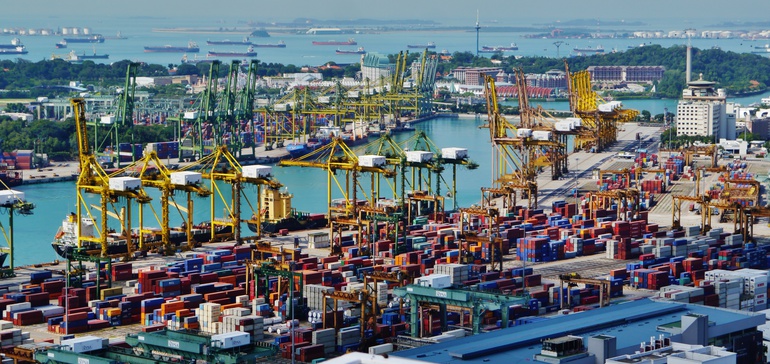
ATLANTA — A sign emerged on the West Coast of a gradual return to operations in China: a container ship arrived at the Port of Los Angeles Monday, the first ship in 10 days to arrive from China, Philip Palin, supply chain resilience author and researcher, told Modex attendees.
“It was sort of like the Navy coming into an 18th-century port, and boy, were people excited,” Palin said Tuesday during a panel discussion about the COVID-19 outbreak and its impact on supply chains.
Palin and other panelists warned, the risk to global supply chains is far from over. They also advised a few factors to which businesses can pay attention, as well as items to execute, to mitigate future risk as much as possible.
1. Understand supply and demand risk
The supply side has been a source of concern for businesses, given the origin of the outbreak in China where a great deal of suppliers and manufacturing are based, said David Shillingford, chairman of Resilience360.
China represents 30% of global manufacturing, and 51,000 companies globally have tier one suppliers located in the country, according to slides Shillingford presented at the Retail Industry Leaders Association’s supply chain conference in February.
“If people aren’t going to stores, aren’t going to stadiums, if they’re not interacting with each other, the demand risk can get severe very quickly.”

David Shillingford
Chairman, Resilience360
Businesses have expressed inventory concerns related to the inability to procure and ship supplies from vendors in China. COVID-19 “is affecting everything from the stock market to the stock levels on our store shelves,” said Kathy Fulton, executive director of the American Logistics Aid Network.
Costco’s CFO said on an earnings call the retailer was facing daily out-of-stocks. Glideaway, a manufacturer of adjustable base beds, sources 65% of its products from China and keeps four to five weeks of inventory on hand, said Wendy Topp, transportation manager at the company. “In two to three weeks, we’re going to be scrambling,” she told Modex attendees Monday.
As the outbreak spreads in dozens of countries, including the U.S., firms with global suppliers should consider the impact to supply and production of the nations most affected and their neighboring states, according to John Paxton, COO of the Materials Handling Institute.
“If the Italy situation moves further into Europe, that is something that would be in the back of my mind if I had a supply chain set up in Germany or France,” he said during the COVID-19 panel discussion.;
But the supply risk is just one side of the coin. Retailers and other consumer-facing companies should expect reduced demand if citizens are under quarantine. Effects can also be psychological as people opt to change behaviors to avoid spread of the disease, Shillingford said.
“If people aren’t going to stores, aren’t going to stadiums, if they’re not interacting with each other, the demand risk can get severe very quickly,” he said.
Unlike supply risk, which supply chains can monitor and measure through close communication with their vendors, demand risk has “no real geographic constraints,” Shillingford said, which makes it difficult to predict and, in turn, challenging for retailers and logistics companies to plan.
2. Map the supply chain
Understanding the location and status of various nodes of the supply chain is important at all times, coronavirus outbreak or not, panelists said.
“Don’t wait until the gun is pointed at your head to start thinking about this mapping,” Palin said.
Mapping the supply chain gives executives visibility up several tiers of suppliers, as well as the logistics between those suppliers.
“Don’t wait until the gun is pointed at your head to start thinking about this mapping.”
Philip Palin
Author, researcher
Panelists said successful mapping often relies on hyperlocal information and requires data- and information-sharing between partners. Paxton recommend mapping to know where inventory is, including at the distribution level.
“If you don’t have full visibility now, you probably should hurry up and find out what you can do, where are your parts, where are your access points, how can you move around, if you get a disruption in any part of the chain,” Paxton said.
Managers, armed with a map, can pinpoint an exact source of disruption and assess how to react accordingly, Shillingford said.
“If I have disruption for my inbound domestic U.S., that’s going to be a bigger problem for me than a logistics disruption between a tier four and tier three supplier,” he said as an example.
3. Plan ‘what-if’ scenarios
With data and maps to paint a picture of the supply chain, executives can assess options and engage in scenario-planning, Paxton said.
“Step by step, say, ‘what would I do if this broke?'” he said.
Panelists emphasized scenario planning, such as mapping, is not only a strategy for dealing with the impacts of the COVID-19 outbreak, but also a best practice for supply chains at all times.
Paxton said supply chains heavily reliant on one source could benefit from buying additional inventory, although they run the risk of overstocking.
On the other hand, supply chains that are largely diversified will have a larger swath of options to select from as back-up plans. “Don’t put all your eggs in one basket. Go where the baskets are if you have them spread out,” Paxton said.
Panelists emphasized scenario planning, such as mapping, is not only a strategy for dealing with the impacts of the COVID-19 outbreak, but also a best practice for supply chains at all times. Paxton noted supply chain stakeholders have talked about risk management and diversification for years, but the viral outbreak pushed the strategies forward and made them top of mind issues, with many firms realizing they should have placed greater focus on such strategies in the past.
In the current risk climate, businesses need as many what-if scenarios as possible, because significant uncertainty surrounds supply, demand and availability of transportation modes. No one knows for certain when and where the ripple effect of the outbreak will end, Paxton said.
“One thing that supply chains hate is variance, and there’s going to be a lot,” Shillingford said.










