






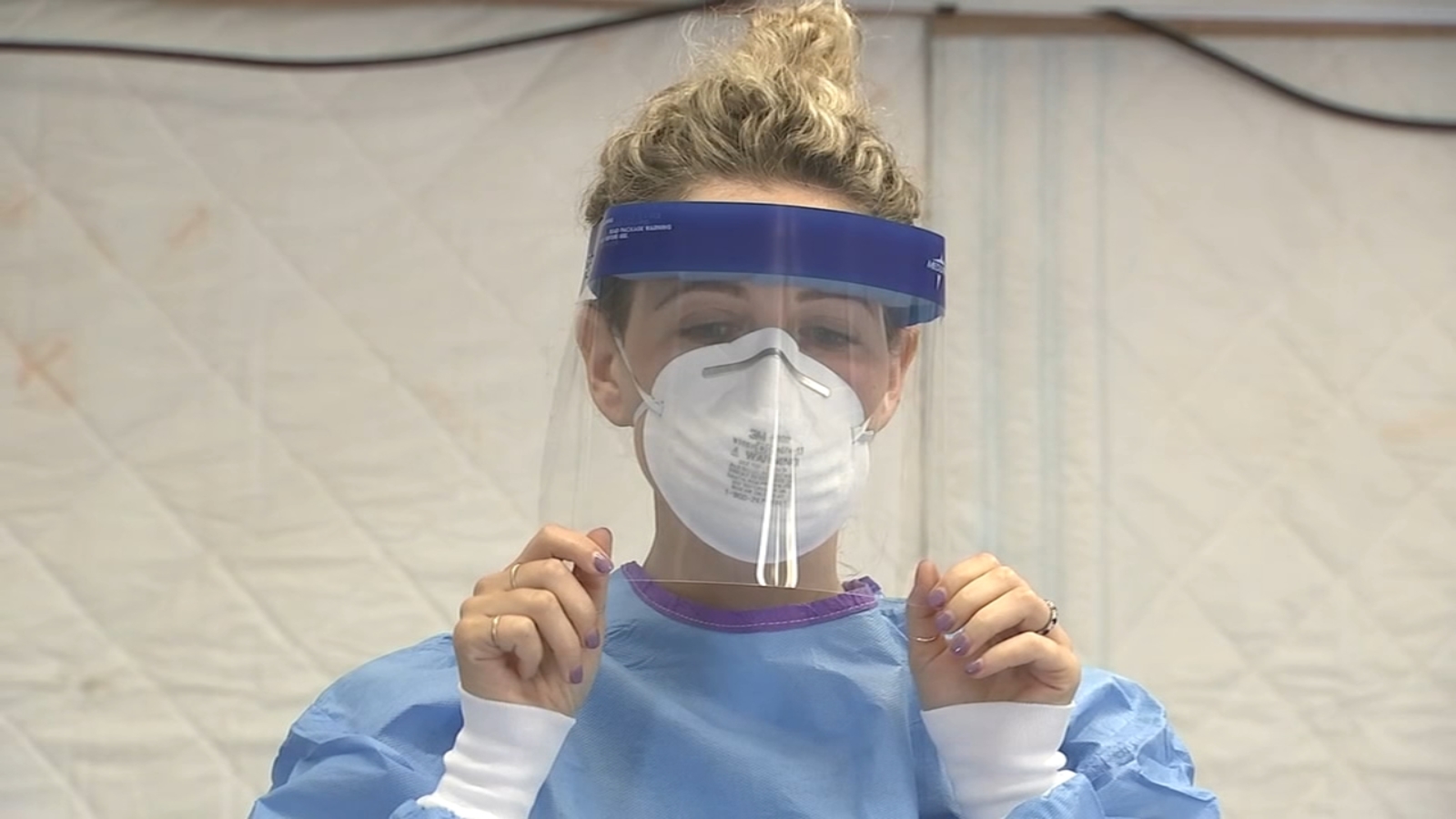
PPE are the gowns, gloves and face masks that keep first responders healthy while on the job testing and treating patients during the COVID-19 outbreak.
“Dealing with PPE right now is like dealing with the wild wild west. It is all for one one for all out there,” said Lou Cappelli, a Camden County freeholder.
Cappelli says the county has received no equipment from the federal government, as resources are being distributed up north in the state where the outbreak is more severe.
He says PPE vendors are flooding the county with offers, but weeding out legitimate ones can be difficult.
“Right now we have under contract 600,000 N95 masks, whether we’ll receive 1 or 1,000 or 100,000. We will never know,” he said.
Action News wanted to know how many pieces of PPE Philadelphia requested and was granted, but the city declined to provide the information, citing the workload to save lives.
Philadelphia Managing Director Brian Abernathy said the city is trying to get as many pieces of equipment as possible.
“The inventory stateside is limited, if it exists at all. Every city, county and state in this country is looking for N95 masks, hand sanitizer, hospital gowns, surgical masks, all of these are personal protective equipment,” he said.
From New York to Illinois to California, states are struggling.
“We all wind up bidding up each other and competing against each other, where you now literally will have a company call you up and say well, California just outbid you,” New York Governor Andrew Cuomo said.
Cuomo and other governors want a better system.
“What we ought to be doing is doing these kinds of purchases on mass through the federal government, they should have led this to begin with,” Illinois Governor, J.B. Pritzker, said.
Most municipalities are buying overseas from China, the Middle East and Mexico.
Capelli said scams and fraud are a major concern.
“There have been some attempted scams on Camden County, which we have stopped and prevented,” he said.
Many governors are calling on the federal government to use its powers to organize to not only buy, but more importantly, force production of these supplies at a reasonable cost, and then distribute to states and local governments.
PPE ISSUES NATIONWIDE
Cities across the U.S. are left vying for the same equipment, creating competition for those materials and driving up prices through bidding wars.
“A system that’s based on state and local governments looking out for themselves and competing with other state and local governments across the nation isn’t sustainable and if left to continue, we’ll certainly exacerbate the public health crisis we’re facing,” said John Cohen, an ABC News contributor and former Acting Undersecretary at U.S. Department of Homeland Security. “There’s a very real possibility that those state and local governments that have the most critical need won’t get the equipment they need.”
In Texas, a large purchase order for PPEs wasn’t honored after someone else offered to pay more and created a “bidding war,” Houston Mayor Sylvester Turner said.
Houston Fire Department Chief Samuel Peña said he recently received a shipment of supplies from Mexico and has looked as far as the Middle East to secure more equipment for first responders.
In New Jersey, Governor Phil Murphy said it is “desperate” for more PPE. Illinois Governor JB Pritzker told CNN the fight for supplies is like the “Wild West.” And on Wednesday, Pritzker said the federal government sent the wrong type of mask – they received surgical masks instead of N95s.
North Carolina has only received a portion of the masks, gowns, gloves and face shields it requested from the federal government.
In New York, which has more than 84,000 confirmed cases, Governor Andrew Cuomo said states are willing to pay whatever it takes to get their hands on supplies and even though that continues to increase costs, it is not even considered price gouging since it is private market competition among bidders.
The gear includes everything from gloves, face shields, gowns, sanitizers and N95 masks, a respiratory protective device that is the best way to prevent a COVID-19 positive patient from transmitting the virus to the workers treating them.
“Not only is it a lack of supplies would harm us or hurt us in the ability to take care of patients, but it would endanger the staff as well and if staff gets sick and they can’t come in to take care of patients that makes it even doubly challenging,” said Cliff Daniels, chief strategy officer for Methodist Hospital of Southern California.
California Gov. Gavin Newsom said the state needs more than 100 million N95 masks just to meet needs. He said governors across the U.S. are starting to form partnerships and consider connecting procurement teams to work together and ensure “none of us are being greedy at this moment and that we have the capacity to move things around.”
“We want to help other states even as large as Illinois and Washington State, some of the largest states in our nation, to see if we can help procure not only a reduction in costs per unit, but also procure a mindset where we’re not playing in the margins of a zero sum where it’s us versus them,” Newsom said.
There’s more than 203,000 confirmed COVID-19 cases in the U.S. as of Wednesday, according to the John Hopkins University’s Coronavirus Resource Center. In addition to protection for frontline workers, the equipment to keep critically ill patients alive is also at the center of the bidding war.
“When I showed you the price of ventilators went from $25,000 to 45,000. Why? Because we bid $25,000. California says, ‘I’ll give you $30,000’ and Illinois says, ‘I’ll give you $35,000’ and Florida says ‘I’ll give you $40,000,'” Cuomo said during a press conference Saturday. “We’re literally bidding up the prices ourselves.”
Cuomo called on the federal government – or even states themselves – to get organized and eliminate private market competition.
“You can’t have the states competing against the states, and then by the way, when the federal government goes out to buy the same equipment for their stockpile, now it’s 50 states competing against the states and the federal government competing against the states,” Cuomo said. “This is not the way to do business. We need a nationwide buying consortium.”
he federal government says it is providing some relief. The U.S. Department of Health & Human Services announced last month that it would purchase 500 million N95 respirators over the next 18 months for the Strategic National Stockpile.
But, health care workers say they need the equipment now and a FEMA spokesperson acknowledges its Strategic National Stockpile can’t fulfill every state and local government’s requests.
Now, the government is relying on additional funding to “exhaust all means to identify and obtain medical and other supplies needed to combat the virus.”
The Coronavirus Aid, Relief, and Economic Security Act, which was signed by President Trump last week, allocates $27 billion “for the development of vaccines and other response efforts, including $16 billion to build up the SNS with critical supplies, including masks, respirators, and pharmaceutics,” according to FEMA.
U.S. governors join President Donald Trump at least once a week for a conference call about the latest on the coronavirus pandemic and where current supplies of personal protective equipment stands.
In a tweet Thursday morning, Trump pushed back on states’ claims that the federal government isn’t providing enough equipment, fast enough.
“Some have insatiable appetites & are never satisfied (politics?). Remember, we are a backup for them. The complainers should have been stocked up and ready long before this crisis hit. Other states are thrilled with the job we have done,” he tweeted. “Sending many Ventilators today, with thousands being built. 51 large cargo planes coming in with medical supplies. Prefer sending directly to hospitals.”
Even when the Federal Emergency Management Agency shares materials from its stockpile, it is sometimes only enough to get cities through a few more days and at times has left cities discussing the possibility of shutting down testing sites due to lack of supplies.
Amid the shortage, the federal government is encouraging the reuse of PPE and creating guidelines for how to adequately clean and recycle the equipment, including some items that healthcare professionals have said are typically intended for one-time use.
During a press conference Monday, Trump said national companies across the U.S. are donating tens of thousands of pieces of PPE to FEMA and ramping up production. Hospitals across the U.S. are also accepting donations of this equipment to help meet supply demands.
Earlier this week, FEMA said 80 tons of PPE supplies were delivered to New York, New Jersey and Connecticut, which have become one of the U.S.’ hotspots for cases. Supplies were also delivered this week to Chicago and FEMA says items will be distributed across the U.S. based on the greatest need, such as “areas experiencing the greatest increase in COVID-19 cases with the largest forecast capacity shortfalls.”
But, cities say, the materials aren’t getting in the hands of healthcare workers quick enough.
Cohen said the pandemic is unlike any other natural disaster. It is taking over the entire U.S.; not just one localized region.
It’s something FEMA is tasked and prepared to handle, he said, but the government was too slow to act, leaving critical need areas struggling to acquire equipment and establish hospital overflow areas.
“They were created to deal with situations like this and they’re beginning to manage this disaster in the way that they prepared to do so. The only question I have is why did it take so long for the administration to activate FEMA at this level? This should’ve been done months ago,” Cohen said. “We’ve lost time and when you lose time in a natural disaster or any type of public health crisis, people die.
Copyright © 2020 WPVI-TV. All Rights Reserved.










