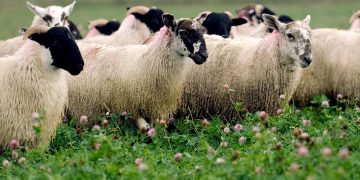







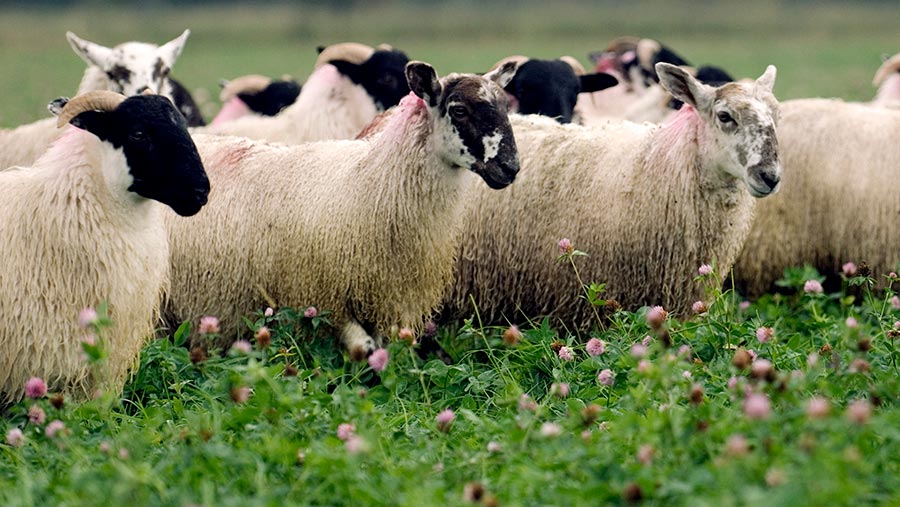
A herbal ley is a diverse sward that includes different grasses and species, with varying rooting depths, properties and drought tolerances.
They have a positive effect on soil health, structure and drainage and usually include nitrogen-fixing legumes, which are high in protein and tannins, and have huge potential for carbon sequestration.
Herbal leys also provide a very rich mineral feed for livestock – the mineral content is much higher than a ryegrass mix and can carry 60% more calcium.
Below, Anthony Ellis and Tom Tolputt from South West Farm Consultants explain how to establish and maintain herbal leys.
See also: Why herbal leys have been added to arable rotation trial
Advice on choosing the mix
You must build the mix to suit your soil type and what you want to achieve.
Perennial ryegrass is the mainstay of most medium- to long-term herbal leys, as it gives the bulk of dry matter, germinates quickly, protects the soil and allows the herbs to establish.
Italian ryegrass is not suitable due to its short-term nature (it generally only lasts two years). It might also outcompete the herbs and can be difficult to grow, especially in hotter conditions.
Other grasses to consider include:
- Cocksfoot This is deep-rooting and grows over a slightly longer season, allowing for extending grazing.
- Timothy Most higher-production grasses need temperatures to be higher than 5-6C to grow, but timothy will grow at a degree lower than this. It is also very palatable, which encourages the animal to consume more dry matter.
- Festulolium A hybrid of fescue and perennial ryegrass it offers the best of both worlds combining stress resistance of fescue with the bulkiness of ryegrass. Although it’s important to check the parent material, as that will influence whether it is more similar to a ryegrass or a tough fescue.
There are a range of different grass, legumes and herbs that can be used. See table below for options.
Advice on establishment
Herbals leys need little fertilisation; with 30% legumes in the mix, they will be self-sustaining. This means they fit nicely into arable rotations, because they build soil carbon, fix nitrogen and mobilise phosphate for the next crop.
However, they can be tricky to establish. Nothing should be drilled deeper than 1cm and the soil should be rolled for good seed-to-soil contact. If you’re in doubt, roll it again.
Herbal leys are slow to emerge, so undersowing them with 100kg/ha of barley makes a good growing environment.
Advice on grazing livestock on herbal leys
From an animal nutrition perspective, livestock are very content on herbal leys, but they must be carefully managed.
Livestock naturally select the most palatable plants, so if you’re not careful, they can graze certain species to extinction.
Therefore, it is best to rotationally graze fields rather than set-stock animals to allow it to be grazed evenly and rested.
Ideally, fields should be left empty for 28-35 days to allow for sufficient recovery. This is a slightly longer rotation than ryegrass, but it will provide a lot more nutrition.
It is also important to graze leys lightly in the first year to encourage tillering and prevent plant damage.
Herbal ley species |
|||||||
|
Name |
What is it? |
Root structure |
Soil type |
Benefits |
Persistence |
Yield |
Grazing/cutting suitability |
|
Cocksfoot |
Grass |
Deep-rooting |
Offers continued growing in dry weather when grown on dry and free-draining soil |
Early and extended grazing, quick recovery |
Very persistent |
Good |
Good, provided it is grazed hard Not good for long-term pasture, as it can become clumpy and unpalatable Varietal choice important |
|
Timothy |
Grass |
Fine, shallow, fibrous roots |
Will grow well on heavy or light soil |
Disease free |
Very persistent |
Good |
Can be made into silage, hay or grazed |
|
Meadow fescue |
Grass |
Medium to deep |
Will grow on nearly all soils, from brash to clay |
Long duration and drought-tolerant alternative to perennial ryegrass |
More persistent, but similar growth habit as perennial ryegrass |
Fair |
Often sown with Timothy for hay or grazing |
|
White clover |
Legume |
Deep taproot during establishment, replaced by shallower, fibrous roots and stoloniferous growth when mature |
Grows on nearly all soils |
Drought-resistant Fixes nitrogen Palatable High protein content Spreads and increases in the sward due to stolons over time Good ground cover |
Very persistent |
Increases overall forage yield |
Best grown with grasses Can be cut or grazed Ideal for grazing – extra protein increases liveweight gain Very palatable |
|
Red clover |
Legume |
Deep taproot |
Grows on nearly all soil types, apart from very acidic soil, where alsike clover should be used |
High-yielding |
Less persistent than white clover, lasting between two and four years |
Produces one-third more yield than white clover |
Normally used in silage, but it can be grazed with careful management Best sown with aggressive ryegrasses Contains oestrogen, so move breeding animals off red clover around conception |
|
Alsike clover |
Legume |
Medium |
Good for acidic or heavy soils |
Works in some soils that red clover might struggle in |
Three years
|
Slightly lower-yielding than red clover |
Slower to grow than red clover |
|
Lucerne |
Legume |
Deep-rooting |
Dry, calcareous soils, free-draining, not acidic |
Protein-rich Drought-resistant Useful complement to maize silage Fixes nitrogen |
Perennial, varies according to soil suitability
|
14t DM/ha without nitrogen on dry land High enough yield to be grown on its own |
Usually sown with a companion grass such as Timothy or meadow fescue Cut three times a year Can cause bloat if grazed |
|
Sainfoin |
Legume |
Deep roots leave soil in great condition Never stops growing – even in dry spells |
Grows on thin, alkaline soils such as dry chalk or limestone |
High in protein Efficiently used by stock Very drought-resistant Pollinators love it Great for grazing and cutting Anti-bloat Natural anthelmintic Fixes nitrogen |
Perennial, varies according to soil suitability |
Good yields when well established, equal to that of lucerne |
Can be cut Contains tannins, which help protein absorption, leading to higher liveweight gains Doesn’t cause bloat May reduce methane emissions Acts as an anthelmintic |
|
Yellow trefoil |
Legume |
Shallow |
Establishes well when undersown |
Sheds seeds freely, so is regenerative |
Hardy annual (will survive a winter or a grazing) |
Adds diversity |
Gives early spring growth, which is unusual, as legumes are normally late to grow |
|
Birdsfoot trefoil |
Legume |
Shallow |
Suited to poor and dry soils |
Anthelmintic
|
Four to five years |
Works well as part of legume mix |
Cut and graze Contains tannins and may have other medicinal benefits |
|
Chicory |
Herb |
Deep-rooting |
Can grow very well on dry soil |
Can penetrate plough pans Good source of minerals Has anthelmintic effects |
Perennial |
High-yielding |
Mainly for grazing, but can be cut occasionally – watch out for wrapped bales with chicory stalks |
|
Ribgrass |
Herb |
Deep-rooting |
Grows well in compacted or dry ground
|
Reliable Grown for vitamin and mineral content – calcium, copper and selenium
|
Perennial |
Low-yielding |
Cut and graze |
|
Yarrow |
Herb |
Deep-rooting |
Works well in certain mixes |
Rich source of vitamin A |
Perennial |
Low-yielding
|
Mainly grazing |
|
Burnet |
Herb |
|
Good for dry soils |
Extremely drought-resistant |
Perennial |
Low-yielding
|
Very palatable Mainly grazing |
|
Sheep’s parsley |
Herb |
Medium |
Light soils |
Works well in mixes |
Perennial |
Low-yielding |
Mainly grazing |
|
Source: Cotswold Seeds |
|||||||
Case study: Peter Cheek
Using herbal leys is helping dairy farm manager Peter Cheek to maintain good growth rates during drought.
He has been growing herbal leys for two years in a field lab trial with the Innovative Farmers programme.
He sows 31ha of herbal leys, using a Cotswold Seeds mix comprising cocksfoot, perennial ryegrass, timothy, meadow fescue, tall fescue, red clover, white clover, alsike clover, sweet clover, birdsfoot trefoil, sainfoin, chicory, ribgrass, burnet, yarrow and sheep’s parsley.
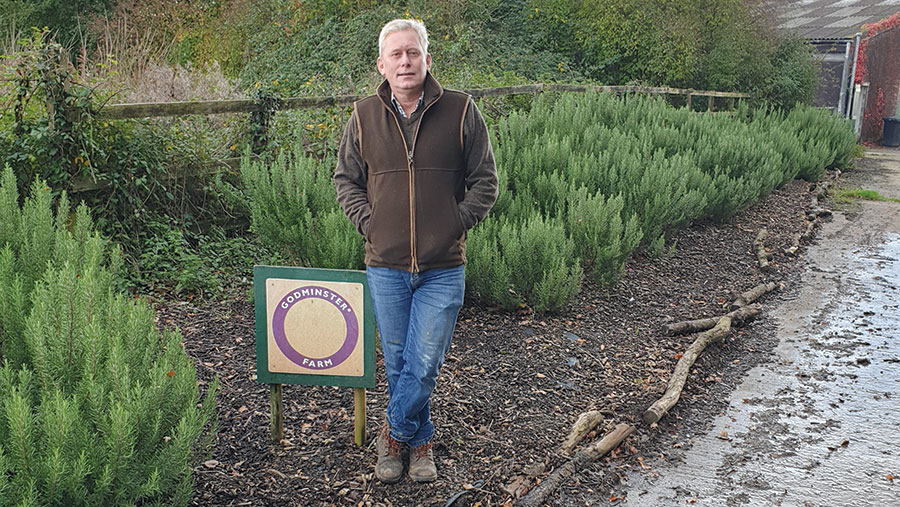
Peter Cheek
Farm facts
- 445ha – 31ha in herbal leys, 41ha of permanent pasture, 161ha arable land and the rest is grass/clover leys
- Runs 287 cows plus followers
- Rears all replacements
- Uses sexed semen
- Spring and autumn calving
- 50% of milk goes to Bruton Dairies, with the other 50% sent to Omsco for cheese
- Four cuts of silage a year from red clover leys
- Cows fed on total mixed ration
- Norwegian Reds, Flekviehs, Normandes and British Friesians
The ley is established with a pea-barley mix in mid-April. Then, once the wholecrop has been harvested, Mr Creek lightly grazes cattle on the crop in September and October.
Close-lying land is in a rotation including four years of a white clover or herbal ley. This is ploughed in the spring and followed by spring wheat or barley.
After harvest, an autumn cover crop of Westerwolds is min-tilled into the soil and is either grazed or cut for silage in the spring.
It is then disced, ready for the pea-barley mix to be undersown and rolled in mid-April.
Offlying land is put down to three years of red clover, then winter wheat, winter oats, and the “Vast and Fast” mix from Cotswold Seeds.
This is followed by another cereal before going back into pea barley mix, undersown with red clover.
“We haven’t measured any specific benefits [to the herbal leys], but the milk yield was maintained when we switched from ryegrass,” says Mr Cheek.
“For two years, we have had drought, and without the herbal ley we would have been in serious trouble.”
Benefits
- Deep-rooting varieties offer extended grazing in drought periods
- Timothy is disease free and very persistent
- Extra protein increases liveweight gains
- Improves soil structure, health and drainage
- Can grow on various soil types
- Tannins reduce worm burden
- Good mineral content; vitamin A, calcium, copper and selenium










